What Is the Words per Minute Calculator?
The Words per Minute (WPM) Calculator measures how fast you type or read by converting the number of words you completed and the time it took into a standard speed score. It reports both gross WPM (raw speed) and net WPM (speed adjusted for errors), plus your typing accuracy. WPM is the universal benchmark for typing tests, transcription jobs, and reading-speed assessments worldwide.
How to Use It
Enter the number of words you typed, the number of errors you made, and the total time. You can split time into whole minutes and extra seconds (for example, 1 minute 30 seconds). The calculator combines them into total minutes and instantly returns your gross WPM, net WPM, and accuracy percentage.
The Formula Explained
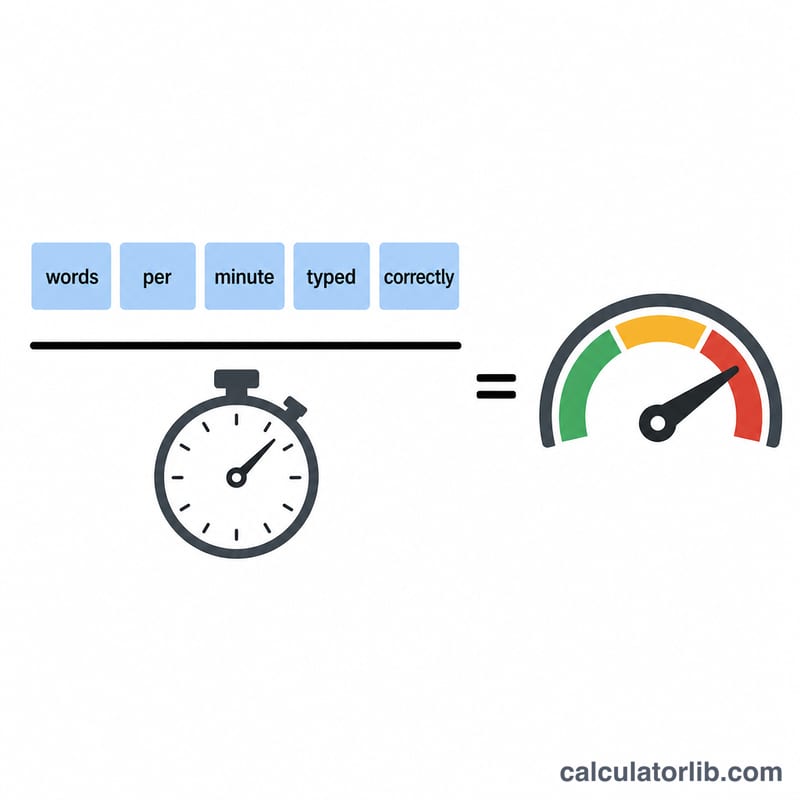
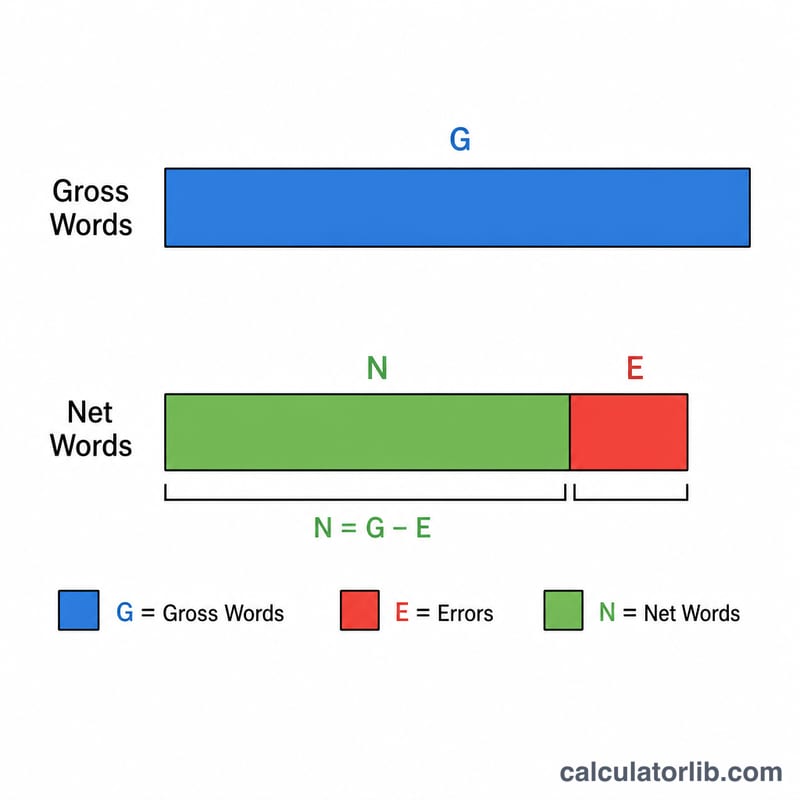
Gross WPM is simply words ÷ minutes. Net WPM subtracts your mistakes first: (words − errors) ÷ minutes, which rewards both speed and precision. Accuracy is (words − errors) ÷ words × 100. Seconds are converted to minutes by dividing by 60 before the division, so the result stays consistent regardless of how you enter the time.
$$\text{Gross WPM} = \frac{\text{Words}}{T}$$ $$\text{Net WPM} = \frac{\text{Words} - \text{Errors}}{T}$$ $$\text{Accuracy} = \frac{\text{Words} - \text{Errors}}{\text{Words}} \times 100\%$$ $$\text{where}\quad T = \text{Minutes} + \frac{\text{Seconds}}{60}$$Worked Example
Suppose you typed 300 words in 5 minutes with 10 errors. Gross WPM \(= 300 \div 5 = 60\) WPM. Net WPM \(= (300 - 10) \div 5 = 290 \div 5 = 58\) WPM. Accuracy \(= (290 \div 300) \times 100 \approx 96.67\%\). A solid result — average typing speed is around 40 WPM, while professional typists exceed 65–75 WPM.
Typical WPM Ranges for Typing and Reading
The bands below are general benchmarks. Exact figures vary by typing test, text difficulty, and source, so treat them as rough guides rather than fixed standards.
| Activity | Speed band (WPM) | Typical context |
|---|---|---|
| Typing: beginner | Under 30 | Hunt-and-peck typing or early touch-typing practice |
| Typing: average | About 40 | Everyday computer use by many adults |
| Typing: proficient | 50-70 | Common range for clerical, administrative, and many office roles; job postings often list requirements in or near this range |
| Typing: advanced | 80-100 | Data entry, transcription, and writing-heavy roles |
| Typing: expert | 100+ | Competitive typists, professional transcribers, and court or captioning-related work (which may also use specialized equipment) |
| Reading (silent, adults) | About 200-300 | Typical comprehension-level reading of general text |
| Skimming | Faster than normal reading | Scanning for key points, usually with lower comprehension |
| Speaking | About 130-160 | Conversational or presentation pace in English |
Employers usually care about net WPM (after errors), not just raw speed. Required speeds differ by employer and country.
Scenario Comparison: Speed vs. Accuracy
Each row uses Gross WPM = Words ÷ T, Net WPM = (Words − Errors) ÷ T, and Accuracy = (Words − Errors) ÷ Words, where T is the total time in minutes.
| Scenario | Words | Errors | Time | Gross WPM | Net WPM | Accuracy |
|---|---|---|---|---|---|---|
| Clean run | 300 | 0 | 5:00 | 60 | 60 | 100% |
| Same speed, more errors | 300 | 30 | 5:00 | 60 | 54 | 90% |
| Fast but sloppy | 450 | 45 | 5:00 | 90 | 81 | 90% |
| Slow and careful | 200 | 4 | 4:00 | 50 | 49 | 98% |
| Short sprint | 180 | 6 | 1:30 | 120 | 116 | 96.67% |
Check of the last row: T = 1 + 30/60 = 1.5 min, so gross = 180 ÷ 1.5 = 120, and net = (180 − 6) ÷ 1.5 = 174 ÷ 1.5 = 116.
The takeaway: the fast-but-sloppy typist (90 gross) still beats the careful typist (50 gross) on net WPM here, but 10% errors cost 9 WPM, and in many real tests or jobs accuracy thresholds also apply.
Key Terms: Gross WPM, Net WPM, and Accuracy
- Standard word
- Many typing tests define one "word" as 5 characters, including spaces and punctuation, so speed does not depend on the length of the actual words. This calculator takes a word count directly, so enter words, or characters ÷ 5 if you are using that convention.
- Total time T (minutes)
- The full duration converted to minutes: \(T = \text{Minutes} + \frac{\text{Seconds}}{60}\). For example, 1 min 30 s gives T = 1.5.
- Gross WPM
- Raw speed without penalizing mistakes: \(\text{Gross WPM} = \frac{\text{Words}}{T}\).
- Error
- A word or character typed incorrectly. Definitions differ: some tests count only uncorrected errors left in the final text, while others count every mistake, including ones you fixed.
- Net WPM
- Speed adjusted for errors: \(\text{Net WPM} = \frac{\text{Words} - \text{Errors}}{T}\).
- Accuracy
- The share of correct output: \(\text{Accuracy} = \frac{\text{Words} - \text{Errors}}{\text{Words}} \times 100\%\).
Note: some platforms subtract a fixed per-error penalty, count errors by keystroke rather than by word, or use uncorrected errors only. Results from this calculator may therefore differ from the score on a specific typing test.
FAQ
What is a good WPM? Around 40 WPM is average, 60–70 WPM is strong, and 90+ WPM is professional level. Reading speeds are typically 200–300 WPM.
What is the difference between gross and net WPM? Gross WPM ignores mistakes; net WPM subtracts errors first, giving a fairer picture of useful output.
How are seconds handled? Extra seconds are divided by 60 and added to the minutes, so 90 seconds is treated as 1.5 minutes.