
What Is an Atwood Machine?
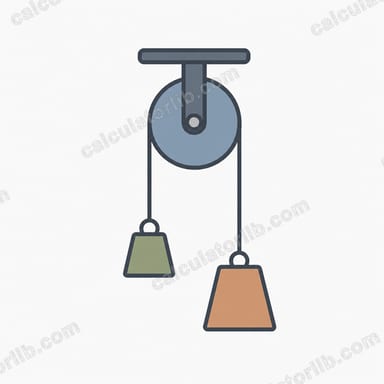
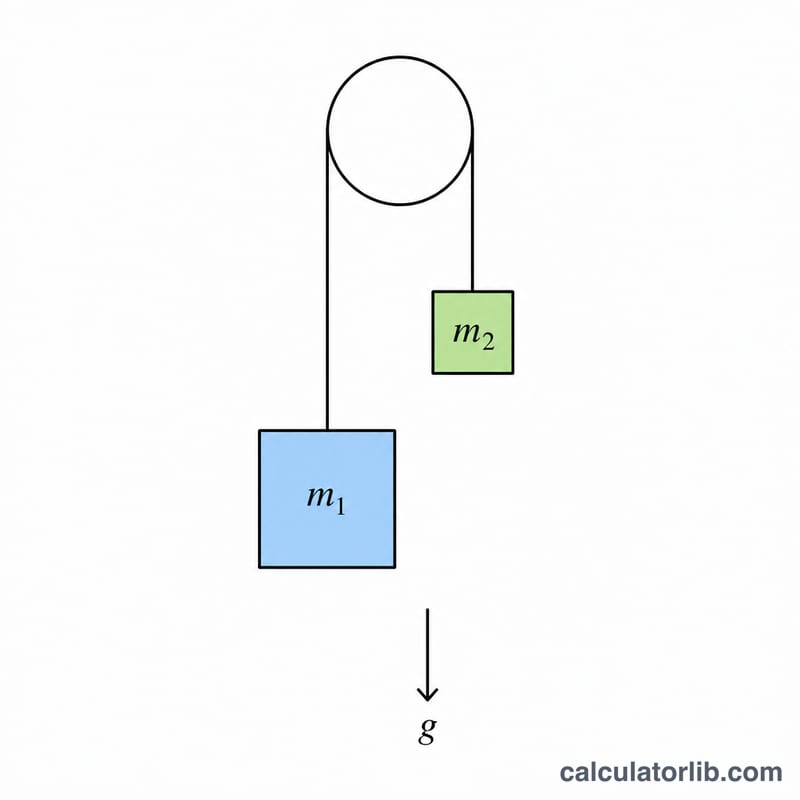
An Atwood machine is a classic physics setup consisting of two masses connected by an inextensible cord that passes over a pulley. In the ideal version — a massless, frictionless pulley and a massless cord — the heavier mass accelerates downward while the lighter mass rises with equal magnitude of acceleration. It is one of the simplest ways to demonstrate Newton's second law and to measure gravitational acceleration in the lab.
How to Use This Calculator
Enter the two masses in kilograms and the local gravitational acceleration (the default 9.81 m/s² is standard Earth gravity). The calculator returns the acceleration magnitude shared by both masses and the tension in the connecting cord. If the masses are equal, the system is balanced and the acceleration is zero.
The Formula Explained
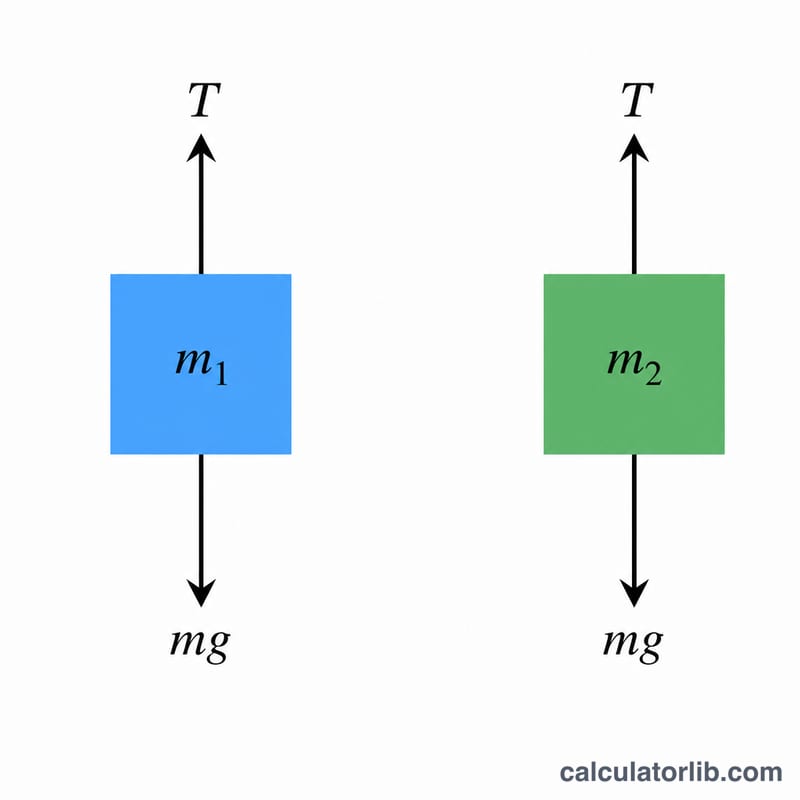
Apply Newton's second law to each mass and combine the two equations. The net driving force is the weight difference \((\text{m}_1 - \text{m}_2)\text{g}\), and the total inertia being accelerated is \((\text{m}_1 + \text{m}_2)\). This gives:
$$a = \frac{\left| \text{m}_1 - \text{m}_2 \right| \cdot \text{g}}{\text{m}_1 + \text{m}_2}$$
Substituting the acceleration back into either mass's equation yields the cord tension:
$$T = \frac{2 \cdot \text{m}_1 \cdot \text{m}_2 \cdot \text{g}}{\text{m}_1 + \text{m}_2}$$
This tension is the same throughout the ideal cord and always lies between the two individual weights.
Worked Example
Suppose \(\text{m}_1 = 5 \text{ kg}\), \(\text{m}_2 = 3 \text{ kg}\), and \(\text{g} = 9.81 \text{ m/s}^2\). The acceleration is $$a = \frac{(5 - 3) \cdot 9.81}{5 + 3} = \frac{2 \cdot 9.81}{8} = 2.4525 \text{ m/s}^2.$$ The tension is $$T = \frac{2 \cdot 5 \cdot 3 \cdot 9.81}{8} = \frac{294.3}{8} = 36.7875 \text{ N}.$$ So both masses accelerate at about 2.45 m/s² with roughly 36.8 N pulling on the cord.
Constants & Reference Values
The value you enter for \(g\) sets the gravitational field strength. The internationally defined standard gravity is \(g_0 = 9.80665\ \text{m/s}^2\), almost always rounded to \(9.81\ \text{m/s}^2\) for physics problems. Earth's surface value varies slightly with latitude and altitude, and other bodies have very different gravity.
| Location / body | g (m/s²) | Note |
|---|---|---|
| Standard gravity (g₀) | 9.80665 | Defined reference value |
| Typical textbook value | 9.81 | Rounded standard gravity |
| Earth equator (sea level) | ≈ 9.78 | Slightly weaker (Earth bulge + spin) |
| Earth poles (sea level) | ≈ 9.83 | Slightly stronger |
| Moon | ≈ 1.62 | About 1/6 of Earth |
| Mars | ≈ 3.71 | About 3/8 of Earth |
For most homework and lab work, use \(g = 9.81\ \text{m/s}^2\). Use a body-specific value (Moon, Mars) only when the problem explicitly takes place there.
Definitions & Glossary
- m1 (kg)
- The first of the two hanging masses. In this calculator it is conventionally the heavier (descending) mass, but the absolute value in the formula means the order does not affect the result.
- m2 (kg)
- The second hanging mass on the other end of the cord. The lighter mass accelerates upward while the heavier one accelerates downward.
- a (m/s²)
- The shared acceleration magnitude. Because the cord is inextensible, both masses move with the same speed and acceleration at every instant — one up, one down.
- T (N)
- The cord tension, the pulling force transmitted along the cord. In an ideal Atwood machine the tension is identical on both sides and lies between the two weights.
- g (m/s²)
- The local gravitational acceleration that gives each mass its weight \(W = mg\). Usually \(9.81\ \text{m/s}^2\) on Earth.
- Inextensible, massless cord
- An idealized cord that does not stretch (so both masses share one acceleration) and has no mass of its own (so tension is the same throughout). Real cords approximate this when light and stiff.
- Frictionless, massless pulley
- An idealized pulley that adds no rotational inertia and no friction at its axle, so it simply redirects the cord without changing the tension. This is what allows the same \(T\) on both sides.
FAQ
What if both masses are equal? The acceleration is zero and the tension equals each weight \((\text{m} \cdot \text{g})\). The system stays in equilibrium.
Does the calculator account for pulley mass or friction? No — it models an ideal Atwood machine. Real pulleys with mass or friction would reduce the acceleration slightly.
Why is the tension always between the two weights? Because the cord must accelerate the lighter mass upward (so \(T > \text{m}_2\text{g}\)) and let the heavier mass fall (so \(T < \text{m}_1\text{g}\)).