
What is a kVA Calculator?
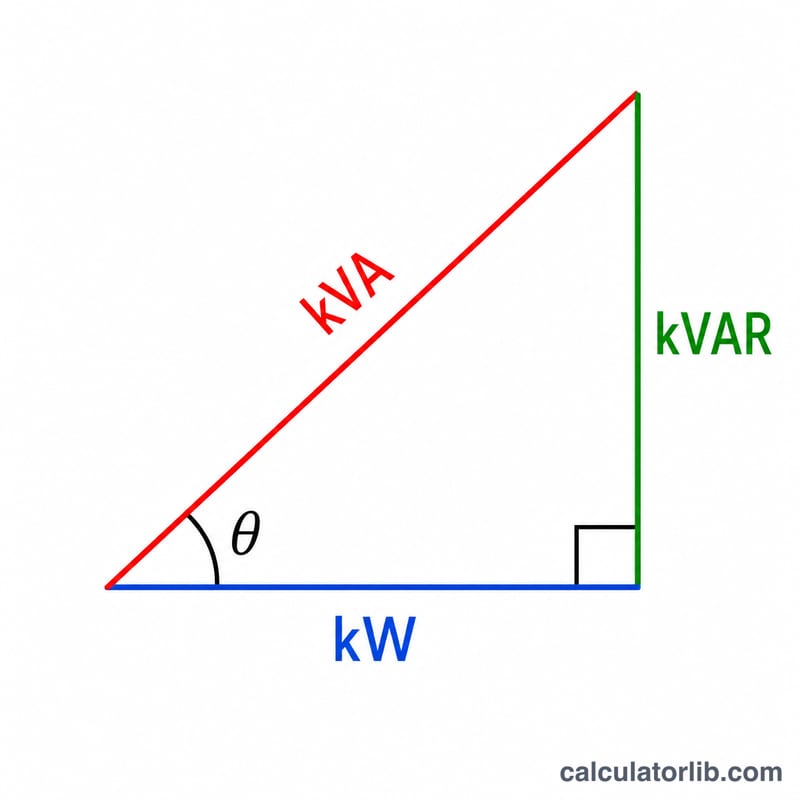
This kVA calculator finds the apparent power of an electrical circuit from its voltage and current. Apparent power, measured in volt-amperes (VA) or kilovolt-amperes (kVA), is the product of the RMS voltage and RMS current in an AC system. Unlike real power (kW), apparent power includes both the working power and the reactive power required by inductive and capacitive loads, which is why transformers, generators and UPS units are rated in kVA.
How to use it
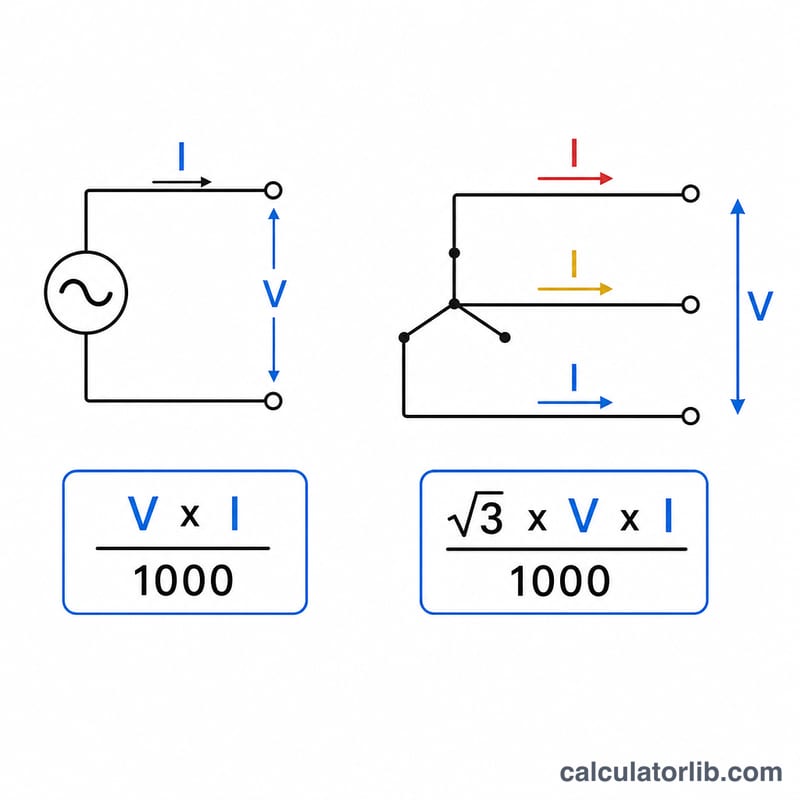
Select whether your system is single-phase or three-phase, enter the voltage in volts and the current in amperes, then read the apparent power in kVA. For single-phase the calculator multiplies voltage by current; for three-phase it includes the \(\sqrt{3}\) (\(\approx 1.732\)) factor that accounts for the phase relationship between the three line conductors.
The formula explained
Single-phase:
$$\text{kVA} = \dfrac{V \times I}{1000}$$Three-phase:
$$\text{kVA} = \dfrac{\sqrt{3} \times V \times I}{1000}$$where \(V\) is the line-to-line voltage and \(I\) is the line current. Dividing by 1000 converts volt-amperes to kilovolt-amperes. To convert kVA to real power (kW), multiply by the power factor.
Worked example
A three-phase motor runs on 400 V drawing 50 A. Apparent power:
$$\text{kVA} = \dfrac{1.732 \times 400 \times 50}{1000} = \dfrac{34{,}640}{1000} \approx 34.64\ \text{kVA}$$A single-phase load at 230 V drawing 10 A is
$$\text{kVA} = \dfrac{230 \times 10}{1000} = 2.3\ \text{kVA}$$FAQ
What's the difference between kVA and kW? kVA is apparent power; kW is real (usable) power. \(\text{kW} = \text{kVA} \times \text{power factor}\).
Why use \(\sqrt{3}\) for three-phase? The \(\sqrt{3}\) factor relates line-to-line voltage and line current in a balanced three-phase system to total apparent power.
Is voltage line-to-line or line-to-neutral? For the three-phase formula above, use the line-to-line voltage (e.g. 400 V or 415 V).