
What Is Cart Abandonment Rate?
Cart abandonment rate is the percentage of online shoppers who add items to their shopping cart but leave before completing the purchase. It is one of the most important metrics in ecommerce because it directly reveals how much potential revenue is slipping away at the final stages of the buying journey. Industry averages typically hover around 65–75%, so even small improvements in checkout can translate into significant sales gains.
How to Use This Calculator
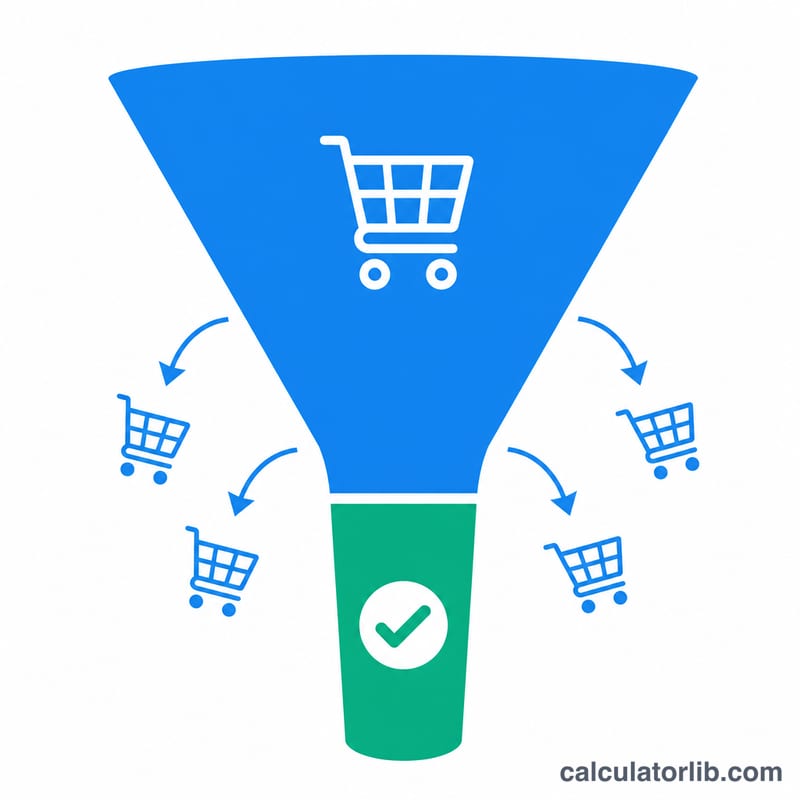
Enter two numbers from your analytics platform: the number of carts initiated (sessions where at least one item was added to the cart) and the number of carts completed (sessions that ended in a successful purchase). The calculator instantly returns your abandonment rate, your conversion rate, and the raw number of abandoned carts.
The Formula Explained
The abandonment rate is calculated as $$\text{Abandonment\%} = \left(1 - \frac{\text{Completed}}{\text{Initiated}}\right) \times 100$$ In plain terms, you divide completed purchases by initiated carts to find the fraction that converted, subtract that from one to find the fraction that did not convert, and multiply by 100 to express it as a percentage. Conversion rate is simply the complement: $$\text{Conversion\%} = \frac{\text{Completed}}{\text{Initiated}} \times 100$$
Worked Example
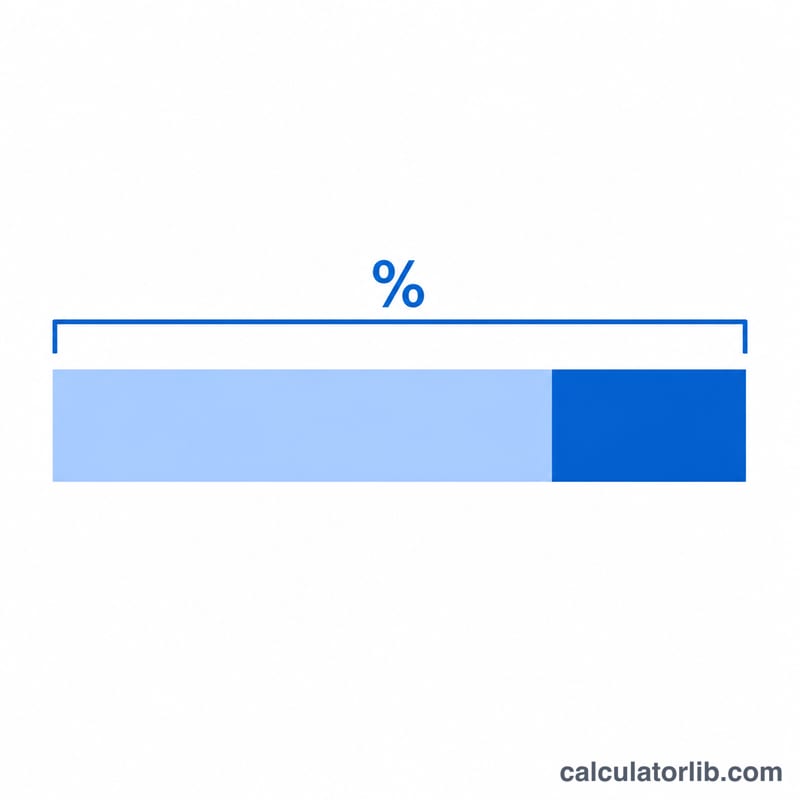
Suppose your store had 1,000 carts initiated last month and 300 of them ended in a purchase. The conversion rate is \(300 \div 1{,}000 = 30\%\). The abandonment rate is $$(1 - 0.30) \times 100 = 70\%$$ meaning 700 carts were abandoned. Reducing that abandonment rate even to 65% would recover 50 additional orders.
FAQ
What counts as a "good" abandonment rate? Anything below 70% is roughly average, and high-performing stores push under 60%. Mobile rates are usually higher than desktop.
Why do shoppers abandon carts? Common reasons include unexpected shipping costs, forced account creation, a long checkout, payment security concerns, and comparison shopping.
How can I reduce cart abandonment? Offer guest checkout, show total costs early, provide multiple payment options, send cart-recovery emails, and simplify your checkout flow.