
What this calculator does
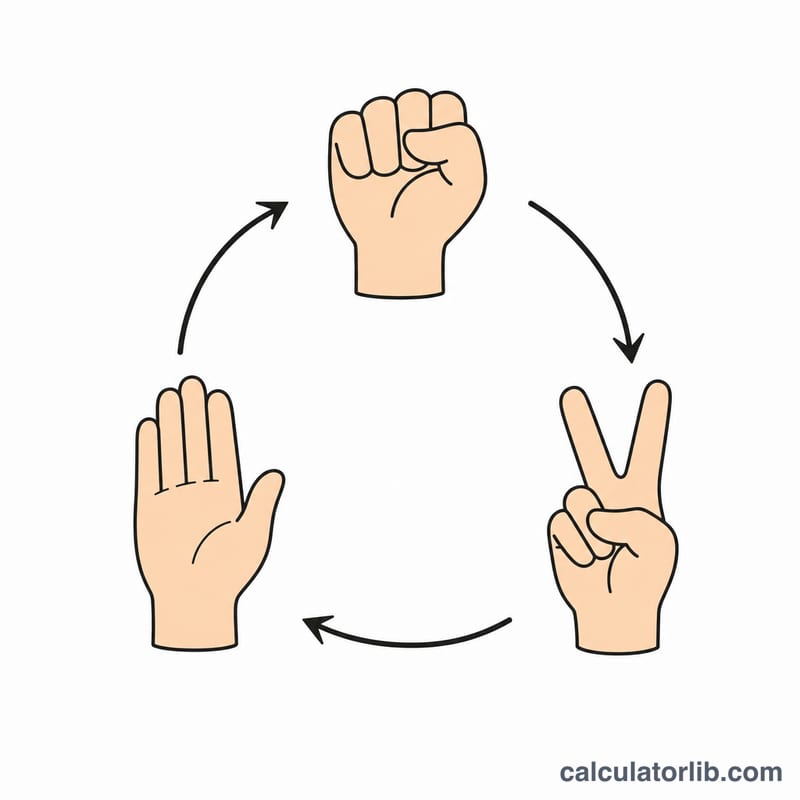
This tool models rock-paper-scissors (janken) played simultaneously by n people. In each round every player independently picks rock, paper or scissors. The game is "decided" when a winner-loser split occurs; otherwise it is a draw and play repeats. The calculator finds the probability that the game is decided within r rounds, and how many rounds are needed for a 99% chance of a decision.
How to use it
Enter the number of players \(n\) (2 to 100) and the number of rounds \(r\). The result shows the cumulative probability that the game has been decided by round \(r\), the single-round decided probability \(p\), and the smallest number of rounds needed to reach a 99% chance of a decision.
The formula
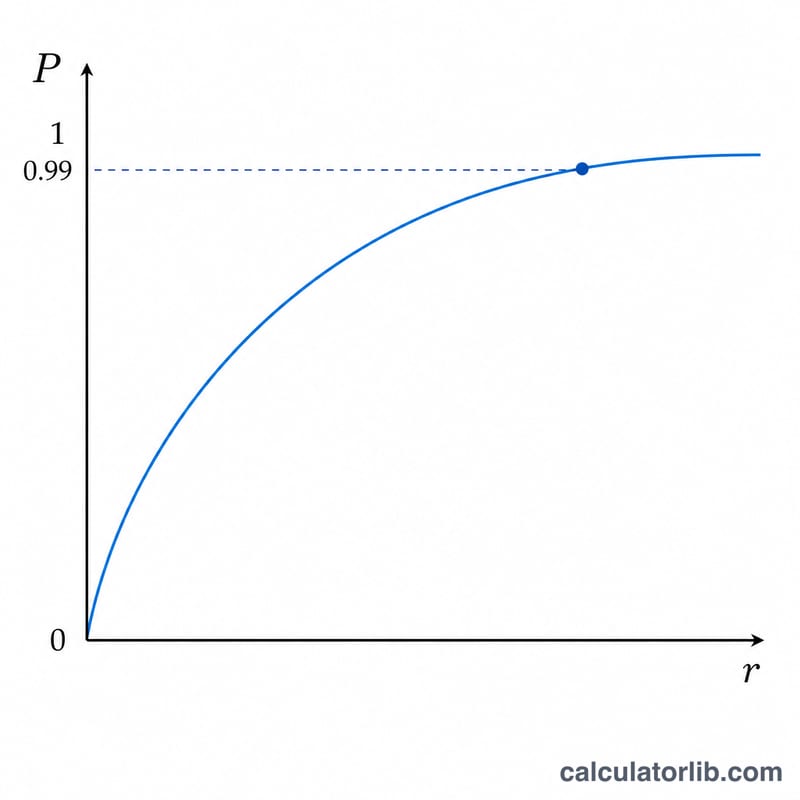
A single round is decided only when exactly two of the three hand types appear (one beats the other). The number of decisive outcomes is \(3 \times (2^n - 2)\), out of \(3^n\) total, so the single-round decided probability is $$p = \frac{2^n - 2}{3^{\,n-1}}.$$ The probability a round is undecided (a draw) is $$q = 1 - p = \frac{3^{\,n-1} - 2^n + 2}{3^{\,n-1}}.$$ Since rounds are independent, the probability the game is still undecided after \(r\) rounds is \(q^r\), giving the cumulative decided probability $$P = 1 - q^r.$$
Worked example
For \(n = 3\) players: \(3^{\,n-1} = 9\), \(2^n = 8\), so \(q = \frac{9 - 8 + 2}{9} = \frac{1}{3}\) and \(p = \frac{2}{3} \approx 66.67\%\). The probability the game is decided within 1 round is $$P = 1 - \frac{1}{3} = 0.6667.$$ Within 2 rounds, $$P = 1 - \left(\frac{1}{3}\right)^2 = 0.8889.$$ To reach 99%, $$r_{\text{Threshold}} = \left\lceil \frac{\ln(0.01)}{\ln(1/3)} \right\rceil = \lceil 4.19 \rceil = 5 \text{ rounds}$$ (\(P\) at \(r=5\) is 0.99588).
FAQ
What counts as a draw? Only two cases: everyone shows the same hand, or all three hands are present. Any case where exactly two hand types appear is decisive.
Why do large n need so many rounds? As \(n\) grows, draws become almost certain each round (\(q\) approaches 1), so reaching 99% can take millions or even \(\sim 10^{14}\) rounds for \(n = 100\).
Is this region-specific? No. Janken is simply rock-paper-scissors; the math is universal for any symmetric three-choice game.