

What Is a Multiple?
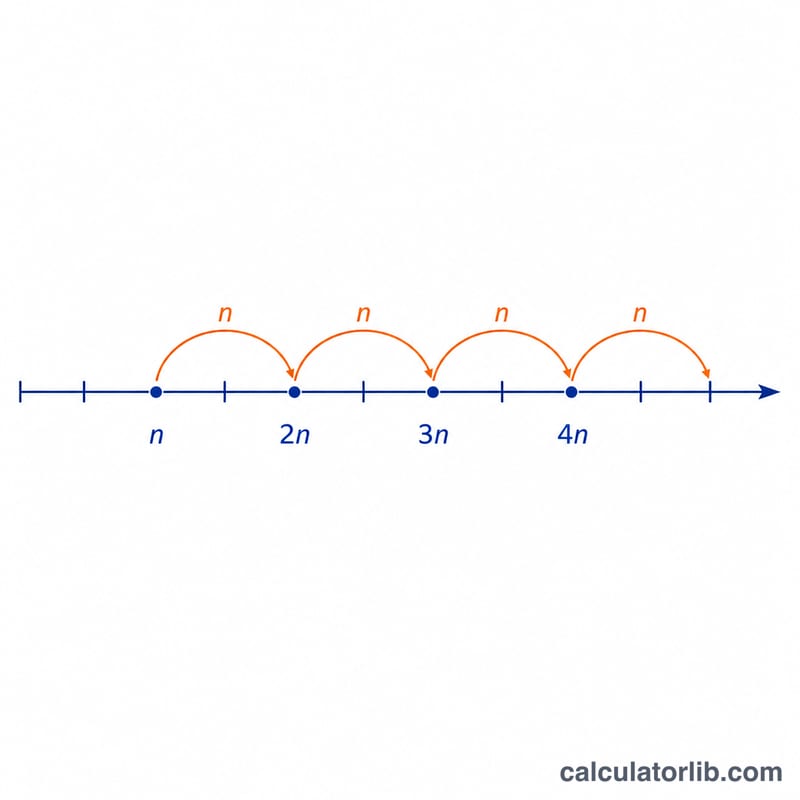
A multiple of a number n is the result of multiplying n by a whole number. For example, the multiples of 5 are 5, 10, 15, 20, and so on — each one is 5 times 1, 2, 3, 4, and beyond. This Multiples Calculator generates the first k multiples of any number you choose, then reports the largest value in the list and the sum of all of them.
How to Use It
Enter the base number n (it can be a whole number or a decimal) and choose how many multiples you want (up to 200). The calculator instantly lists them in order, from n up to \(k\cdot n\), and adds two handy summaries: the largest multiple and the running total.
The Formula Explained
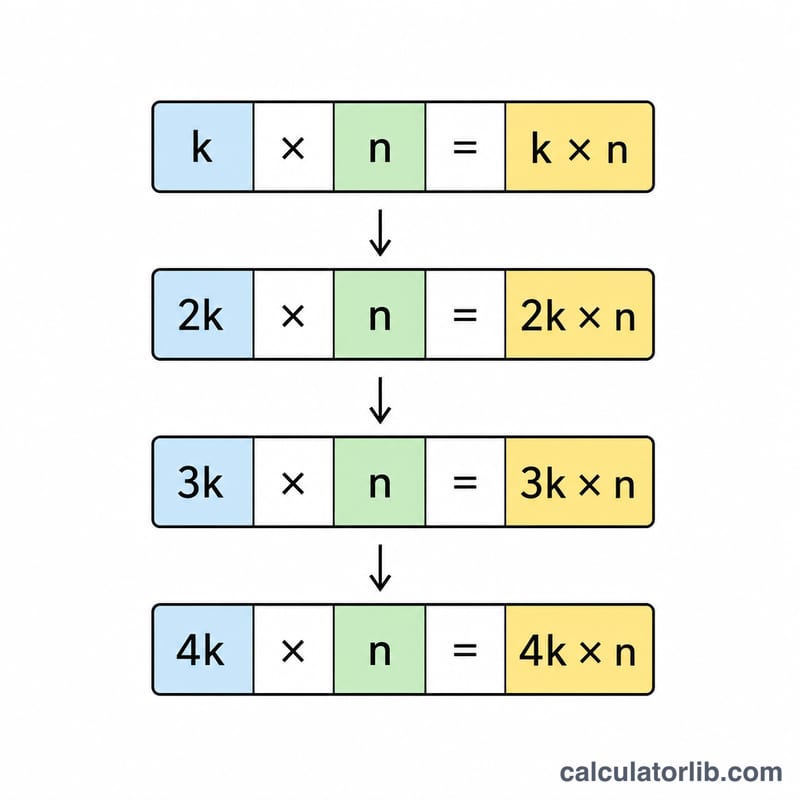
The multiples are simply: n, 2n, 3n, …, kn. To add them all together you can multiply n by the kth triangular number: $$n \times \frac{k(k+1)}{2}$$ This shortcut works because \(1 + 2 + 3 + \ldots + k\) equals \(\frac{k(k+1)}{2}\).
Worked Example
Suppose n = 7 and you want the first 10 multiples. The list is: 7, 14, 21, 28, 35, 42, 49, 56, 63, 70. The largest is \(7 \times 10 = 70\). The sum is $$7 \times \left(\frac{10 \times 11}{2}\right) = 7 \times 55 = 385.$$
FAQ
Is zero a multiple of every number? Technically yes (\(0 \times n = 0\)), but this tool starts the list at \(1n\) because those are the multiples people usually want.
Can I use decimals? Yes. If you enter 2.5 you'll get 2.5, 5, 7.5, 10, and so on.
What's the difference between multiples and factors? Multiples are bigger (or equal) — you multiply n outward. Factors divide evenly into n. Multiples of 6 include 6, 12, 18; factors of 6 are 1, 2, 3, 6.