
What is Chemical Oxygen Demand (COD)?
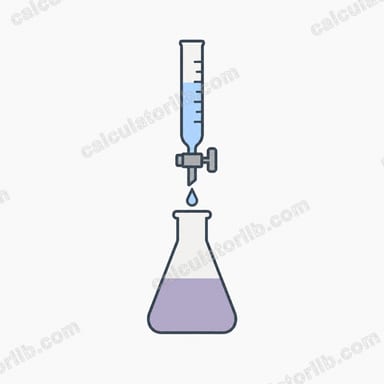
Chemical Oxygen Demand (COD) measures the amount of oxygen required to chemically oxidize the organic and inorganic matter in a water or wastewater sample. Expressed in milligrams of oxygen per litre (mg O₂/L), it is one of the most widely used indicators of water pollution and treatment-plant performance. This calculator uses the results of the standard dichromate reflux titration with ferrous ammonium sulphate (FAS) as titrant.
How to use this calculator
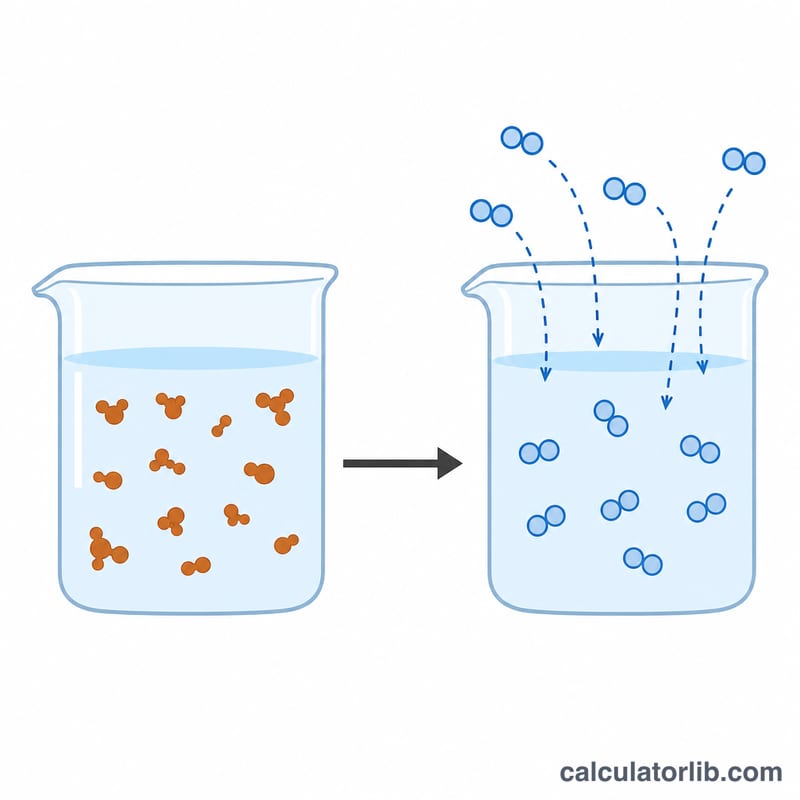
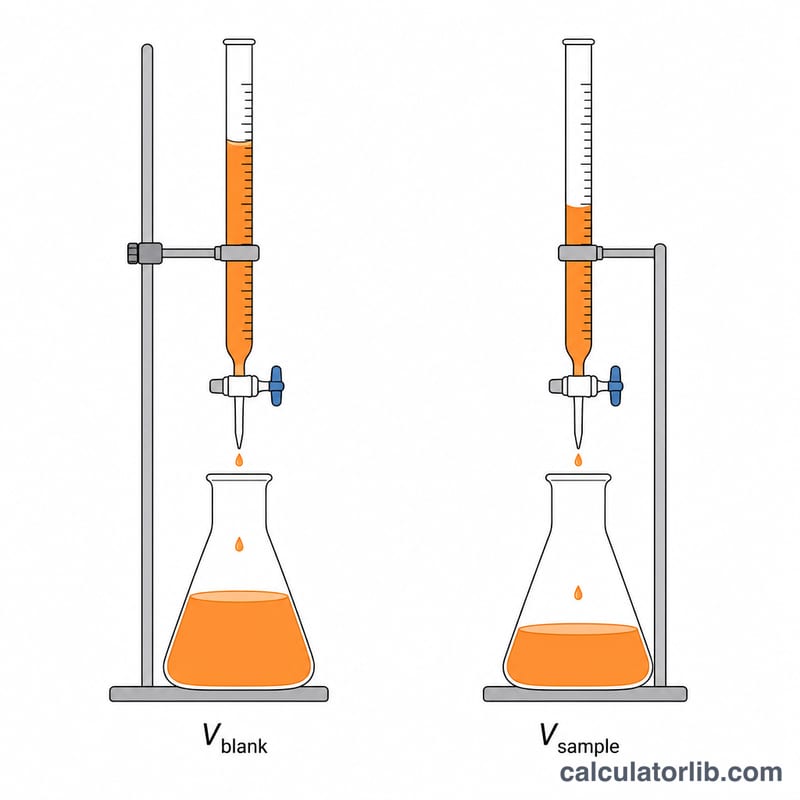
Enter the volume of FAS used to titrate the blank (no sample), the volume used to titrate your sample, the normality of the FAS solution, and the original sample volume that was digested. The calculator returns the COD in mg/L. The blank volume is normally larger than the sample volume because the sample consumes some of the dichromate before titration.
The formula explained
The working equation is:
$$\text{COD (mg/L)} = \frac{\left(\text{V}_{\text{blank}} - \text{V}_{\text{sample}}\right) \times \text{N}_{\text{FAS}} \times 8000}{\text{V}_{\text{sample}}}$$
The difference in titrant volumes represents the dichromate consumed by the sample. Multiplying by the FAS normality converts this to equivalents, and the 8000 factor converts equivalents of oxygen (equivalent weight 8 g = 8000 mg) to a per-litre basis. Dividing by the sample volume scales the result to the volume of water tested.
Worked example
Suppose the blank required 9.8 mL of FAS, the sample required 4.5 mL, the FAS normality was 0.1 N, and the sample volume was 10 mL. Then $$\text{COD} = \frac{(9.8 - 4.5) \times 0.1 \times 8000}{10} = \frac{5.3 \times 0.1 \times 8000}{10} = \frac{4240}{10} = 424 \text{ mg/L}.$$
FAQ
Why is the factor 8000 used? The equivalent weight of oxygen is 8 g/equivalent; expressed in mg and per litre, this becomes 8000.
What does a high COD mean? A high COD indicates a large amount of oxidizable matter, signalling heavily polluted or organically loaded water.
How is COD different from BOD? BOD measures only the biologically degradable fraction over several days, while COD chemically oxidizes nearly all organic matter in a few hours, so COD is usually higher than BOD.