
What Is the Retention Ratio?
The retention ratio — also called the plowback ratio — measures the proportion of a company's net income that is kept (retained) in the business rather than paid out to shareholders as dividends. A high retention ratio means management is reinvesting profits into growth, debt repayment, or future opportunities, while a low ratio signals that most earnings are being returned to investors.
How to Use This Calculator
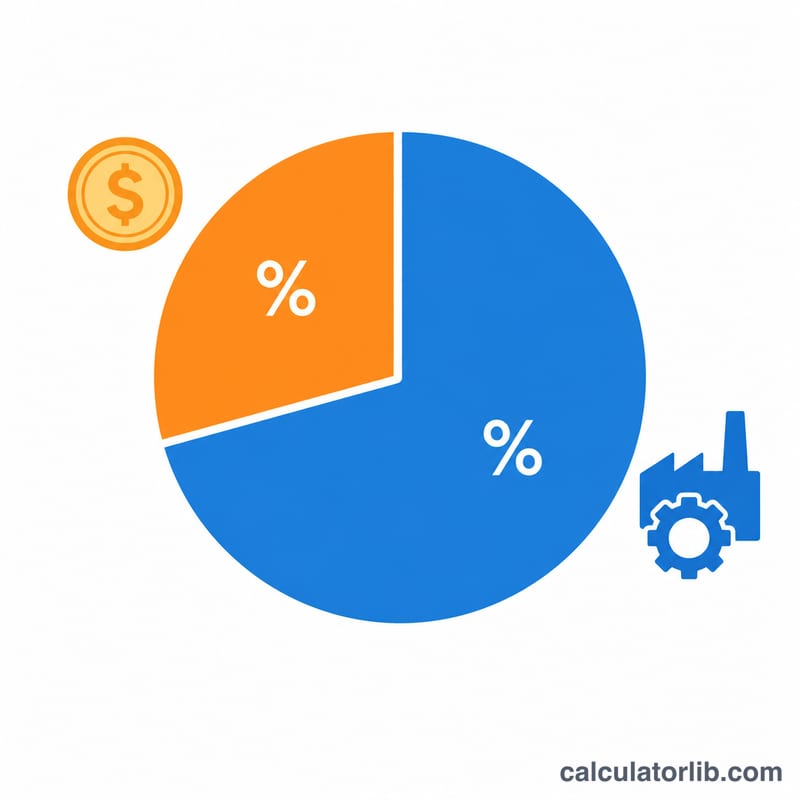
Enter the company's net income (after-tax profit for the period) and the total dividends paid to shareholders. The calculator returns the retention ratio as a percentage and decimal, the complementary dividend payout ratio, and the dollar amount of retained earnings. All figures should come from the same period (usually the same fiscal year or quarter).
The Formula Explained
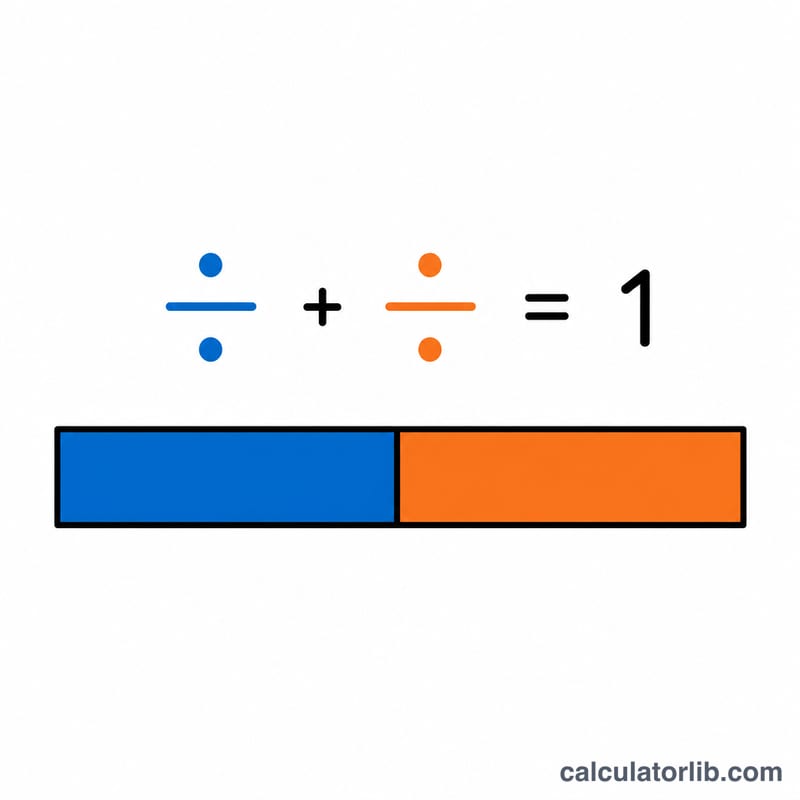
$$\text{Retention Ratio} = \frac{\text{Net Income} - \text{Dividends Paid}}{\text{Net Income}} \times 100\%$$ Since dividends plus retained earnings equal net income, this is mathematically identical to \(1 - \text{Payout Ratio}\), where the payout ratio is \(\text{Dividends} \div \text{Net Income}\). Both ratios always sum to 1 (100%).
Worked Example
Suppose a company reports net income of $100,000 and pays $40,000 in dividends. Retained earnings $$= \$100{,}000 - \$40{,}000 = \$60{,}000.$$ Retention ratio $$= \frac{\$60{,}000}{\$100{,}000} = 0.60, \text{ or } 60\%.$$ The dividend payout ratio is the remaining 40%. The company plows 60 cents of every profit dollar back into operations.
FAQ
What is a good retention ratio? It depends on the stage and industry. Fast-growing firms often retain 70–100% to fund expansion, while mature companies may retain less and pay larger dividends.
How does retention ratio relate to growth? The sustainable growth rate equals the retention ratio multiplied by return on equity (ROE), so retaining more earnings can support faster internally funded growth.
Can the retention ratio be negative? Yes — if dividends paid exceed net income (or the company has a net loss while still paying dividends), the ratio can fall below zero, indicating dividends are funded from reserves rather than current profit.