

What Is the Price to Sales Ratio?
The price-to-sales (P/S) ratio is a valuation metric that compares a company's market value to its total revenue. It tells you how much investors are willing to pay for every dollar of a company's sales. Because revenue is harder to manipulate than earnings and exists even when a company is not yet profitable, the P/S ratio is especially useful for valuing young, high-growth, or unprofitable businesses where the price-to-earnings (P/E) ratio falls apart.
How to Use This Calculator
Enter the company's market capitalization (share price multiplied by the number of shares outstanding) and its total revenue for the trailing twelve months or most recent fiscal year. The calculator instantly returns the P/S ratio. You can also compute it on a per-share basis by entering the share price and sales per share — the result is mathematically identical.
The Formula Explained
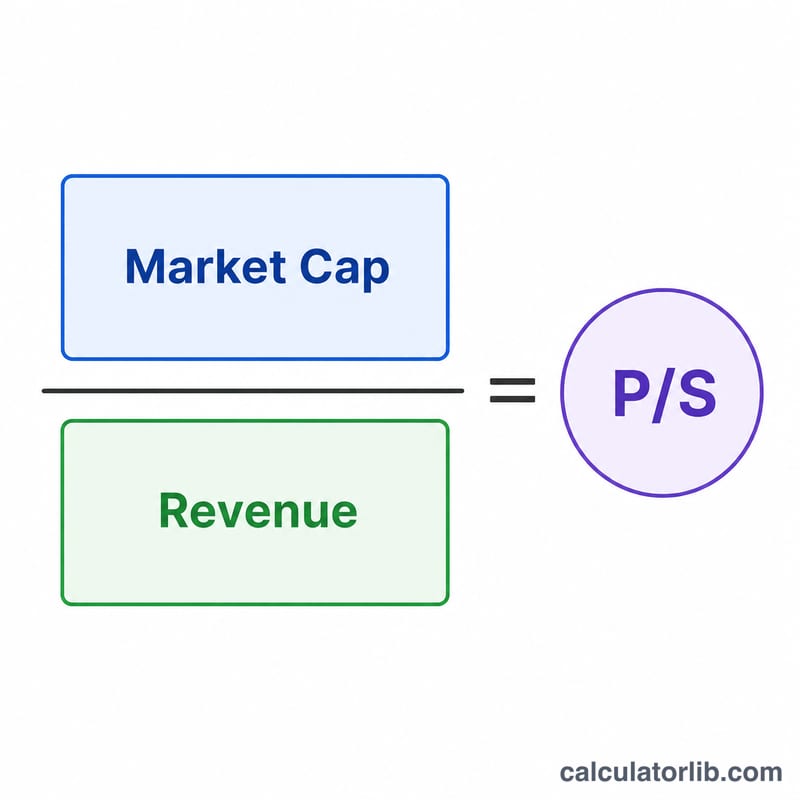
The core equation is simply $$\text{P/S} = \text{Market Cap} \div \text{Total Revenue}$$ A ratio of 2 means the market values the company at twice its annual sales. Lower ratios can signal undervaluation, while high ratios often reflect strong growth expectations. Always compare P/S within the same industry, since acceptable multiples vary widely — a software company may trade at \(10\times\) sales while a grocery chain trades below \(1\times\).
Worked Example
Suppose a company has a market capitalization of $5,000,000,000 and total revenue of $1,000,000,000. The P/S ratio is $$5{,}000{,}000{,}000 \div 1{,}000{,}000{,}000 = \mathbf{5.0}$$ Investors are paying $5 for every $1 of sales.

FAQ
What is a good P/S ratio? There is no universal "good" number — generally a P/S below 1 is considered low and above 4 is considered high, but it depends heavily on the industry and growth rate.
P/S vs P/E ratio? P/E uses earnings, which can be negative or zero; P/S uses revenue, which is always positive for an operating company, making P/S more usable for early-stage firms.
Should I use trailing or forward revenue? Trailing twelve-month revenue is most common, but forward (estimated) revenue can give a forward-looking P/S for fast-growing companies.