
What Is the ABV Calculator?
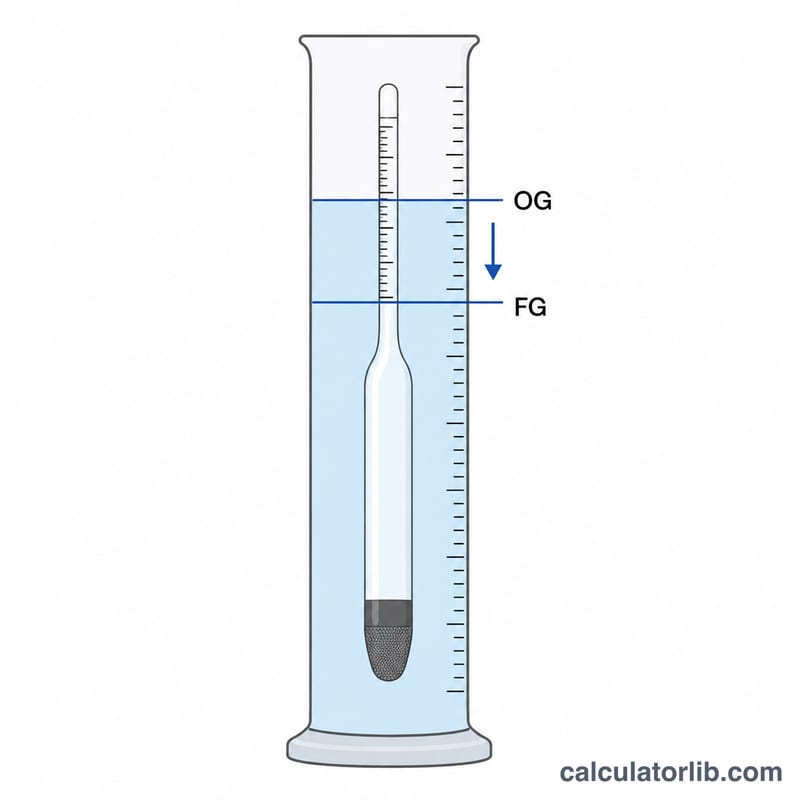
The Alcohol By Volume (ABV) calculator estimates how much alcohol is in your home-brewed beer, wine, cider, or mead. It uses two specific gravity measurements taken with a hydrometer: the original gravity (OG) before fermentation and the final gravity (FG) after fermentation is complete. As yeast converts sugar into alcohol and CO₂, the density of the liquid drops, and that drop tells you how much alcohol was produced.
How to Use It
Take a hydrometer reading of your wort or must before pitching yeast — that is your OG (for example 1.050). When fermentation finishes, take another reading — that is your FG (for example 1.010). Enter both values and the calculator returns the estimated ABV plus the apparent attenuation. Be sure to temperature-correct your hydrometer readings for the most accurate result.
The Formula Explained
The standard simplified equation is:
$$\text{ABV\%} = (\text{OG} - \text{FG}) \times 131.25$$
The constant 131.25 converts the difference in gravity points into a percentage of alcohol by volume. It works well in the typical home-brewing range (under about 7% gravity drop); stronger brews may read slightly low with this linear formula.
Worked Example
Suppose your OG is 1.060 and your FG is 1.012. The difference is 0.048. Multiply by 131.25: $$0.048 \times 131.25 = 6.3\% \text{ ABV}$$ The apparent attenuation is $$\frac{0.048}{0.060} \times 100 = 80\%$$
Typical OG, FG, and ABV by Beverage Style
Original gravity (OG) measures the density of the unfermented wort or must relative to water, while final gravity (FG) measures the density once fermentation is complete. The difference between the two, multiplied by 131.25, gives an estimate of alcohol by volume using the standard formula:
$$\text{ABV \%} = (\text{OG} - \text{FG}) \times 131.25$$
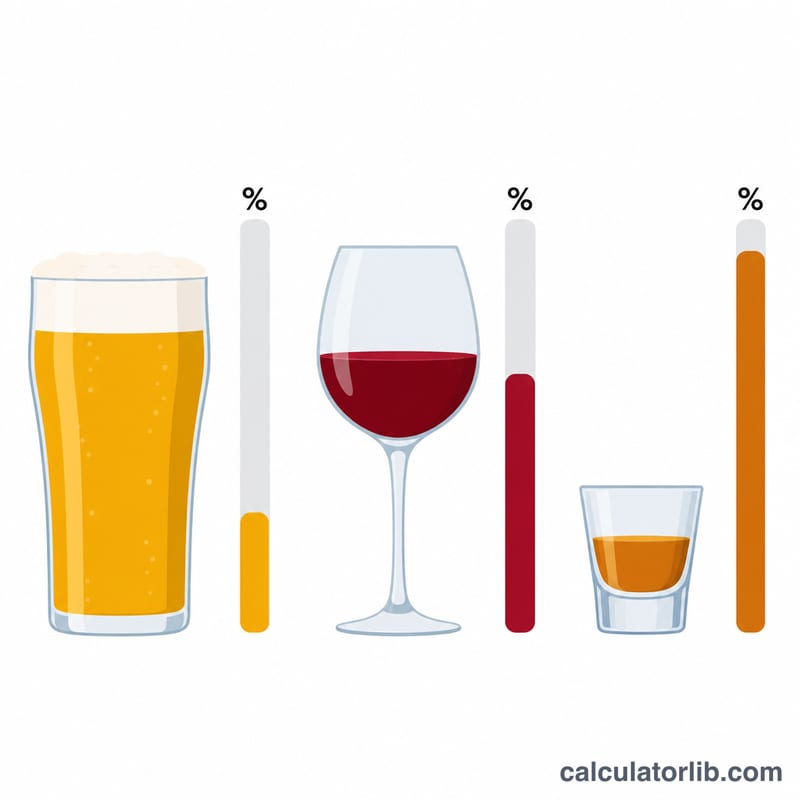
The table below shows broadly representative gravity and ABV ranges for common fermented beverage styles. Actual values vary widely with recipe, yeast strain, and process, so treat these as typical starting points rather than strict limits.
| Style | Typical OG | Typical FG | Typical ABV |
|---|---|---|---|
| Light lager | 1.040–1.050 | 1.006–1.012 | 4.0%–5.5% |
| IPA | 1.056–1.075 | 1.010–1.018 | 5.5%–8.5% |
| Stout | 1.044–1.075 | 1.010–1.022 | 4.0%–8.0% |
| Dry wine | 1.080–1.100 | 0.990–0.998 | 11%–14% |
| Mead | 1.090–1.140 | 0.996–1.020 | 10%–18% |
| Cider | 1.045–1.065 | 0.998–1.010 | 5.0%–8.5% |
Note that dry wines and some meads can finish below 1.000 (less dense than water) because alcohol is lighter than water, which pulls the final gravity down past the water reference point.
ABV Across Common OG/FG Scenarios
Each row below applies the standard formula to a realistic OG/FG pair. The gravity drop is \((\text{OG} - \text{FG})\), the ABV is that drop multiplied by 131.25, and apparent attenuation is the fraction of original gravity points consumed during fermentation:
$$\text{Attenuation \%} = \frac{\text{OG} - \text{FG}}{\text{OG} - 1} \times 100$$
| OG | FG | Gravity drop | ABV | Apparent attenuation |
|---|---|---|---|---|
| 1.040 | 1.010 | 0.030 | 3.94% | 75% |
| 1.050 | 1.012 | 0.038 | 4.99% | 76% |
| 1.060 | 1.015 | 0.045 | 5.91% | 75% |
| 1.065 | 1.010 | 0.055 | 7.22% | 85% |
| 1.075 | 1.012 | 0.063 | 8.27% | 84% |
| 1.090 | 0.998 | 0.092 | 12.08% | 102% |
| 1.110 | 1.005 | 0.105 | 13.78% | 95% |
For example, with an OG of 1.060 and FG of 1.015 the gravity drop is \(1.060 - 1.015 = 0.045\), so \(0.045 \times 131.25 = 5.91\%\) ABV. Attenuation above 100% (as in the mead row) simply reflects a final gravity below 1.000, which the apparent-attenuation formula treats as more than complete fermentation of the available extract.
Hydrometer Temperature Correction Factors
Most hydrometers are calibrated to read accurately at 20 °C (68 °F). When your sample is warmer or cooler than this, the liquid's density shifts and the raw reading must be corrected. Warm samples are less dense, so the hydrometer reads low and you add to the reading; cold samples are denser, so the hydrometer reads high and you subtract. The table gives approximate corrections in specific-gravity units to apply to a reading taken at the listed temperature.
| Sample temperature (°C) | Sample temperature (°F) | Correction to reading |
|---|---|---|
| 10 °C | 50 °F | −0.0007 |
| 15 °C | 59 °F | −0.0005 |
| 20 °C | 68 °F | 0.0000 (calibration point) |
| 25 °C | 77 °F | +0.0008 |
| 30 °C | 86 °F | +0.0017 |
| 35 °C | 95 °F | +0.0028 |
| 40 °C | 104 °F | +0.0040 |
Example: if you read 1.050 at 30 °C, add 0.0017 to get a corrected gravity of about 1.0517, which rounds to 1.052. These values assume calibration at 20 °C/68 °F; some hydrometers are calibrated at 15.6 °C (60 °F), in which case use the correction chart that matches your instrument.
FAQ
What is specific gravity? It is the density of your liquid relative to water (1.000). Sugar makes it higher; alcohol is lighter than water, so it falls as sugar ferments.
Why does my reading need temperature correction? Hydrometers are calibrated at a specific temperature (often 20°C/68°F). Readings taken at other temperatures are slightly off and should be adjusted.
Is this formula exact? No — it is an estimate. For high-gravity brews a more advanced equation gives better accuracy, but this formula is the widely used standard for typical batches.