
What is Heron's Formula?
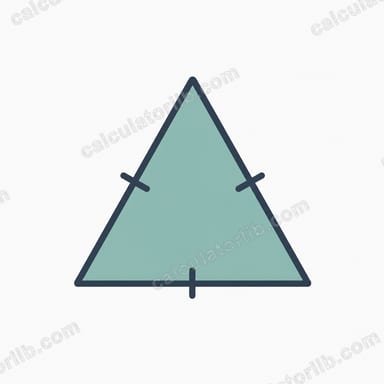
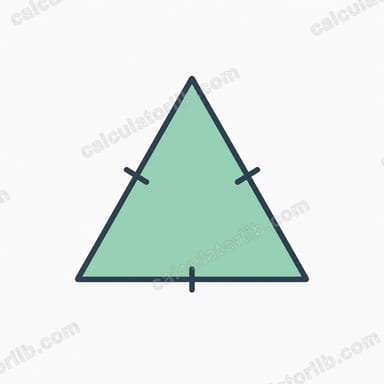
Heron's formula (also called Hero's formula) lets you compute the area of a triangle when you know the lengths of all three sides — without needing the height, an angle, or any trigonometry. It is named after Hero of Alexandria, the Greek engineer who described it nearly 2,000 years ago. This calculator is universal: it works with any consistent unit (cm, m, inches, feet) and the result is simply in those units squared.
How to use this calculator
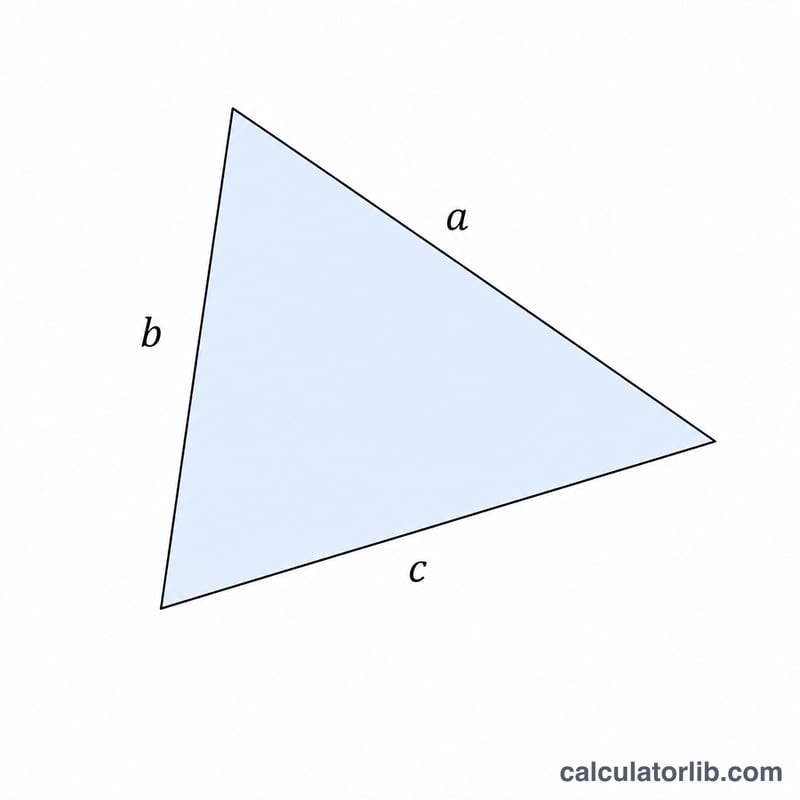
Enter the three side lengths a, b and c in the same unit, then read off the area. The tool also shows the semi-perimeter (\(s\)) — an intermediate value used by the formula — and the full perimeter. For a valid triangle the sum of any two sides must be greater than the third side (the triangle inequality); if that condition fails the area is reported as zero because no such triangle exists.
The formula explained
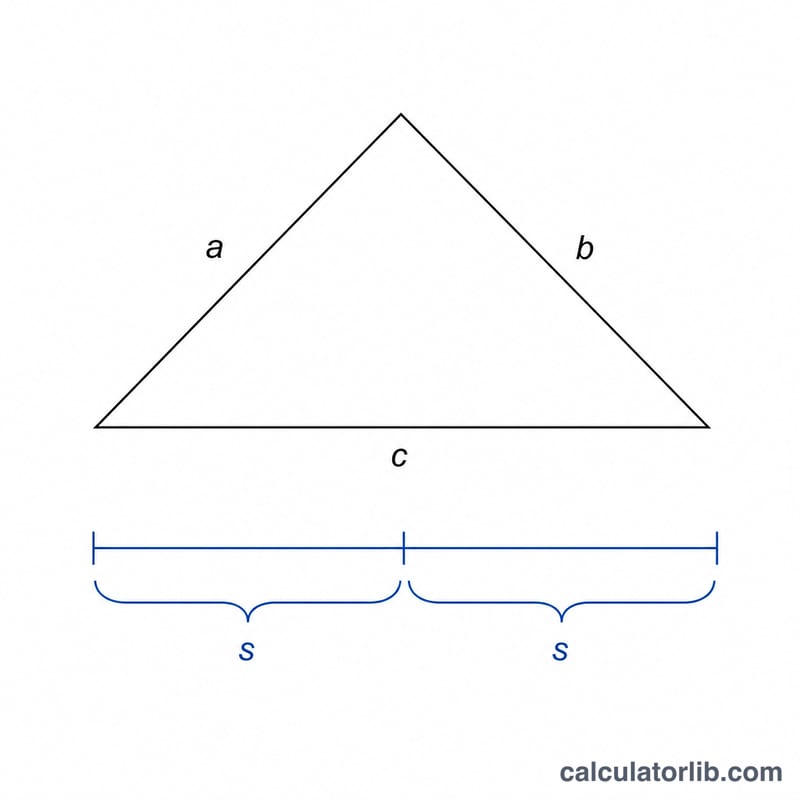
First compute the semi-perimeter, half the perimeter:
$$s = \frac{a + b + c}{2}$$
Then the area is:
$$A = \sqrt{s\,(s - a)\,(s - b)\,(s - c)}$$
Each factor \((s - a)\), \((s - b)\) and \((s - c)\) is positive only when the triangle inequality holds, which is what guarantees a real (non-imaginary) area.
Worked example
Take a triangle with sides \(a = 3\), \(b = 4\), \(c = 5\). The semi-perimeter is $$s = \frac{3 + 4 + 5}{2} = 6.$$ Then $$A = \sqrt{6 \times (6-3) \times (6-4) \times (6-5)} = \sqrt{6 \times 3 \times 2 \times 1} = \sqrt{36} = 6$$ square units. This is the classic right triangle, and indeed \(\frac{1}{2} \times \text{base} \times \text{height} = \frac{1}{2} \times 3 \times 4 = 6\) confirms the answer.
FAQ
Do the sides need the same unit? Yes — use one unit for all three sides; the area comes out in that unit squared.
Why does it return zero? If the sides cannot form a triangle (one side is longer than or equal to the sum of the other two), there is no valid area, so zero is shown.
Does it work for right, isosceles and scalene triangles? Yes. Heron's formula applies to every triangle regardless of its shape or angles.