
What Is the Inverse Square Law?
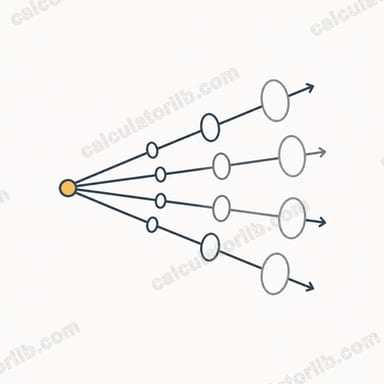
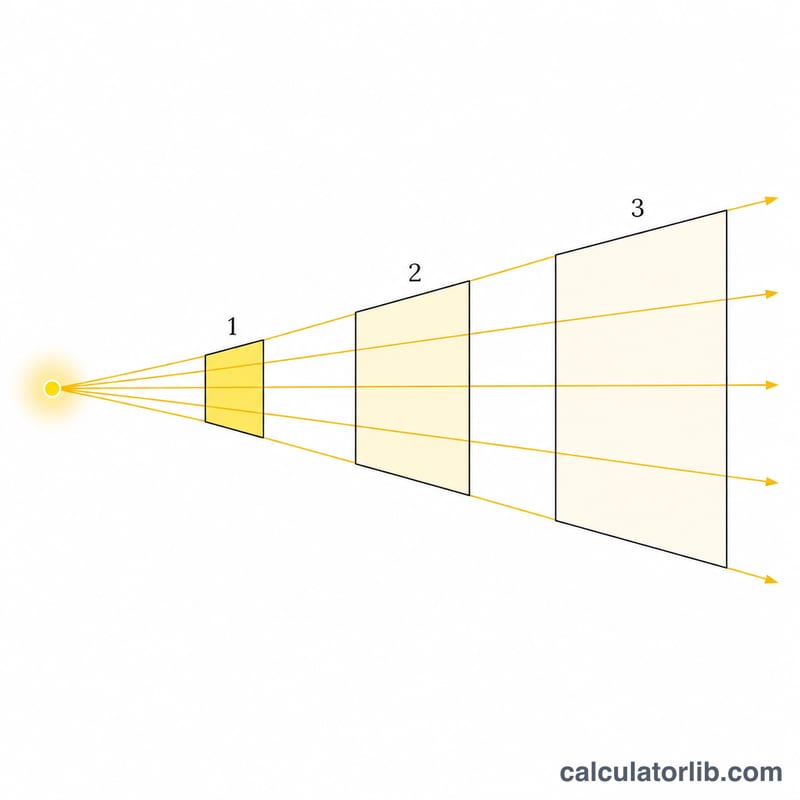
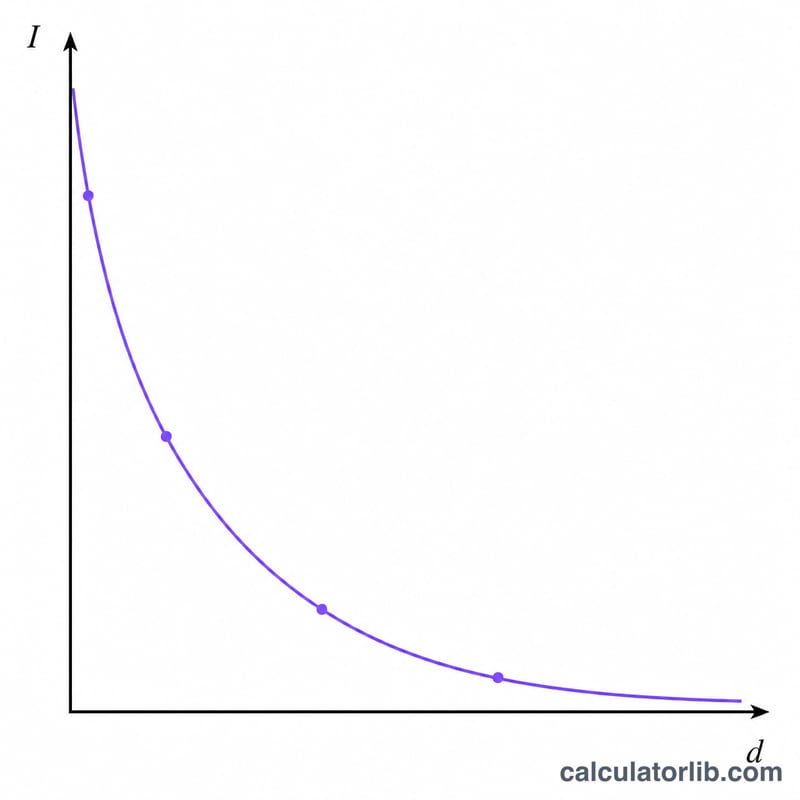
The inverse square law states that the intensity of a physical quantity radiating from a point source falls off in proportion to the square of the distance from that source. It applies to light, sound, gravity, electric fields, and ionizing radiation. If you double the distance, the intensity drops to one quarter; triple it, and you get one ninth. This calculator lets you take a known intensity at one distance and predict the intensity at any other distance.
How to Use This Calculator
Enter three values: the known intensity I₁, the distance d₁ at which that intensity was measured, and the new distance d₂ where you want to know the intensity. The calculator returns I₂ in the same units as I₁. The distances must use the same unit as each other (meters, feet, etc.).
The Formula Explained
The relationship is $$I_2 = \text{I}_1 \times \left( \frac{\text{d}_1}{\text{d}_2} \right)^{2}$$ Because intensity is energy spread over the surface of an expanding sphere (area = \(4\pi r^2\)), the same energy is diluted by the square of the radius. The ratio \(d_1/d_2\) captures the change in distance, and squaring it gives the proportional change in intensity.
Worked Example
Suppose a lamp produces 100 lux at 1 meter. What is the illuminance at 2 meters? Apply the formula: $$I_2 = 100 \times \left( \frac{1}{2} \right)^{2} = 100 \times 0.25 = 25 \text{ lux}$$ Moving twice as far away cuts the brightness to one quarter — a dramatic and often surprising drop.
FAQ
Does this work for sound? Yes. Sound intensity from a point source follows the inverse square law, dropping about 6 dB per doubling of distance.
What units should I use? Any units are fine for intensity, as long as both distances share the same unit; the result is in the same intensity unit as I₁.
Why must distance not be zero? At zero distance the formula diverges (division by zero), and real sources are never truly point-like at that scale, so the model breaks down.