
What Is Coulomb's Law?
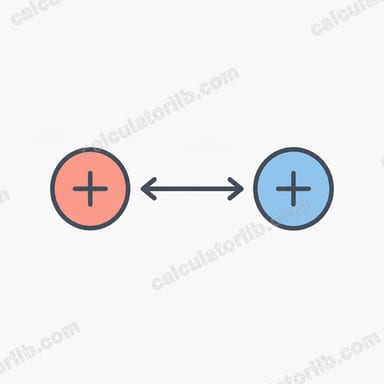
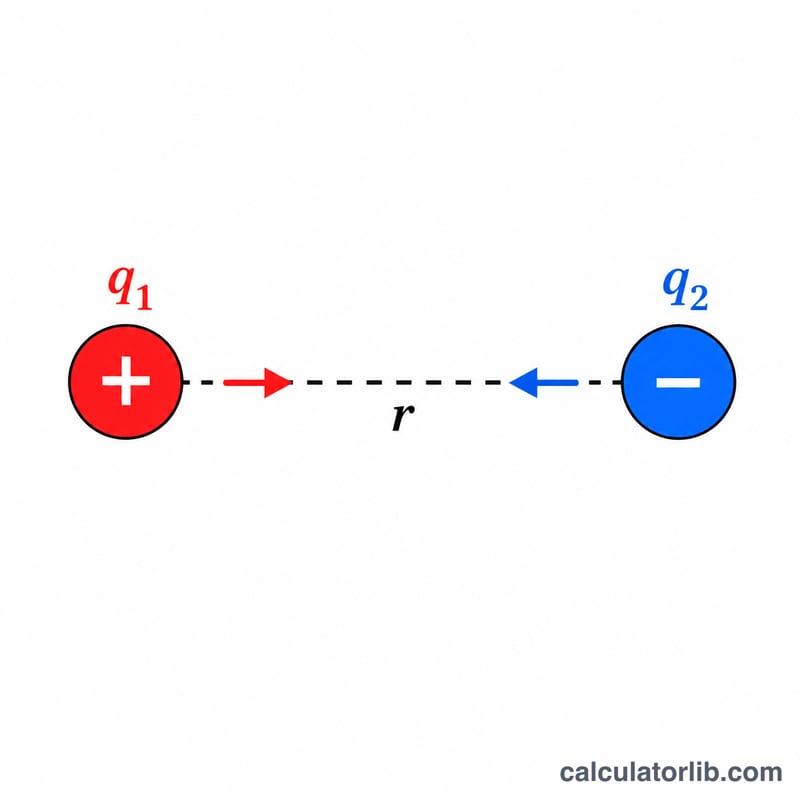
Coulomb's law describes the electrostatic force between two stationary, point-like electric charges. The force is directly proportional to the product of the two charges and inversely proportional to the square of the distance between them. A positive result indicates a repulsive force (like charges), while a negative result indicates an attractive force (opposite charges).
How to Use This Calculator
Enter the two charges \(q_1\) and \(q_2\) in coulombs (C) and the separation distance \(r\) in meters (m). Charges can be entered in scientific notation, e.g. 1e-6 for one microcoulomb. The calculator returns the magnitude of the force in newtons, the signed force value, and whether the interaction is attractive or repulsive.
The Formula Explained
The equation is
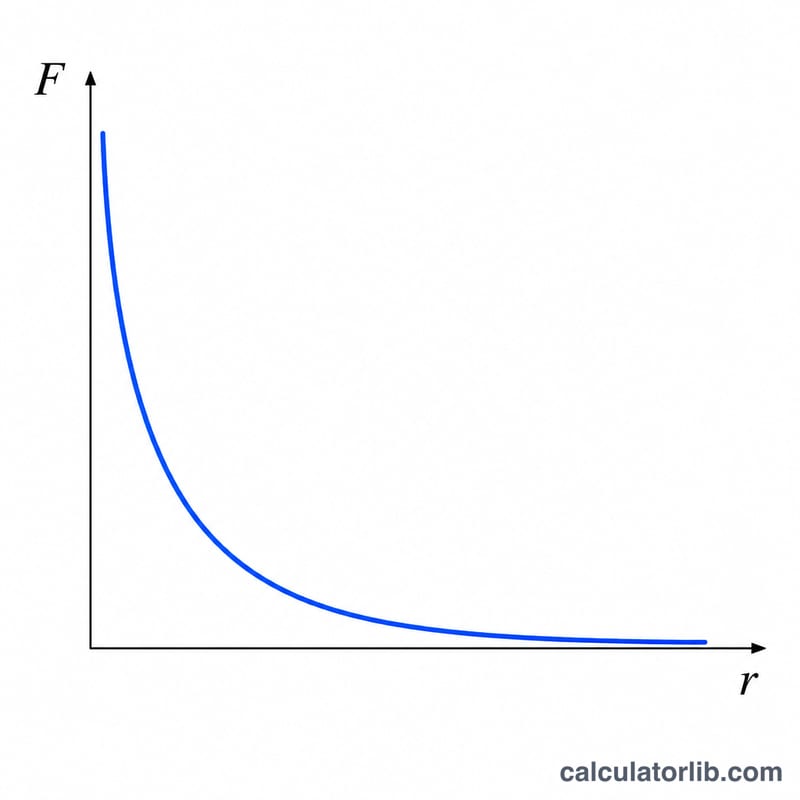
$$F = k \cdot \frac{\text{Charge } q_1 \cdot \text{Charge } q_2}{\text{Distance } r^{2}}$$where \(k\) is Coulomb's constant, approximately \(8.988 \times 10^{9} \ \text{N}\cdot\text{m}^2/\text{C}^2\). The constant comes from \(k = 1/(4\pi\varepsilon_0)\), where \(\varepsilon_0\) is the permittivity of free space. Because force falls off with the square of distance, doubling the separation reduces the force to a quarter of its original value.
Worked Example
Two charges of \(q_1 = 1 \times 10^{-6}\ \text{C}\) and \(q_2 = 1 \times 10^{-6}\ \text{C}\) are placed 0.1 m apart. Then
$$F = 8.988 \times 10^{9} \times \frac{(1 \times 10^{-6})(1 \times 10^{-6})}{(0.1)^2} = 8.988 \times 10^{9} \times \frac{1 \times 10^{-12}}{0.01} = 0.8988\ \text{N}$$Since both charges are positive, the force is repulsive.
FAQ
What units should I use? Use SI units: coulombs for charge and meters for distance, giving force in newtons.
What does a negative result mean? A negative signed force means the charges attract (one positive, one negative). The magnitude shown is always positive.
Does this work for charges in a medium? This calculator assumes a vacuum (or air, which is close). In other media, divide the result by the relative permittivity of the material.