
What is the mg/dL to mmol/L converter?
Many lab results report concentrations in milligrams per deciliter (mg/dL), while much of the world uses millimoles per liter (mmol/L). This calculator converts between the two for any substance once you know its molecular weight (MW). It is widely used for blood glucose, cholesterol, and triglycerides.
How to use it
Enter the value in mg/dL, then pick the substance from the list or choose Custom and type its molecular weight in g/mol. The calculator instantly returns the equivalent concentration in mmol/L.
The formula explained
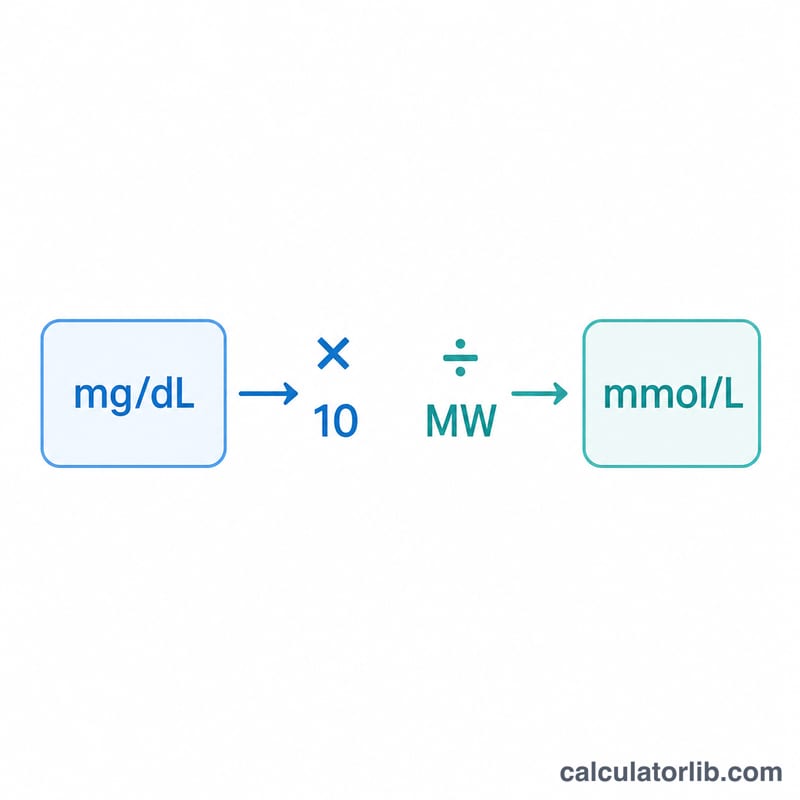
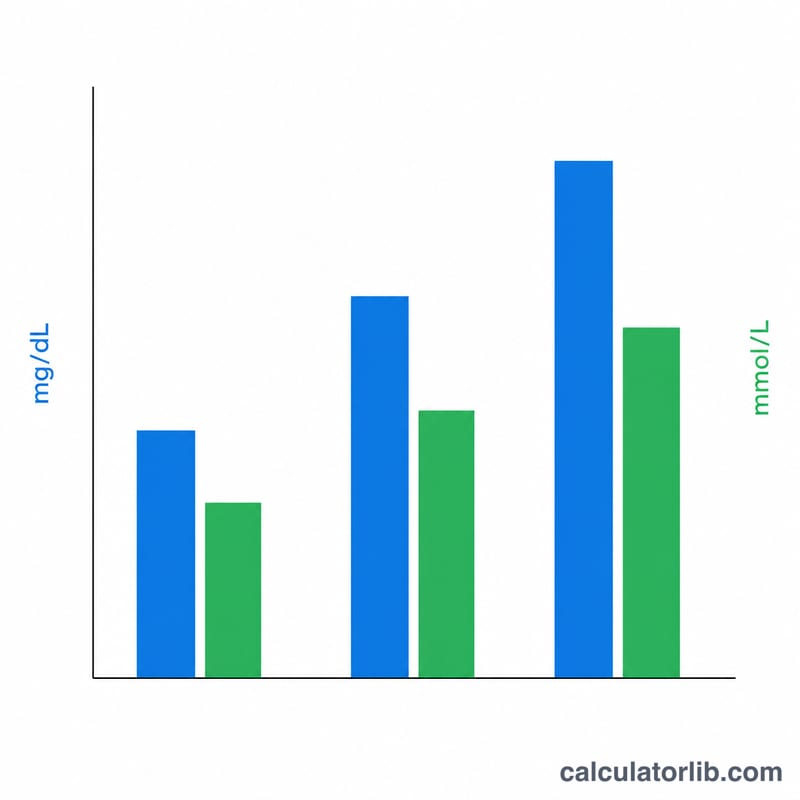
The conversion is $$\text{mmol/L} = \frac{\text{Concentration (mg/dL)} \times 10}{\text{Molecular Weight}}$$ The factor of 10 converts per-deciliter mass to per-liter mass (1 dL = 0.1 L), and dividing by the molecular weight converts milligrams to millimoles. A larger molecule (higher MW) yields a smaller molar concentration for the same mass.
Worked example
For glucose (MW 180.16) at 100 mg/dL: $$\text{mmol/L} = \frac{100 \times 10}{180.16} = \frac{1000}{180.16} \approx 5.55 \text{ mmol/L}$$ This is why a fasting glucose of 100 mg/dL is often quoted as about 5.6 mmol/L.
FAQ
Why does glucose use 18 as a divisor? Because \(10 / 180.16 \approx 0.0555\), equivalent to dividing mg/dL by about 18 to get mmol/L.
Can I convert cholesterol? Yes. Cholesterol uses MW 386.65, so the practical divisor is roughly 38.67 (mg/dL \(\div\) 38.67 \(\approx\) mmol/L).
Is this medical advice? No. It is a unit conversion tool; always interpret lab values with a qualified healthcare professional.