
What this calculator does
This tool converts a substance concentration measured in mmol/L (millimoles per litre) into mg/dL (milligrams per decilitre). These are two common ways of reporting blood and lab values: most of the world uses mmol/L, while the United States and a few other countries often report mg/dL. Because the conversion depends on the molecular weight of the substance, the same mmol/L value gives a different mg/dL number for glucose, cholesterol, creatinine and so on.
How to use it
Enter your value in mmol/L, then pick the substance from the list. The molecular weight (MW) is filled in automatically for common analytes. Choose Custom if you want to type your own MW in g/mol. The result is the equivalent value in mg/dL.
The formula explained
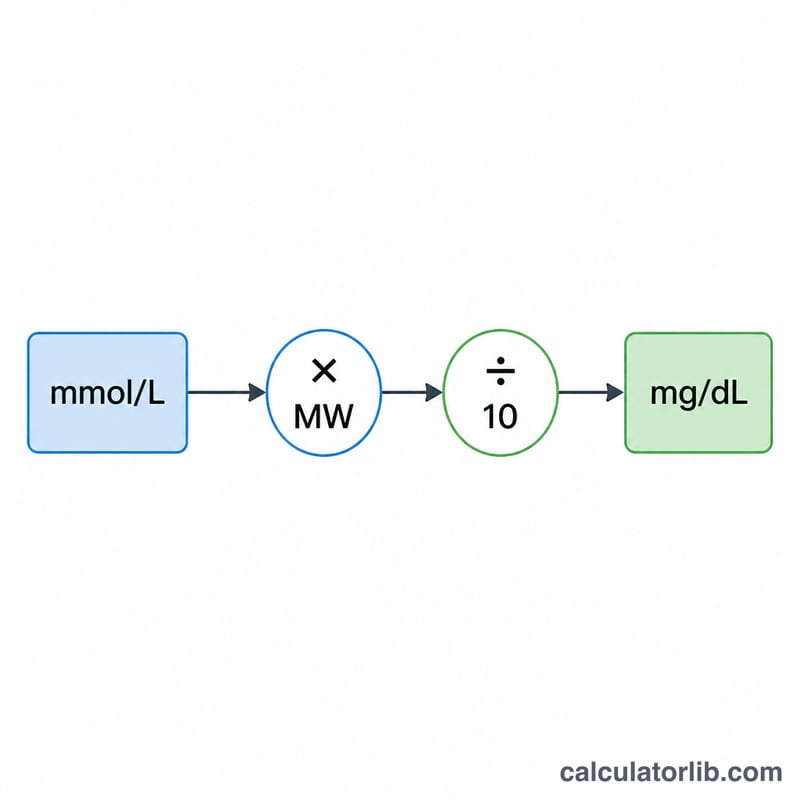
The conversion is $$\text{mg/dL} = \frac{\text{mmol/L} \times \text{MW}}{10}$$ A millimole is MW milligrams of substance, and converting from per-litre to per-decilitre divides by 10 (\(1\,\text{dL} = 0.1\,\text{L}\)). Multiplying the molar concentration by MW turns moles into mass; dividing by 10 rescales the volume.
Worked example
For glucose (MW = 180.16) at 5.5 mmol/L: $$\text{mg/dL} = \frac{5.5 \times 180.16}{10} = \frac{990.88}{10} = 99.09\ \text{mg/dL}$$ That is a typical fasting glucose reading.
FAQ
Why is glucose roughly ×18? Because \(180.16 / 10 \approx 18.016\), so \(\text{mmol/L} \times 18 \approx \text{mg/dL}\) for glucose.
Does this work for cholesterol? Yes — select Cholesterol (MW 386.65), which gives a factor near 38.67 (\(\text{mmol/L} \times 38.67 \approx \text{mg/dL}\)).
Is this medical advice? No. This is a unit conversion utility. Always interpret lab results with a qualified clinician.