
What This Calculator Does
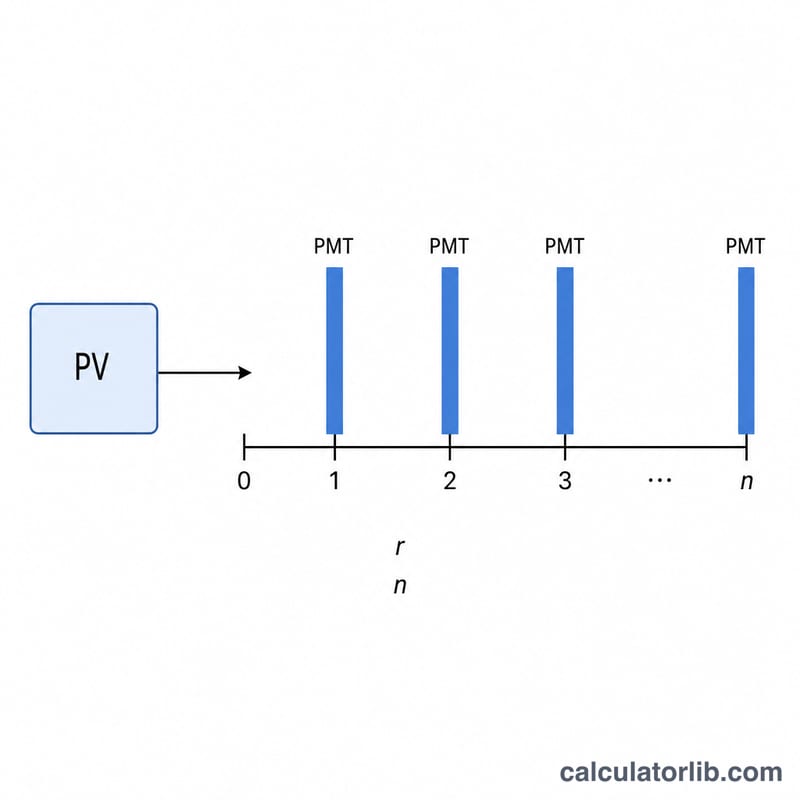
The Loan Payment (PMT) Calculator computes the fixed periodic payment required to fully pay off a loan — its present value — over a chosen term at a given interest rate. It is the standard annuity formula used by banks for mortgages, car loans, and personal loans. This tool is currency-neutral: enter amounts in whatever currency you use.
How to Use It
Enter the present value (the amount borrowed today), the annual interest rate as a percentage, the loan term in years, and how many payments you make per year (monthly is most common). The calculator returns the payment per period, the total number of payments, the total amount paid over the life of the loan, and the total interest cost.
The Formula Explained
The core equation is $$\text{PMT} = \frac{PV \cdot r}{1-(1+r)^{-n}}$$ Here PV is the present value, r is the periodic interest rate (annual rate divided by payments per year), and n is the total number of payments (years × payments per year). When the interest rate is zero, the payment is simply \(PV / n\).
Worked Example
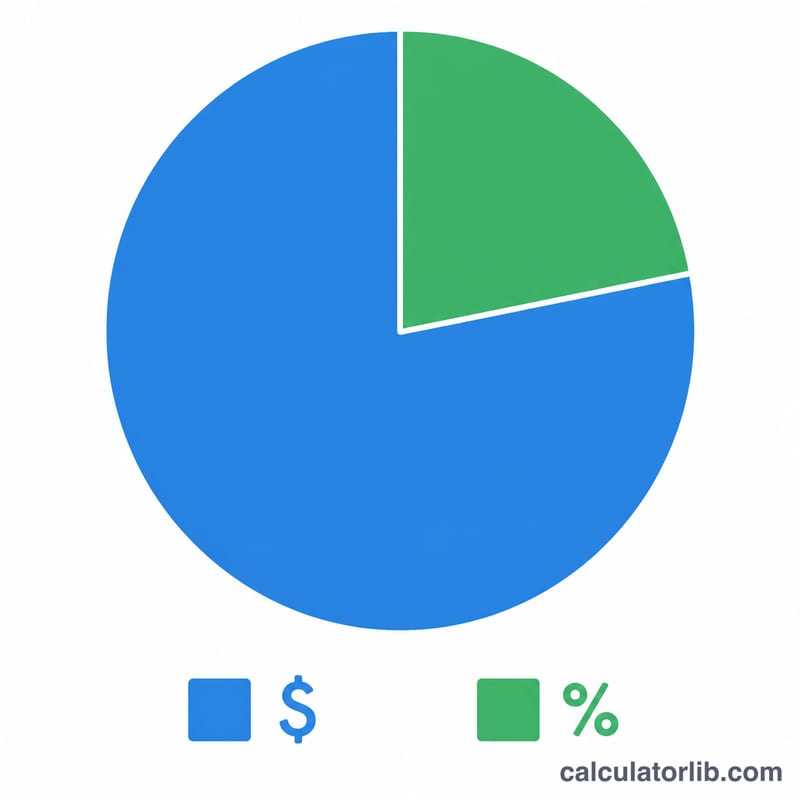
Borrow 10,000 at 6% annual interest over 5 years, paid monthly. The periodic rate is \(0.06 / 12 = 0.005\) and \(n = 60\). $$\text{PMT} = 10{,}000 \times \frac{0.005}{1 - 1.005^{-60}} \approx 193.33$$ per month. Total paid ≈ 11,599.68, so total interest ≈ 1,599.68.
FAQ
Is the payment the same every period? Yes — this is a fully amortizing loan, so each payment is identical and the loan reaches a zero balance after the final payment.
Does this include fees or insurance? No. It only covers principal and interest. Add escrow, fees, or insurance separately.
What if my rate is 0%? The calculator handles that case by dividing the present value evenly across all payments.