
What this calculator does
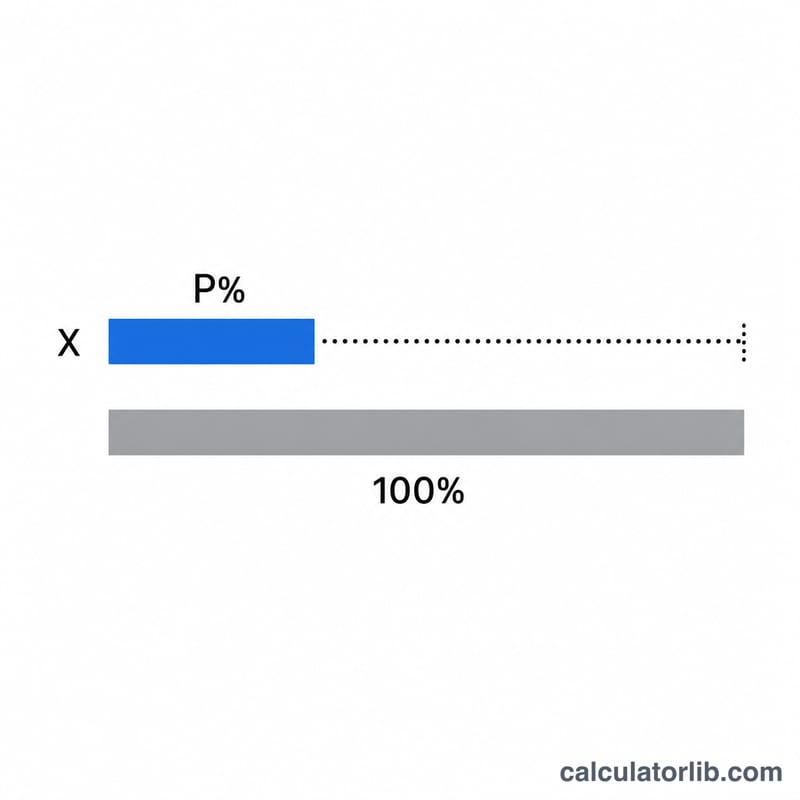
This reverse percentage calculator answers the everyday question: "X is P% of what number?" Instead of finding a percentage of a known total, it works backward — you know a part and the percentage it represents, and it returns the original whole (the 100% value).
How to use it
Enter the part (the amount you already know) and the percentage that part represents. The calculator divides the part by the percentage written as a decimal and shows the full amount. For example, if a 20% deposit is 5,000, the calculator tells you the full price.
The formula explained
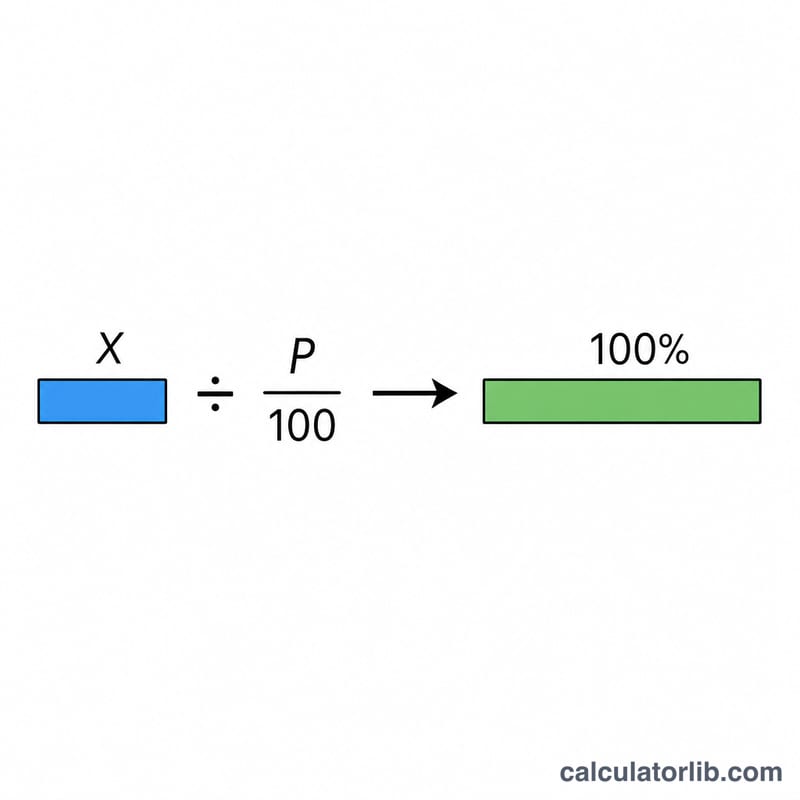
The relationship is \( \text{Part} = \text{Whole} \times (\text{Percent} \div 100) \). Rearranging to solve for the whole gives $$\text{Whole} = \frac{\text{Part}}{\dfrac{\text{Percentage (\%)}}{100}}$$ Dividing by the percentage-as-decimal scales the part back up to the full 100% figure. The calculator guards against a zero percentage, which has no defined whole.
Worked example
Suppose 25 is 20% of some number. Convert 20% to a decimal: \( 20 \div 100 = 0.20 \). Then divide: $$25 \div 0.20 = \mathbf{125}$$ Check it: \( 20\% \text{ of } 125 = 0.20 \times 125 = 25 \). ✓
FAQ
How is this different from a normal percentage calculator? A normal one finds a percentage of a known total; this one finds the unknown total from a known part and percentage.
Can the percentage be over 100? Yes. If the part is larger than the whole, the percentage exceeds 100 and the whole will be smaller than the part.
Why does a 0% input give nothing? Nothing can be 0% of a finite number, so the division is undefined and the result is shown as 0.