
What Is the Rocket Thrust Calculator?
This calculator estimates the thrust produced by a rocket engine using the classic rocket thrust equation. Thrust is the force that pushes a rocket forward, and it comes from two contributions: the momentum of the high-speed exhaust gases and the pressure difference acting across the nozzle exit area. The tool works for any engine — chemical, cold-gas, or otherwise — as long as you supply the right numbers in SI units. It is a universal physics calculation and applies anywhere.
How to Use It
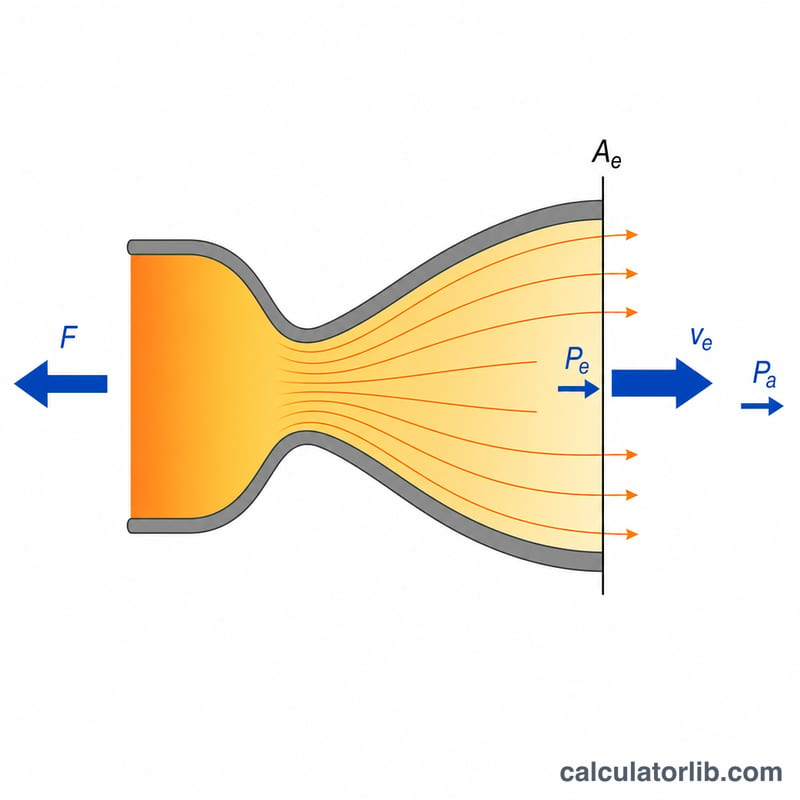
Enter the propellant mass flow rate (\(\dot{m}\)) in kilograms per second, the exhaust (exit) velocity (\(v_e\)) in metres per second, the nozzle exit pressure (\(P_e\)) and ambient pressure (\(P_a\)) in pascals, and the nozzle exit area (\(A_e\)) in square metres. The calculator returns total thrust in newtons and kilonewtons, and breaks it down into momentum thrust and pressure thrust so you can see how each part contributes.
The Formula Explained
The equation is $$F = \dot{m} \cdot v_e + \left( P_e - P_a \right) \cdot A_e$$ The first term, \(\dot{m} \cdot v_e\), is the momentum thrust — mass leaving per second times its speed. The second term, \(\left( P_e - P_a \right) \cdot A_e\), is the pressure thrust. When the exit pressure equals ambient pressure the nozzle is "perfectly expanded" and the pressure term vanishes. If \(P_e\) is greater than \(P_a\) (under-expanded) it adds thrust; if \(P_e\) is less than \(P_a\) (over-expanded) it subtracts.
Worked Example
Suppose \(\dot{m} = 250\ \text{kg/s}\), \(v_e = 2800\ \text{m/s}\), \(P_e = 101{,}325\ \text{Pa}\), \(P_a = 101{,}325\ \text{Pa}\), and \(A_e = 0.5\ \text{m}^2\). Momentum thrust $$250 \times 2800 = 700{,}000\ \text{N}.$$ Pressure thrust $$\left( 101{,}325 - 101{,}325 \right) \times 0.5 = 0\ \text{N}.$$ Total thrust = 700,000 N, or 700 kN.
FAQ
What units should I use? Use SI units: kg/s, m/s, pascals, and square metres. The result is in newtons.
What is effective exhaust velocity? It is total thrust divided by mass flow rate (\(F/\dot{m}\)), and it accounts for the pressure term too.
Can pressure thrust be negative? Yes — if exit pressure is below ambient pressure (over-expanded nozzle), the pressure term reduces total thrust.