
What Is a Regular Polygon Area Calculator?
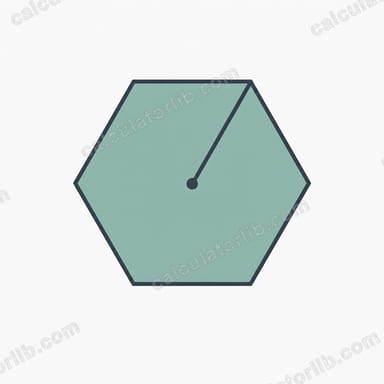
A regular polygon is a closed shape with all sides equal in length and all interior angles equal — think of an equilateral triangle, a square, a regular pentagon, or a hexagon. This calculator finds the enclosed area of any such polygon directly from two numbers: how many sides it has and how long each side is. It also reports the apothem, perimeter, and interior angle as a bonus.
How to Use It
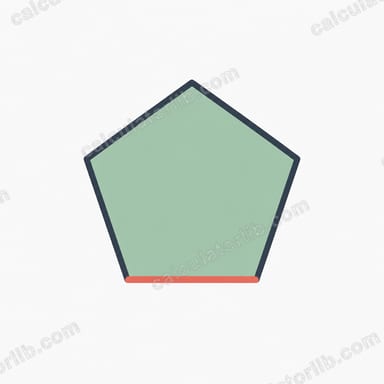
Enter the number of sides (n), which must be 3 or more, and the length of one side (s) in any unit you like. The result comes back in those same units squared. For example, if your side length is in centimetres, the area is in square centimetres.
The Formula Explained
The area of a regular n-sided polygon with side length s is:
$$A = \frac{1}{4} \, \text{n} \cdot \text{s}^{2} \cdot \cot\!\left(\frac{\pi}{\text{n}}\right)$$
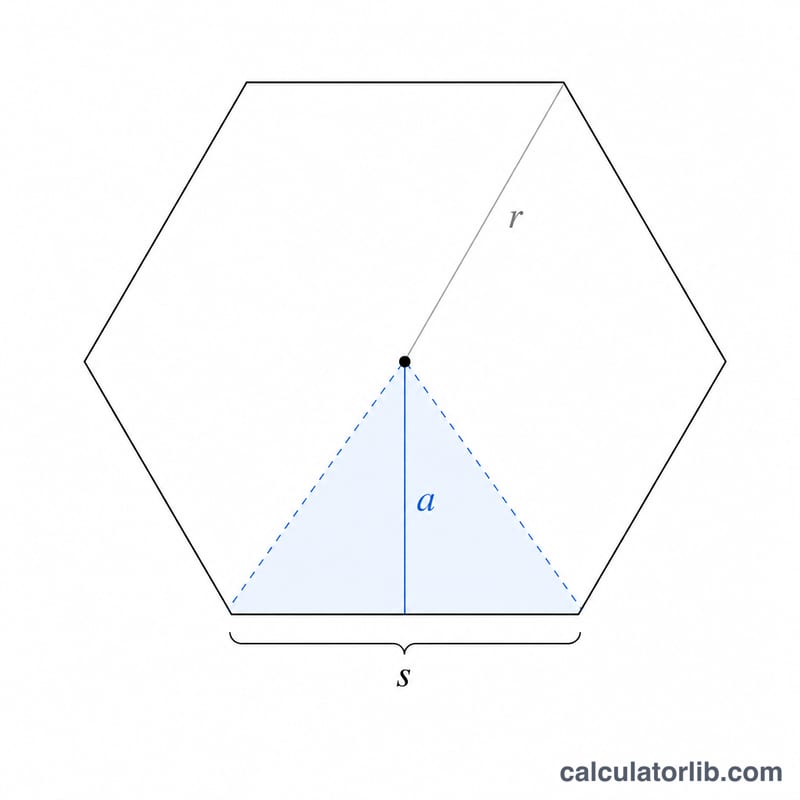
The polygon can be split into n identical isosceles triangles meeting at the center. Each triangle has base s and height equal to the apothem \(a = s / (2\cdot\tan(\pi/n))\). Summing their areas gives the formula above. The cotangent term grows as the polygon gains sides, so for a fixed side length more sides means more area.
Worked Example
Take a regular hexagon (n = 6) with a side length of 10. Then \(\cot(\pi/6) = \cot(30°) = \sqrt{3} \approx 1.7320508\). The area is $$A = 0.25 \times 6 \times 100 \times 1.7320508 \approx 259.81 \text{ square units}.$$ The apothem is \(10 / (2\cdot\tan 30°) \approx 8.66\), the perimeter is 60, and each interior angle is 120°.
Definitions & Glossary
- Regular polygon
- A closed plane figure with all sides equal in length and all interior angles equal. Examples include the equilateral triangle, square, and regular hexagon.
- Side length (\(s\))
- The common length of each edge of the polygon. In the area formula it appears squared, so doubling the side quadruples the area.
- Number of sides (\(n\))
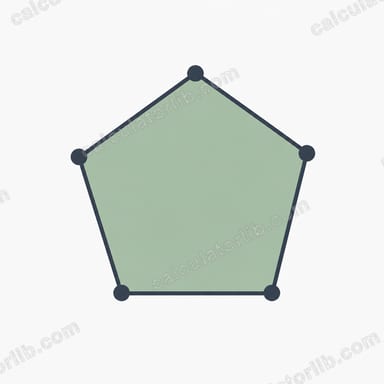
- The count of edges (equivalently, vertices) of the polygon. It must be an integer of at least 3.
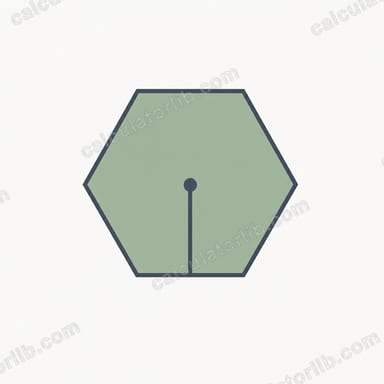
- Apothem (\(a\))
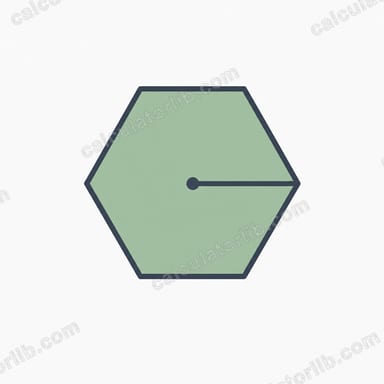
- The perpendicular distance from the center of the polygon to the midpoint of any side. It equals the radius of the inscribed circle and is given by \(a = \tfrac{s}{2}\cot(\pi/n)\). The area can also be written as \(A = \tfrac{1}{2}\,a\,P\).
- Perimeter (\(P\))
- The total distance around the polygon, \(P = n\,s\) for a regular polygon.
- Interior angle
- The angle formed inside the polygon at each vertex between two adjacent sides, equal to \(\dfrac{(n-2)\,180^{\circ}}{n}\). All interior angles are equal in a regular polygon.
- Central angle
- The angle subtended at the center of the polygon by one side, equal to \(\dfrac{360^{\circ}}{n}\) (or \(2\pi/n\) radians). Each side spans one central angle, and the \(n\) central angles together make a full turn.
- Cotangent (\(\cot\))
- A trigonometric function, \(\cot(x) = \dfrac{\cos(x)}{\sin(x)} = \dfrac{1}{\tan(x)}\). In the formula \(\cot(\pi/n)\) converts the half-central-angle of one triangular slice into the ratio that determines the polygon's height relative to its side, yielding the apothem and area.
FAQ
Does this work for triangles and squares? Yes. A 3-sided polygon is an equilateral triangle and a 4-sided polygon is a square — the formula handles both.
What units does the area use? Whatever unit you used for the side length, squared. The calculator is unit-agnostic.
Can I use it for irregular shapes? No. This formula only applies when every side and angle is equal. Irregular polygons need a different method such as the shoelace formula.