
What is a truncated cone?
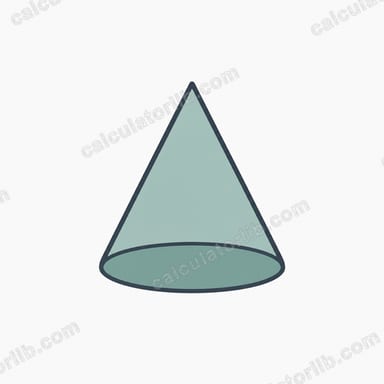
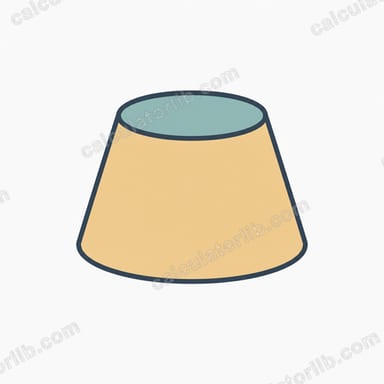
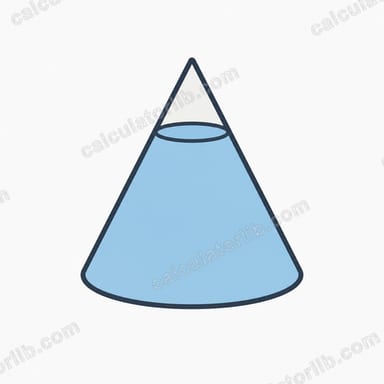
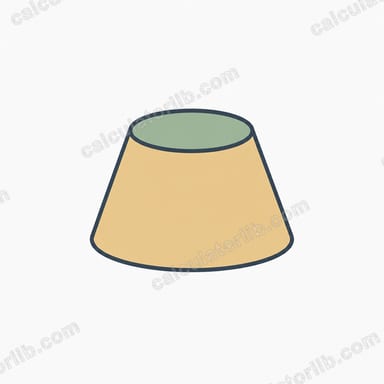
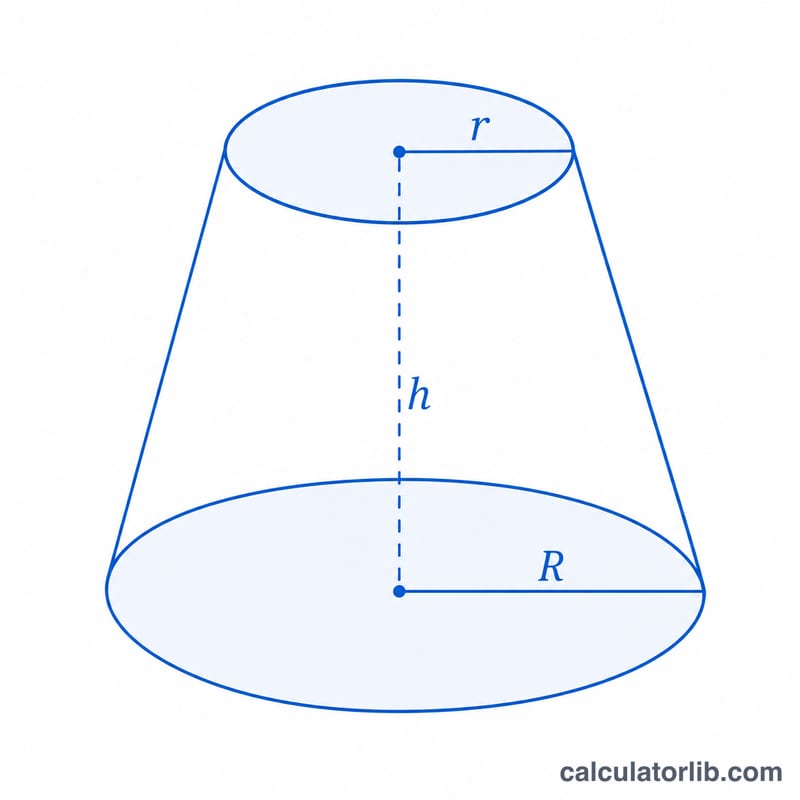
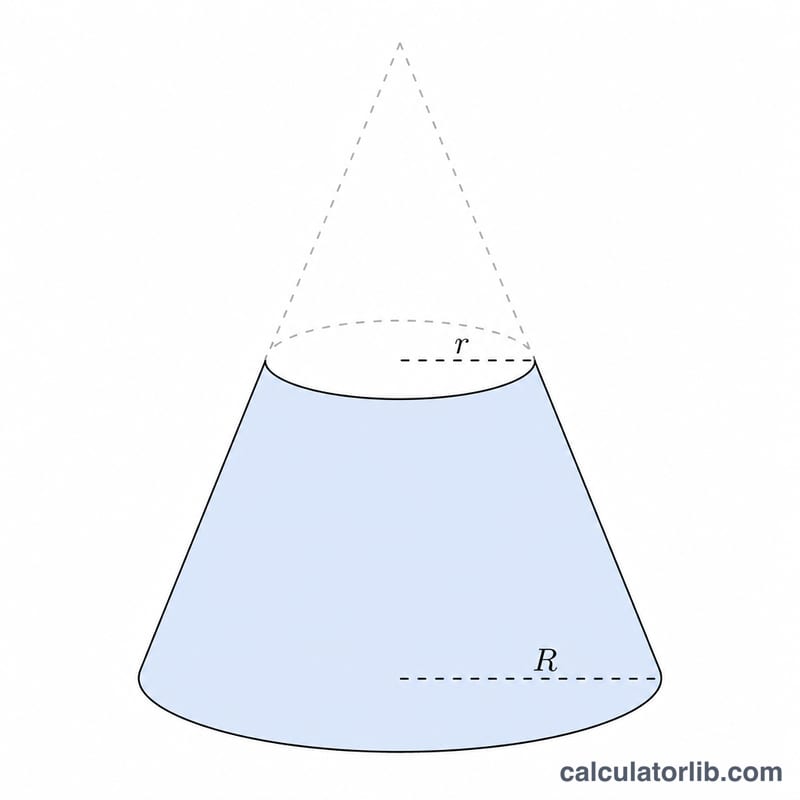
A truncated cone — also called a conical frustum — is the solid you get when you slice the top off a cone with a cut parallel to its base. It has two circular faces: a larger bottom circle of radius R and a smaller top circle of radius r, separated by a perpendicular height h. Everyday examples include drinking cups, buckets, flower pots, lampshades, and grain silos.
How to use this calculator
Enter the bottom radius (R), the top radius (r), and the vertical height (h) in any consistent unit. The calculator returns the enclosed volume in the corresponding cubic units. If you only know diameters, divide each by 2 to get the radius first. The two radii may be equal (giving a cylinder) or the top radius may be zero (giving a full cone).
The formula explained
The volume of a truncated cone is given by $$V = \frac{1}{3}\pi\,h\left(R^{2} + R\,r + r^{2}\right)$$ The bracketed term \(R^{2} + R\,r + r^{2}\) blends the contributions of both circular faces. When \(r = R\) it simplifies to \(\pi\,R^{2}\,h\) (a cylinder); when \(r = 0\) it reduces to \(\frac{1}{3}\pi\,R^{2}\,h\) (a cone) — confirming the formula behaves correctly at both extremes.
Worked example
Suppose a bucket has a bottom radius \(R = 5\) cm, top radius \(r = 3\) cm, and height \(h = 10\) cm. Then $$R^{2} + R\,r + r^{2} = 25 + 15 + 9 = 49$$ So $$V = \frac{1}{3}\cdot\pi\cdot 10\cdot 49 = \frac{490}{3}\pi \approx 513.13 \text{ cm}^{3}$$
FAQ
Does it matter which radius is on top? No. The formula is symmetric in R and r, so swapping them gives the same volume.
What units should I use? Any length unit works as long as all three measurements share it; the result is in that unit cubed.
Is "slant height" needed? Not for volume — only the perpendicular height h is used. Slant height is needed for surface area, not volume.