
What Is the Apothem?
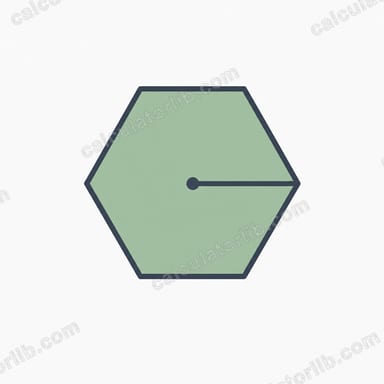
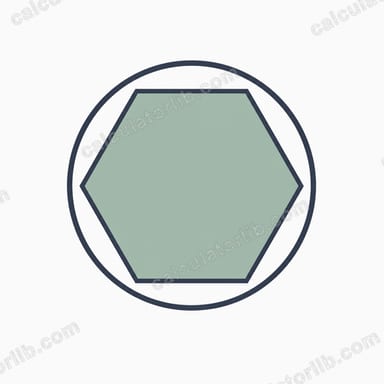
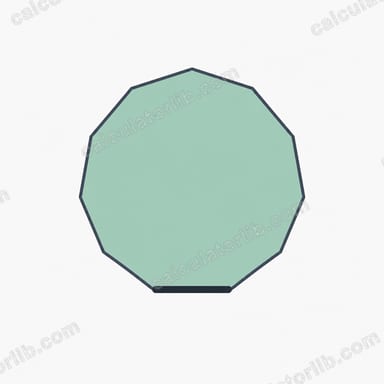
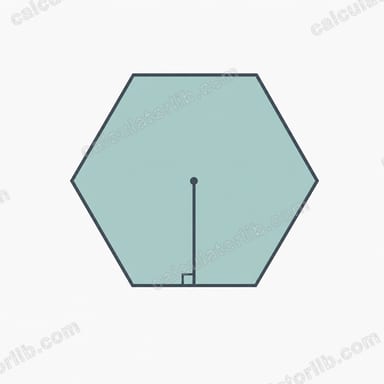
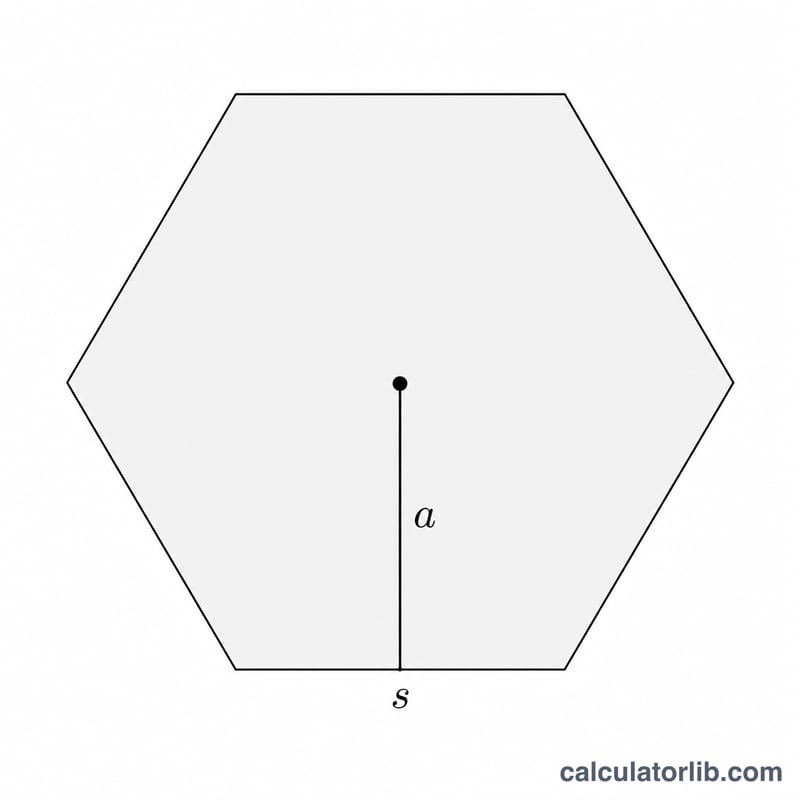
The apothem of a regular polygon is the perpendicular distance from the center of the polygon to the midpoint of any one of its sides. Because every side of a regular polygon is identical and equidistant from the center, the apothem is the same no matter which side you measure to. It is sometimes called the inradius, since it equals the radius of the largest circle that fits inside the polygon.
How to Use This Calculator
Enter two values: the number of sides (n) and the length of one side (s). The calculator instantly returns the apothem, along with the polygon's perimeter and area. The number of sides must be at least 3 (a triangle is the simplest polygon). The side length can be in any unit — centimeters, inches, meters — and the apothem comes out in that same unit.
The Formula Explained
The apothem is found with:
$$a = \frac{s}{2 \cdot \tan\!\left(\dfrac{\pi}{n}\right)}$$
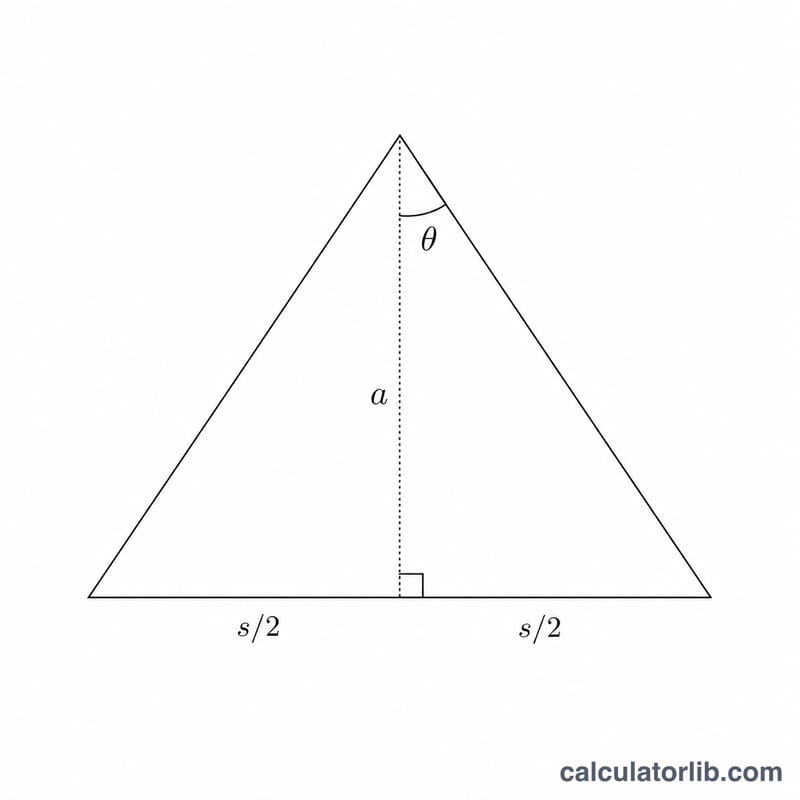
Here \(\pi/n\) is half the central angle subtended by one side (in radians). Drawing a line from the center to a vertex and another to the midpoint of a side creates a right triangle whose opposite side is \(s/2\) and whose adjacent side is the apothem. Rearranging \(\tan(\pi/n) = (s/2) / a\) gives the formula above. The area then follows from \(A = \tfrac{1}{2} \times \text{perimeter} \times \text{apothem}\).
Worked Example
Take a regular hexagon (\(n = 6\)) with side length \(s = 10\). Then \(\pi/n = \pi/6 = 0.5236\) rad and \(\tan(\pi/6) \approx 0.57735\). The apothem is $$a = \frac{10}{2 \times 0.57735} \approx 8.6603.$$ The perimeter is \(6 \times 10 = 60\), and the area is \(\tfrac{1}{2} \times 60 \times 8.6603 \approx 259.81\).
Apothem Reference Table for Common Polygons
The apothem of a regular polygon is the perpendicular distance from the center to the midpoint of any side. It is computed from the side length \(s\) and the number of sides \(n\) using:
$$a = \frac{s}{2 \tan\!\left(\dfrac{\pi}{n}\right)}$$Because the geometry only depends on \(n\), the ratio \(a/s = \dfrac{1}{2\tan(\pi/n)}\) is a fixed constant for each polygon shape. To find your apothem, simply multiply your side length by the a/s ratio in the table below. Likewise, the area for a side length of 1 is the area coefficient; multiply it by \(s^2\) to get the area for any side length, since the total area is \(A = \tfrac{1}{2}\,n\,s\,a = \tfrac{n}{4}\,s^2\cot(\pi/n)\).
| Sides (n) | Name | tan(π/n) | Apothem ratio a/s | Area coefficient (s = 1) |
|---|---|---|---|---|
| 3 | Triangle | 1.732051 | 0.288675 | 0.433013 |
| 4 | Square | 1.000000 | 0.500000 | 1.000000 |
| 5 | Pentagon | 0.726543 | 0.688191 | 1.720477 |
| 6 | Hexagon | 0.577350 | 0.866025 | 2.598076 |
| 7 | Heptagon | 0.481575 | 1.038261 | 3.633912 |
| 8 | Octagon | 0.414214 | 1.207107 | 4.828427 |
| 9 | Nonagon | 0.363970 | 1.373739 | 6.181824 |
| 10 | Decagon | 0.324920 | 1.538842 | 7.694209 |
| 11 | Hendecagon | 0.293626 | 1.702844 | 9.365640 |
| 12 | Dodecagon | 0.267949 | 1.866025 | 11.196152 |
For example, a regular hexagon with side length 1 has an apothem of 0.866025 and an area of 2.598076. Scale either value by your actual side length (apothem) or its square (area).
FAQ
Is the apothem the same as the radius? No. The apothem reaches the midpoint of a side (the inradius), while the circumradius reaches a vertex. The circumradius is always longer.
Does this work for irregular polygons? No — the apothem is only well-defined for regular polygons, where all sides and angles are equal.
What units does the apothem use? Whatever unit you used for the side length. The formula is purely geometric and unit-independent.