
What this calculator does
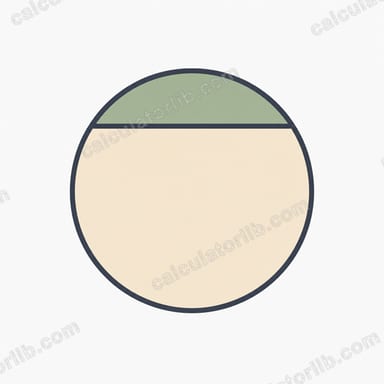
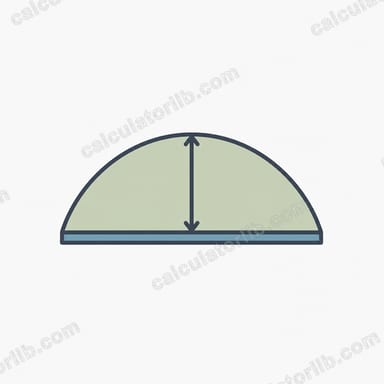
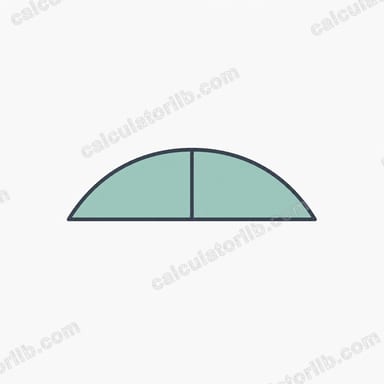
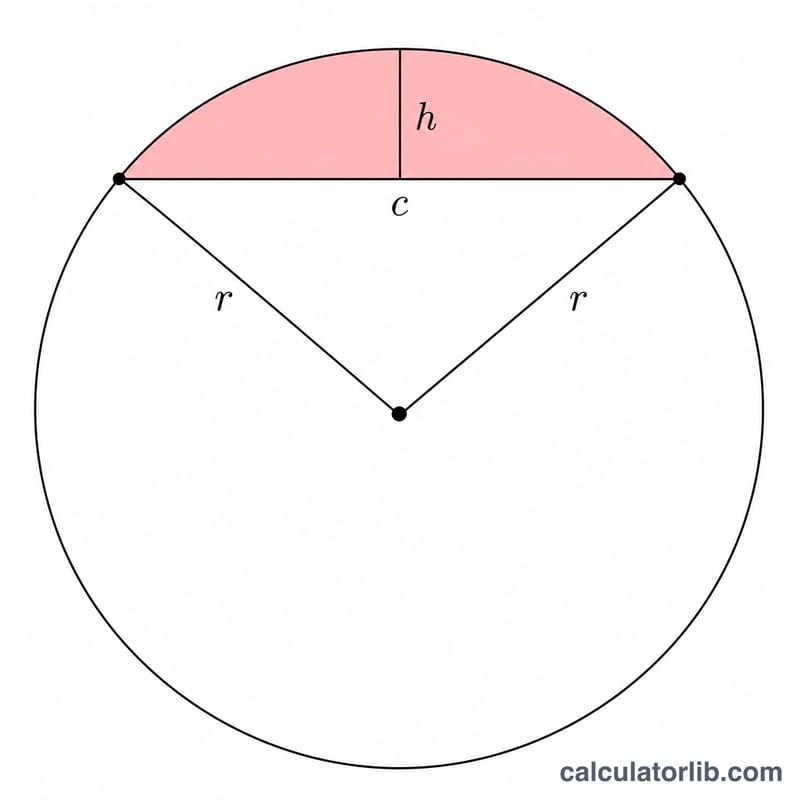
This tool finds the radius of a circle when you only know the length of a chord and the sagitta — the perpendicular height of the arc measured from the midpoint of the chord to the arc itself. It is a universal geometry tool that works in any consistent unit (mm, cm, inches, feet), so no country or jurisdiction applies.
How to use it
Measure the straight-line distance across the arc (the chord, c) and the height of the arc above that line (the sagitta, h). Enter both values in the same unit and press calculate. The calculator returns the radius and the diameter of the full circle the arc belongs to.
The formula explained
The relationship comes from the right-triangle formed by the radius, half the chord, and the distance from the center to the chord:
$$r = \frac{\text{Chord }(c)^{2}}{8 \cdot \text{Height }(h)} + \frac{\text{Height }(h)}{2}$$
Here \(c^{2}/(8h)\) accounts for the spread of the chord while \(h/2\) corrects for the curvature of the arc. As long as \(h > 0\) the formula gives an exact radius. The diameter is then \(d = 2r\).
Worked example
Suppose a curved doorway top has a chord of 12 inches and rises 2 inches at its peak. Then $$r = \frac{12^{2}}{8 \cdot 2} + \frac{2}{2} = \frac{144}{16} + 1 = 9 + 1 = 10 \text{ inches},$$ giving a diameter of 20 inches. So you would set a compass to a 10-inch radius to draw the matching arc.
FAQ
What is the sagitta? It is the height of the arc — the maximum vertical distance between the chord and the curve, measured at the chord's midpoint.
Why does the height have to be greater than zero? If \(h = 0\) the points are collinear (a straight line), so there is no finite circle and the formula would divide by zero.
Can I use any units? Yes — just keep the chord and height in the same unit, and the radius comes out in that same unit.