
What Is a Dilation?
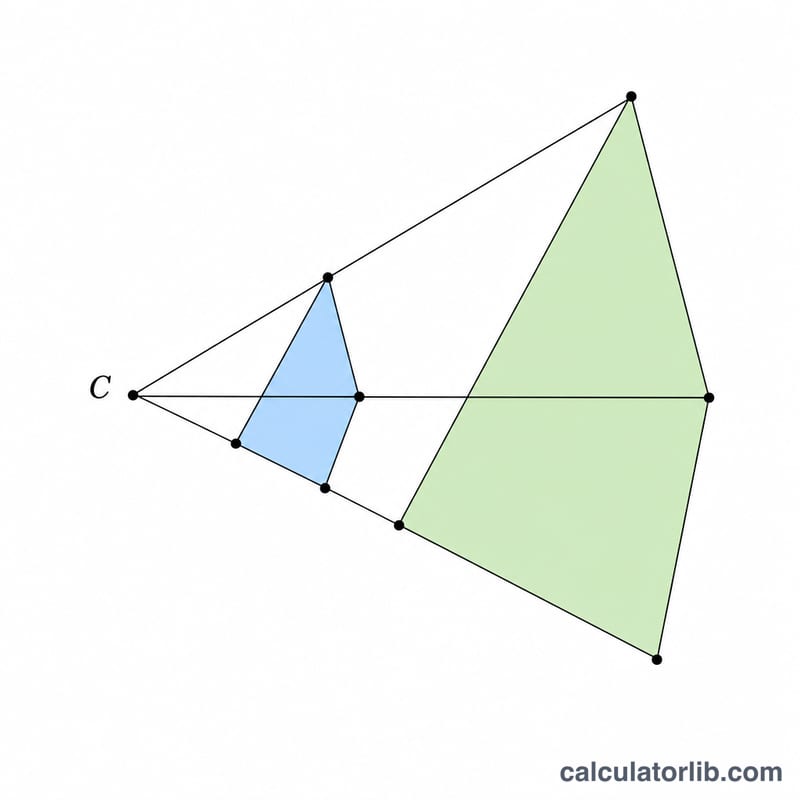
A dilation is a geometric transformation that resizes a figure by a scale factor k while keeping its shape and orientation. Every point moves toward (when 0 < k < 1) or away from (when k > 1) a fixed point called the center of dilation. A negative k reflects the point through the center as well as scaling it. This calculator computes the image of any point after a dilation about any chosen center.
How to Use It
Enter the original point coordinates (x, y), the center of dilation (cx, cy), and the scale factor k. The calculator returns the transformed image point (x', y'). If your center is the origin, simply leave cx and cy as 0 — the formula then reduces to \((x', y') = (kx, ky)\).
The Formula Explained
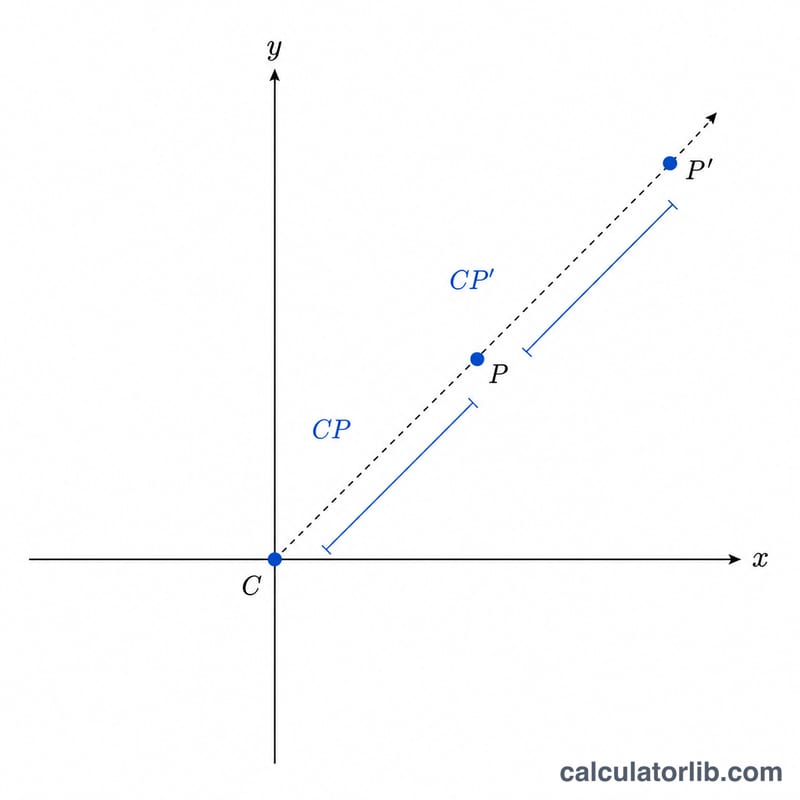
The image point is found by measuring the displacement of the original point from the center, scaling that displacement by k, and adding it back to the center:
$$x' = c_x + k(x - c_x)$$$$y' = c_y + k(y - c_y)$$The term \((x - c_x,\, y - c_y)\) is the vector from the center to the point. Multiplying by k stretches or shrinks that vector, and adding the center back places the result in the coordinate plane.
Worked Example
Dilate the point (4, 6) by a factor of 0.5 about the origin (0, 0):
$$x' = 0 + 0.5 \times (4 - 0) = 2$$$$y' = 0 + 0.5 \times (6 - 0) = 3$$The image point is (2, 3) — exactly half as far from the origin, as expected for a scale factor of one-half.
FAQ
What happens when \(k = 1\)? The point stays exactly where it is; a scale factor of 1 is the identity transformation.
What does a negative k do? It scales the point and reflects it through the center, landing it on the opposite side.
Does the center have to be the origin? No. Any point can serve as the center of dilation, and this calculator handles any center you provide.