
What this calculator does
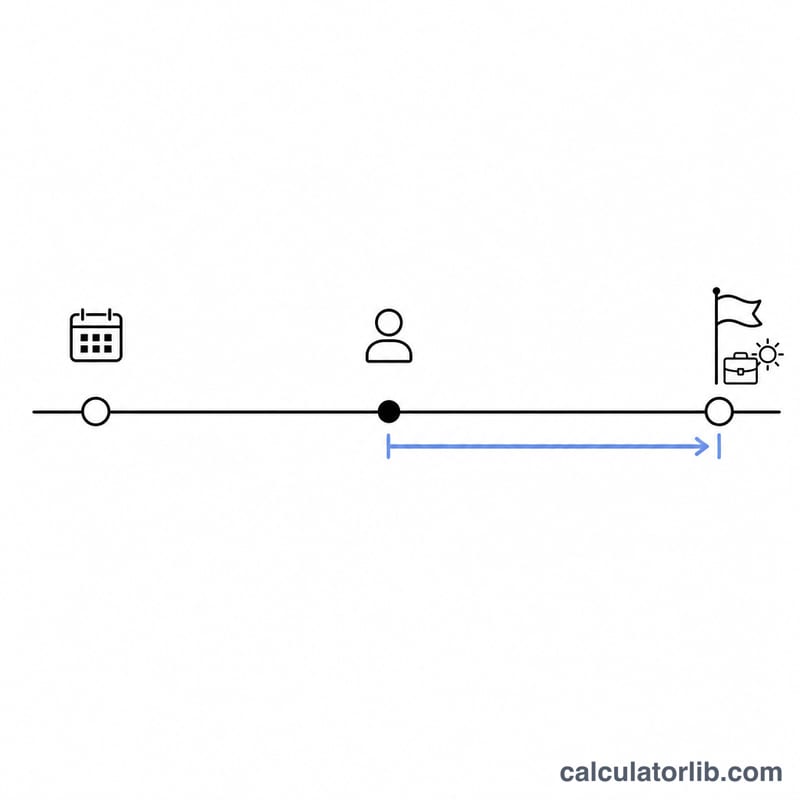
This tool applies to Japan. It finds the exact calendar date you will retire and how long is left until then. You enter your birth date, a target retirement age, the company retirement-timing rule, and today's date. Both the birth date and today can be entered using the Western (Gregorian) calendar or a Japanese era (gengo) such as Showa, Heisei or Reiwa. Date arithmetic is universal, but the era input and the four retirement rules reflect common Japanese employment practice (including fiscal-year-end retirement on March 31).
How to use it
Pick the calendar for your birth date and enter the year, month and day. If you choose an era, enter the era-relative year (for example Showa 35). Set your retirement age (default 65) and the timing rule. The cut-off (closing) day applies only to the "month they reach the age" and "month after" rules; it defines which day of that month is your final day, and "last day of month" auto-resolves to 28/29/30/31. Finally enter today's date and choose whether today itself counts as one of the remaining days.
The formula
Each era year is normalised to a Gregorian year: Gregorian = offset + eraYear (offset is 0 for Western). The retirement date is built from the birthday on which you turn the chosen age, then adjusted by the rule. The remaining span is a serial-day difference:
$$\text{Days} = \text{Serial}(\text{Retirement Date}) - \text{Serial}\!\left(\text{Today Y},\ \text{Today M},\ \text{Today D}\right) + \text{Count Today}$$plus one when "Include today" is selected. Weeks, months and years use calendar-aware stepping so each "X units + Y days" breakdown reconstructs exactly back to the date. The retirement birthday and serial-day conversion are defined by:
$$\begin{gathered} \text{Age Birthday} = (Y_b + \text{Retirement Age}),\ \text{Birth M},\ \text{Birth D} \\[1.5em] \text{where}\quad Y_b = \text{offset}\!\left(\text{Birth Era}\right) + \text{Birth Year} \end{gathered}$$$$\begin{gathered} \text{Serial}(y,m,d) = d + \left\lfloor\tfrac{153\,mm + 2}{5}\right\rfloor + 365\,yy + \left\lfloor\tfrac{yy}{4}\right\rfloor - \left\lfloor\tfrac{yy}{100}\right\rfloor + \left\lfloor\tfrac{yy}{400}\right\rfloor - 32045 \\[1.5em] \text{where}\quad \left\{ \begin{aligned} a &= \left\lfloor\tfrac{14 - m}{12}\right\rfloor \\ yy &= y + 4800 - a \\ mm &= m + 12a - 3 \end{aligned} \right. \end{gathered}$$
Worked example
Birth: Showa 35 (1960) / 4 / 1; retirement age 65; rule "in the month they reach the age"; closing day 20; today 2024 / 6 / 15; exclude today. You turn 65 on 2025-04-01, so the retirement date is 2025-04-20. From 2024-06-15 to 2025-04-20 is \(309\) days — about \(44\) weeks + \(1\) day, or \(10\) months + \(5\) days.
FAQ
What is the March 31 rule? Many Japanese employers retire staff at the fiscal-year end (nendo-matsu), the first March 31 on or after you reach the retirement age.
How are leap-day birthdays handled? A February 29 birthday is treated as February 28 in any non-leap retirement year for a deterministic result.
Why can the result be negative? If the retirement date is already in the past, the remaining days show as zero or negative, indicating you have already passed that date.