
What is the Levy Distribution Percentile Calculator?
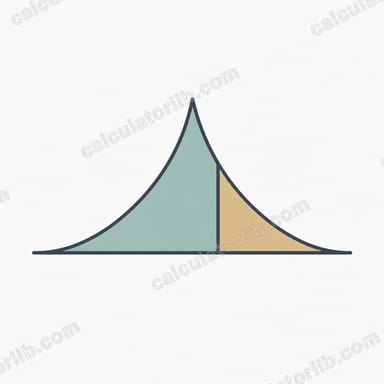
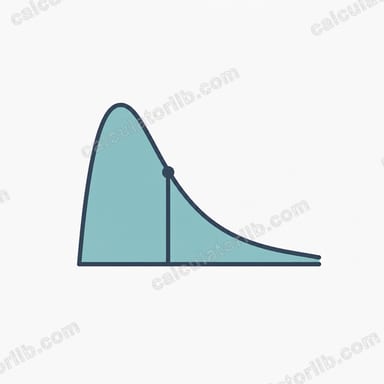
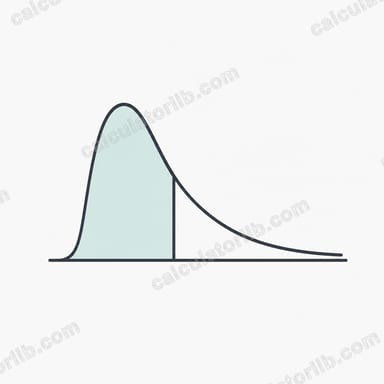
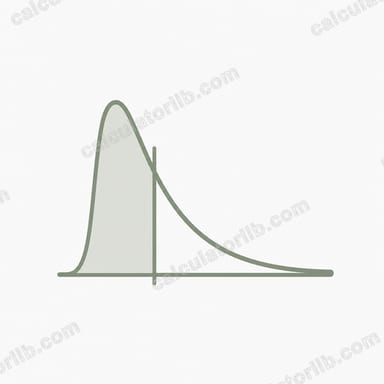
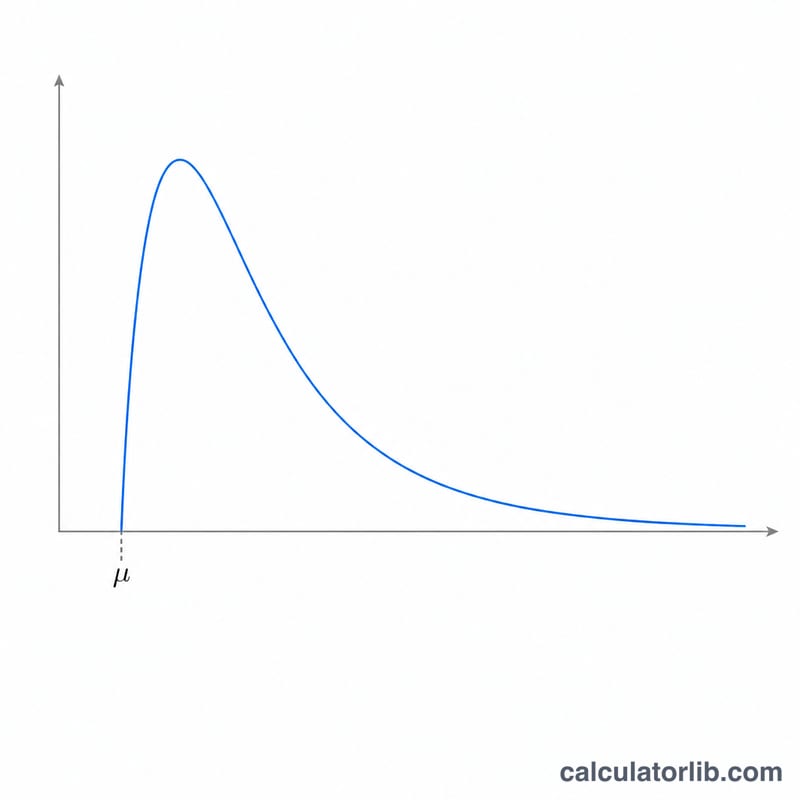
The Levy distribution is a continuous, heavy-tailed probability distribution defined for values greater than its location parameter mu. It is described by two parameters: the location mu (any real number) and the scale c (which must be positive). This calculator solves the inverse problem: given a probability, it returns the percentile (quantile) x — the value of the random variable at which the cumulative distribution function equals that probability.
How to use it
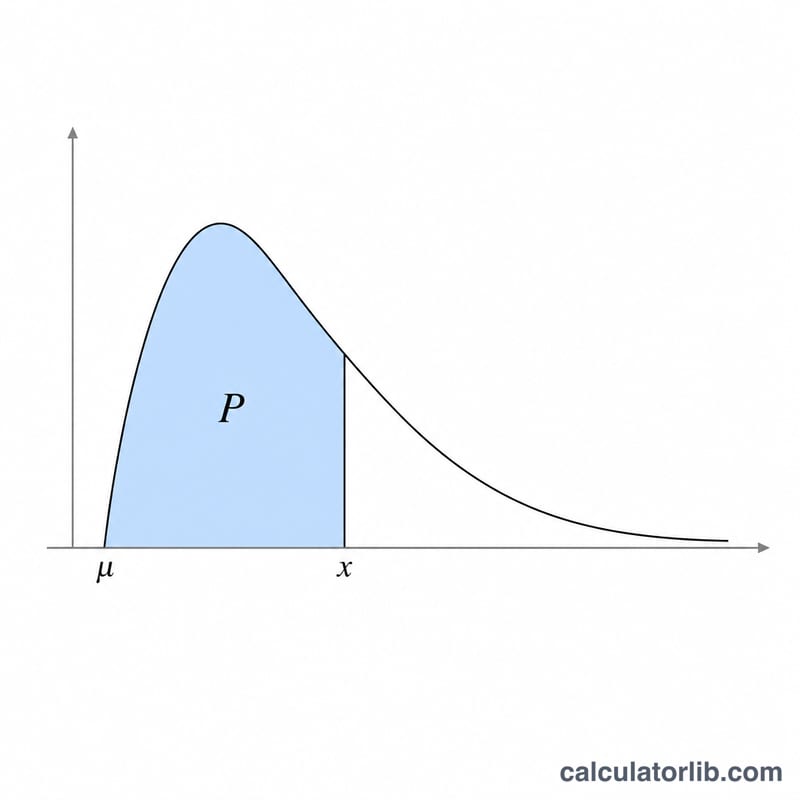
Enter a probability strictly between 0 and 1. Choose whether that probability is a lower cumulative probability P(x) or an upper cumulative probability Q(x) = 1 - P(x). Then enter the location parameter mu and the scale parameter c (c must be greater than 0). The calculator returns x. If you choose the upper option, the tool first converts to the lower probability with P = 1 - Q.
The formula explained
The Levy cumulative distribution function is \( P(x) = \operatorname{erfc}\left( \sqrt{ \frac{c}{2(x - \mu)} } \right) \), where erfc is the complementary error function. Inverting it gives $$ x = \mu + \frac{c}{2\left[\operatorname{erfc}^{-1}(P)\right]^{2}} $$ The calculator evaluates the inverse error function with a high-accuracy rational approximation refined by Newton iteration, so no external library is needed.
Worked example
For probability = 0.5 (lower), mu = 0, c = 1: \( \operatorname{erfc}^{-1}(0.5) = \operatorname{inverseErf}(0.5) \approx 0.476936 \). Squaring gives \( \approx 0.227468 \), so $$ x = 0 + \frac{1}{2 \times 0.227468} \approx 2.1981 $$ This is the median of the standard Levy distribution.
FAQ
Why must the probability be strictly between 0 and 1? At p approaching 0 the percentile diverges to infinity, and at p approaching 1 it collapses to mu, so endpoints are excluded.
What does the upper option mean? It treats your value as the right-tail probability Q(x); the calculator uses P = 1 - Q internally. This is handy for tail-risk style questions.
Why are large percentiles so big? The Levy distribution has a very heavy right tail (its mean is infinite), so even a 90th lower percentile can be many times the median.