
What is the Laplace Distribution Percentile Calculator?
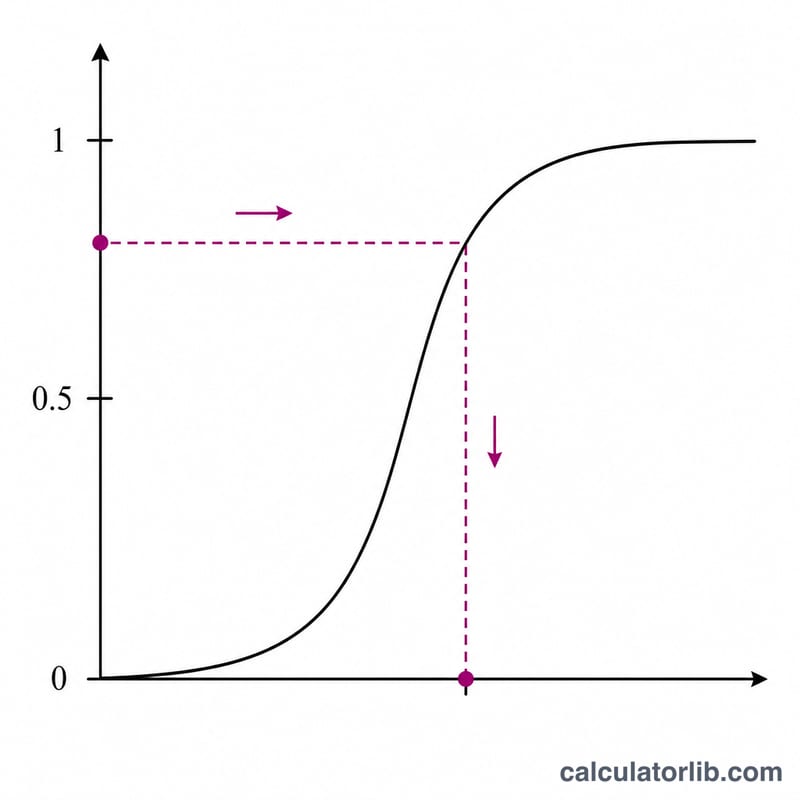
This tool computes the percentile, or quantile, of a Laplace distribution (also called the double-exponential distribution). Given a cumulative probability, it returns the value x at which that probability is reached. It is a universal mathematical tool and works identically everywhere, with no country-specific assumptions.
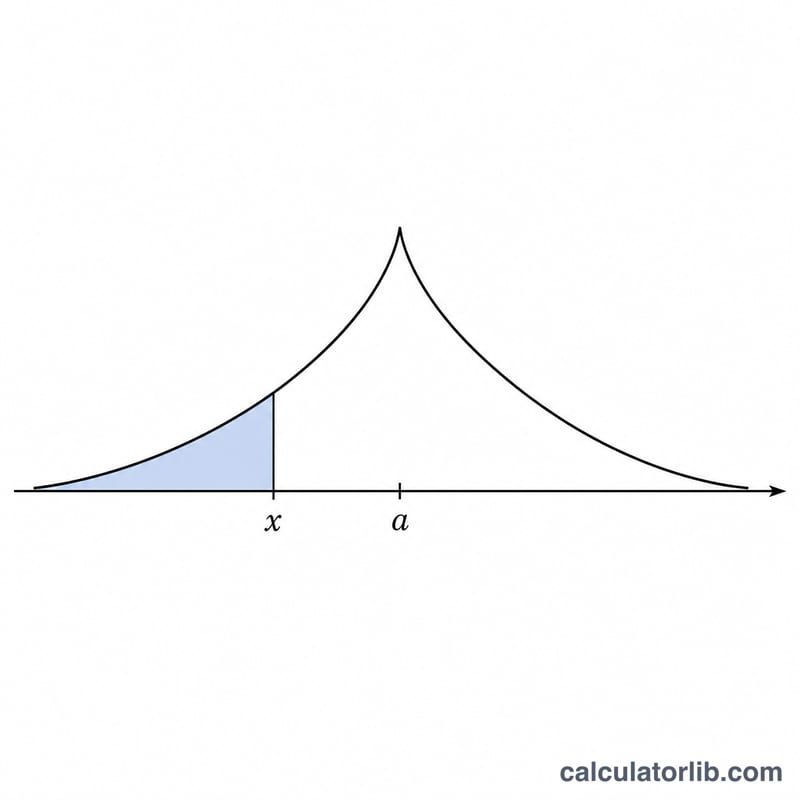
The Laplace distribution has location parameter \(a\) (its mean and median) and scale parameter \(b\) (\(b > 0\)). Its probability density is $$f(x) = \frac{1}{2b}\cdot\exp\!\left(-\frac{|x-a|}{b}\right),$$ giving a sharp peak at \(a\) and symmetric exponential tails. Variance equals \(2b^2\).
How to use it
Enter the location parameter \(a\), the scale parameter \(b\) (must be positive), choose whether your probability is a lower cumulative probability \(P = \Pr(X \le x)\) or an upper cumulative probability \(Q = \Pr(X > x)\), and enter that probability strictly between 0 and 1. The calculator returns the quantile \(x\).
The formula explained
The Laplace CDF is \(P(x) = 0.5\cdot\exp\!\left(\frac{x-a}{b}\right)\) for \(x < a\), and \(P(x) = 1 - 0.5\cdot\exp\!\left(-\frac{x-a}{b}\right)\) for \(x \ge a\). Inverting it gives the quantile function: $$x = \begin{cases} a + b \ln\!\left(2P\right), & P \le 0.5 \\[1em] a - b \ln\!\left(2(1-P)\right), & P > 0.5 \end{cases}$$ When you supply an upper probability \(Q\), the tool first sets \(P = 1 - Q\), then applies the same inversion. Note that \(P = 0.5\) always returns \(x = a\), since the median equals the location parameter.
Worked example
Let \(a = 0\), \(b = 1\), lower probability \(P = 0.75\). Since \(P > 0.5\), $$x = 0 - 1\cdot\ln(2\cdot0.25) = -\ln(0.5) = \ln(2) \approx 0.6931471806.$$ So 75% of the probability mass lies at or below \(x \approx 0.693\).
FAQ
Why must \(0 < p < 1\)? As \(p\) approaches 0 the quantile diverges to negative infinity, and as \(p\) approaches 1 it diverges to positive infinity, so only strictly interior probabilities give a finite answer.
What if I have an upper-tail probability? Choose "Upper cumulative probability Q"; the tool converts it via \(P = 1 - Q\) automatically.
Why does the scale have to be positive? The scale \(b\) controls spread and appears in a division inside the standardization, so \(b \le 0\) would be degenerate and is rejected.