

What this calculator does
This tool tells a restaurant or food-service operator how many times each seat must turn over (be occupied by a new paying customer) on an average business day to reach a target level of monthly sales. It is a simple, currency-independent management ratio used for planning and break-even analysis. The math works with any currency.
How to use it
Enter four numbers: your monthly sales target, the average spend per customer (the average amount one guest pays, often called the average check or "kyaku-tanka"), the number of business days you operate in the month, and your number of seats. The calculator returns the required daily seat turnover and the equivalent total customers you need each day.
The formula explained
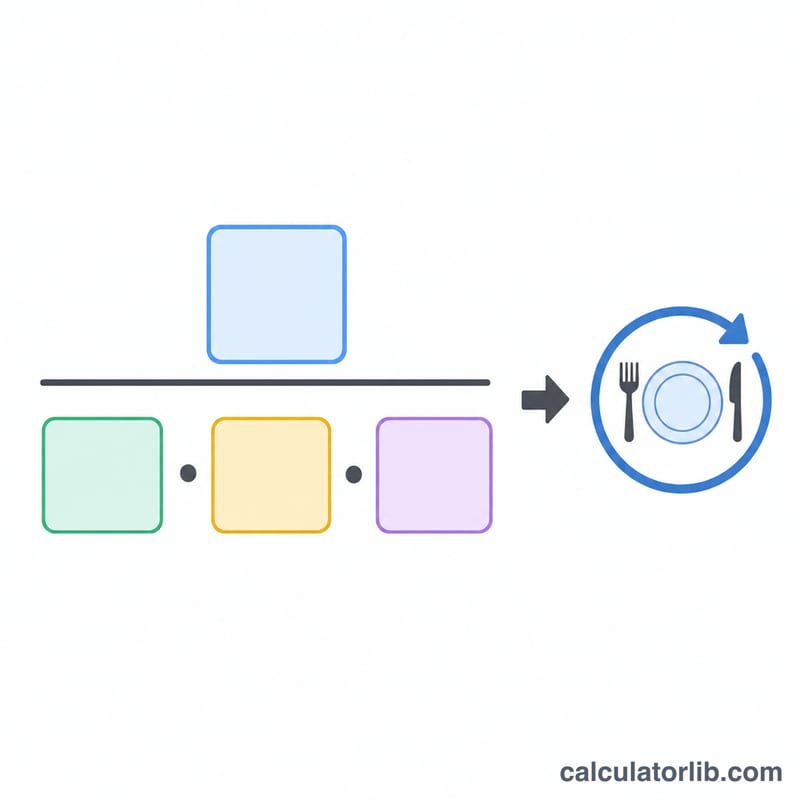
Monthly sales equal the average spend per customer multiplied by the number of customers per day multiplied by business days. Customers per day equal seats multiplied by turnover. Rearranging gives:
$$\text{dailyTurnover} = \frac{\text{monthlySalesTarget}}{\text{averageSpendPerCustomer} \times \text{seats} \times \text{businessDaysPerMonth}}$$
The result is usually a fractional number; it is an average, so values like \(2.67\) are normal and expected.
Worked example
Suppose the monthly target is 3,000,000, the average spend per customer is 1,500, you trade 25 business days, and you have 30 seats. The denominator is $$1{,}500 \times 30 \times 25 = 1{,}125{,}000.$$ Dividing gives $$\frac{3{,}000{,}000}{1{,}125{,}000} = 2.67$$ turns per seat per day. That means each of the 30 seats must be filled about 2.67 times every business day, or roughly 80 customers per day.
FAQ
Can the turnover be more than 1? Yes. A turnover above 1 simply means each seat serves more than one customer per day, which is common in busy venues.
What if the result is very high? A required turnover above about 5 or 6 may signal that the target is unrealistic for your seat count, or that you need higher average spend, more seats, or more business days.
Does currency matter? No. As long as the target and the average spend use the same currency, the turnover ratio is the same.