
What Is the Diagonal of a Square?
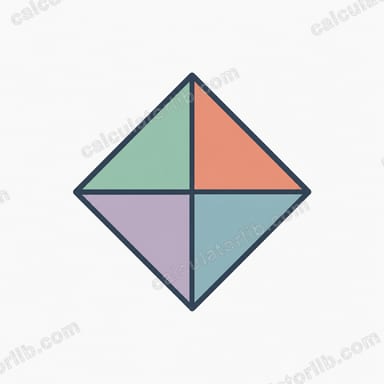
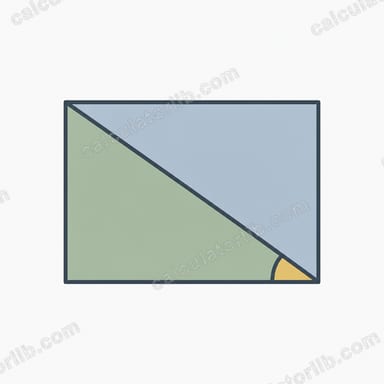
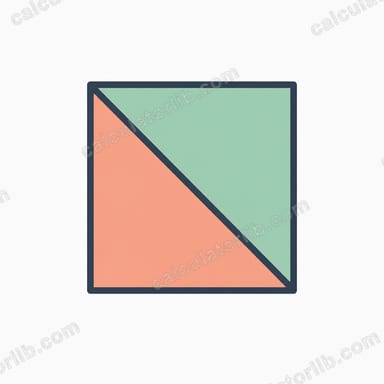
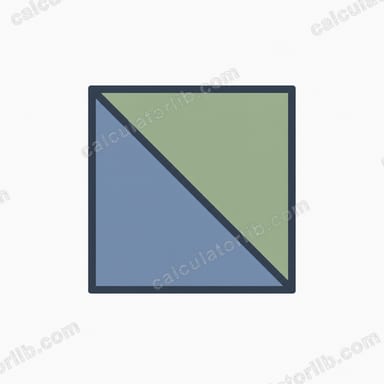
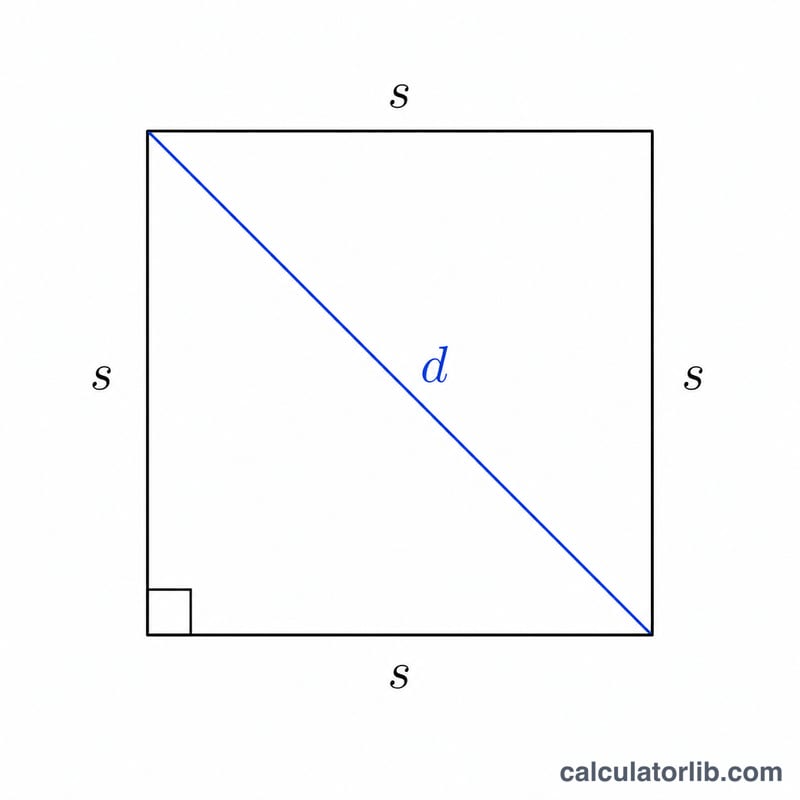
The diagonal of a square is the straight line connecting two opposite corners. Because a square's four sides are equal and meet at right angles, the diagonal acts as the hypotenuse of a right triangle whose two legs are the sides. This makes the diagonal predictable and easy to compute from a single measurement.
How to Use This Calculator
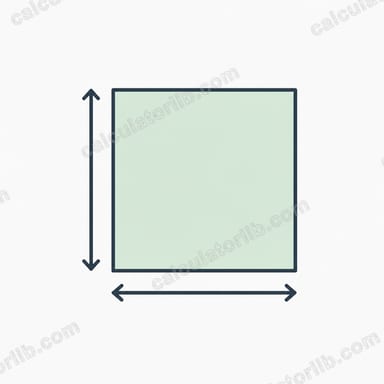
Enter the side length (s) of your square in any unit — centimeters, inches, meters, etc. The calculator instantly returns the diagonal, along with the perimeter and area for convenience. The result is expressed in the same unit you entered (the area uses squared units).
The Formula Explained
By the Pythagorean theorem, the diagonal \(d\) satisfies \(d^2 = s^2 + s^2 = 2s^2\). Taking the square root gives \(d = s\sqrt{2}\), where \(\sqrt{2} \approx 1.41421356\). So the diagonal is always about 41.4% longer than the side. The perimeter is \(P = 4s\) and the area is \(A = s^2\).
$$d = \text{Side (s)} \times \sqrt{2}$$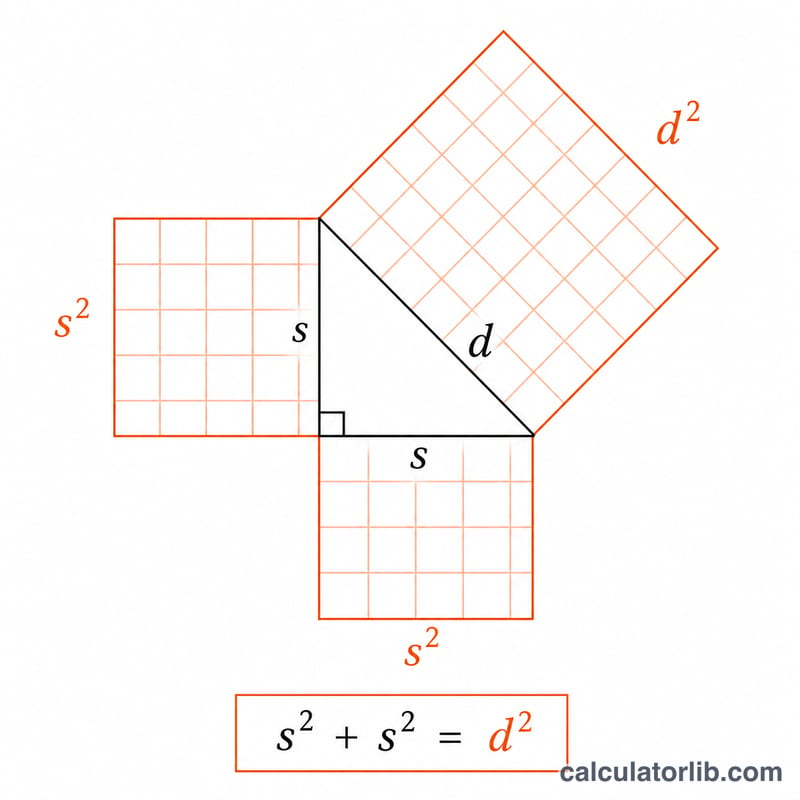
Worked Example
Suppose a square tile has a side of 10 cm. The diagonal is
$$d = 10 \times \sqrt{2} = 10 \times 1.41421 \approx 14.14 \text{ cm}$$Its perimeter is \(4 \times 10 = 40\) cm and its area is \(10^2 = 100\) cm². Knowing the diagonal helps when checking if a square object fits through an opening or onto a shelf.
FAQ
How do I find the side from the diagonal? Rearrange the formula: \(s = d \div \sqrt{2}\), or equivalently \(s = d \times (\sqrt{2} \div 2)\).
Why is the diagonal longer than the side? The diagonal spans two corners across the square, forming the hypotenuse of a right triangle, which is always the longest side.
Does this work for any unit? Yes. The formula is unit-independent, so as long as you keep the same unit, the diagonal comes out in that unit and the area in its square.