
What Is a Factor Pair?
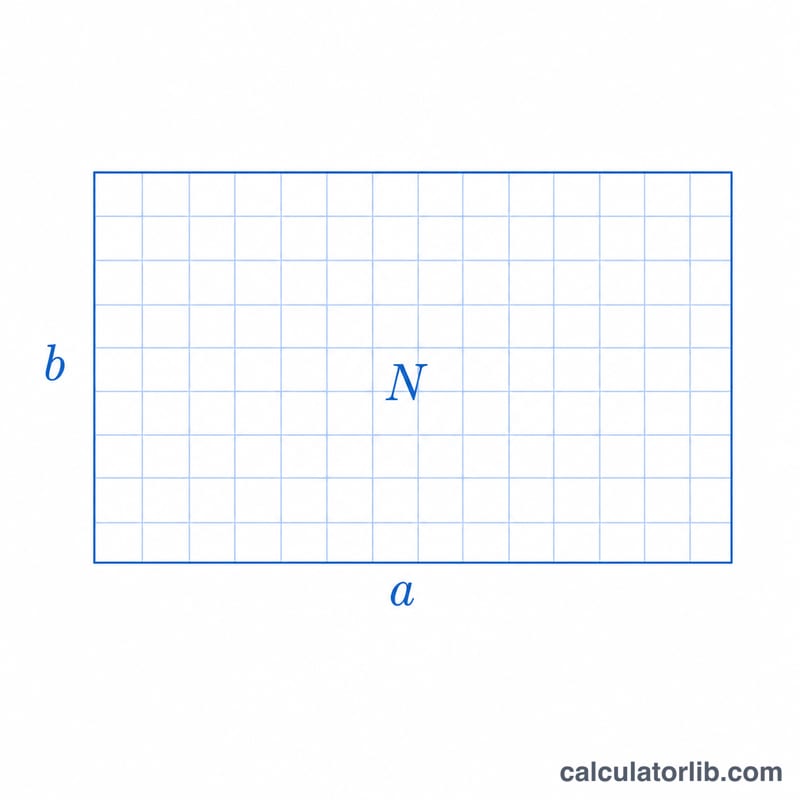
A factor pair of a number N is a set of two whole numbers that multiply together to give N. For example, the factor pairs of 12 are \((1 \times 12)\), \((2 \times 6)\) and \((3 \times 4)\). Every positive integer has at least one factor pair, \((1 \times N)\), and finding all of them reveals the complete divisor structure of the number — useful for simplifying fractions, factoring algebraic expressions, and understanding prime versus composite numbers.
How to Use This Calculator
Enter any positive whole number in the Number (N) box and submit. The calculator returns every unique factor pair, the total count of pairs, and the total number of divisors. A prime number returns exactly one pair, \((1 \times N)\); a perfect square returns a pair where both factors are equal, such as \((6 \times 6)\) for 36.
The Formula Explained
We look for every pair \((a, b)\) where $$a \times b = N$$ Instead of checking all numbers up to N, we only test candidates from 1 up to the square root of N. Whenever a divides N evenly, its partner \(b = N/a\) is automatically a divisor too, so we capture the pair in one step. This is why the search runs in \(O(\sqrt{N})\) time and stays fast even for large numbers.
$$\{(a,\,b)\ :\ a \times b = \text{N},\ \ 1 \le a \le \sqrt{\text{N}}\}$$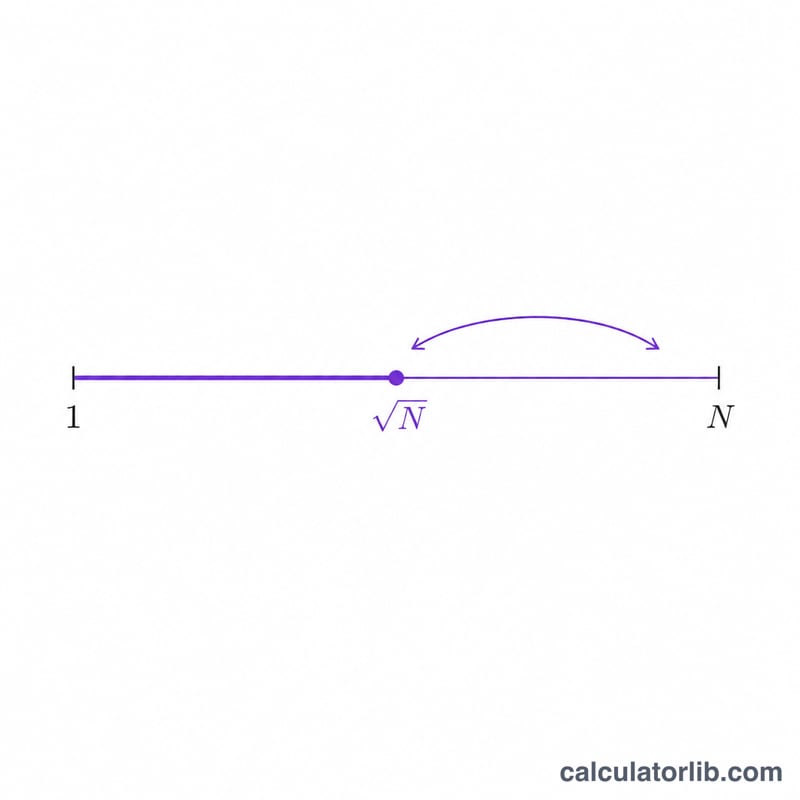
Worked Example
For \(N = 36\), the square root is 6. Testing \(a = 1, 2, 3, 4, 6\) (the divisors up to 6): $$36 \div 1 = 36,\quad 36 \div 2 = 18,\quad 36 \div 3 = 12,\quad 36 \div 4 = 9,\quad 36 \div 6 = 6$$ That gives pairs \((1 \times 36)\), \((2 \times 18)\), \((3 \times 12)\), \((4 \times 9)\) and \((6 \times 6)\) — 5 factor pairs and 9 total divisors.
FAQ
What if I enter a prime number? You will get just one factor pair, \((1 \times N)\), confirming the number is prime.
Why is a perfect square's pair count different? A perfect square has a pair like \((6 \times 6)\) where both factors are identical, so it counts as one pair but the divisor 6 is only counted once in the divisor total.
Does this include negative factors? No — this calculator lists positive factor pairs only, which is the standard convention.