What this tool does
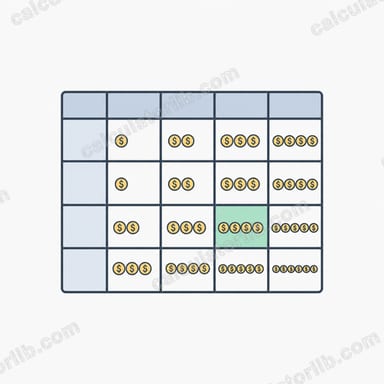
The Loan Payment Table Generator builds a grid of fixed monthly payments for a fully-amortizing loan. Instead of computing one payment at a time, it varies two quantities across the rows and columns of a table while holding a third constant, so you can compare many loan-amount and term scenarios at a glance. It works for any installment loan with end-of-period payments, such as a car loan, personal loan or mortgage. Amounts are treated as plain US dollars and the rate as an annual percentage.
How to use it
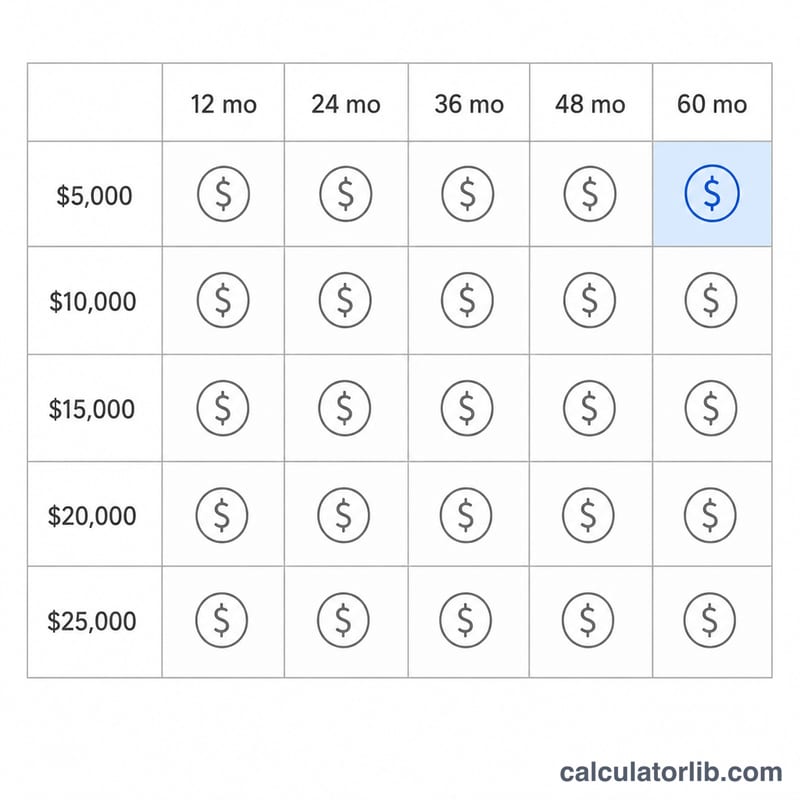
Pick an axis layout: "Months and Loan" (default) holds the annual rate constant and varies loan amount down the rows and term across the columns; "Rate and Loan" holds the term constant; "Rate and Months" holds the loan amount constant. Enter the constant rate, the starting value and increment for each axis, and how many rows and columns to generate. The first column starts at "Starting Month" and adds "Increments (months)" each step; the first row starts at "Starting Amount" and adds "Increments ($)" each step.
The formula explained
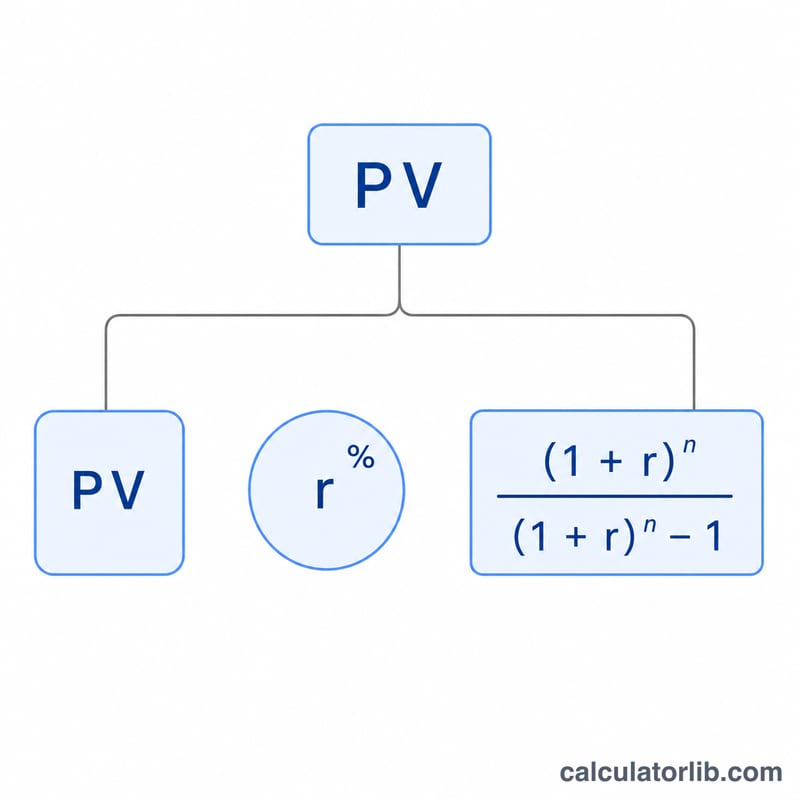
Each cell uses the standard amortization formula $$\text{PMT} = PV \times r \times \dfrac{(1+r)^n}{(1+r)^n - 1}$$ where \(r\) is the monthly rate equal to the annual percent divided by 100 and then by 12, and \(n\) is the number of monthly payments. If the rate is zero the formula would divide by zero, so the tool falls back to $$\text{PMT} = \dfrac{PV}{n}$$
Worked example
Take a $15,000 loan at 3.125% annual rate over 24 months. The monthly rate is \(3.125 / 100 / 12 = 0.00260417\). Then \((1+r)^{24} = 1.064466\), so $$\text{PMT} = 15000 \times 0.00260417 \times \frac{1.064466}{0.064466} = \$645.55$$ per month, the top-left cell of the default table.
Central bank policy rates today
The latest official policy rates of major central banks, updated automatically — the benchmark that bank deposit and loan rates follow.
- Federal Reserve · United States
- 3.75–4.00%
- As of
- 2026-11-12
- Change in 1 year
- 0 pp
Latest change Up +25 bp Federal Reserve changed its rate on 2026-09-17: from 3.50–3.75% to 3.75–4.00%.
| Central bank | Policy rate | As of | Change in 1 year |
|---|---|---|---|
| Banco Central do Brasil (Selic) · Brazil | 13.75% | 2026-11-16 | −1.25 pp |
| Banco de México · Mexico | 6.25% | 2026-11-10 | −1.00 pp |
| Federal Reserve · United States | 3.75–4.00% | 2026-11-12 | 0 pp |
| ECB | 2.50% | 2026-11-16 | +0.50 pp |
| Sveriges Riksbank · Sweden | 2.00% | 2026-11-16 | +0.25 pp |
| Saudi Central Bank (SAMA) · Saudi Arabia | 4.50% | 2026-10-29 | 0 pp |
| Reserve Bank of Australia · Australia | 4.60% | 2026-10-31 | +1.00 pp |
| Central Bank of the Republic of Türkiye · Türkiye | 36.00% | 2026-11-06 | −3.50 pp |
| Bank of Russia · Russia | 14.00% | 2026-11-10 | −2.50 pp |
| People’s Bank of China · China | 3.00% | 2026-11-10 | 0 pp |
| Bank of Canada · Canada | 2.50% | 2026-11-13 | +0.25 pp |
| Reserve Bank of India · India | 5.50% | 2026-10-19 | 0 pp |
| Bank of England · United Kingdom | 4.00% | 2026-11-16 | 0 pp |
| Bank of Japan · Japan | 1.25% | 2026-11-10 | +0.75 pp |
| Bank of Korea · South Korea | 3.00% | 2026-11-02 | +0.50 pp |
Federal Reserve: key rates and overnight market rates
The rates that frame monetary policy and the overnight market rate they steer, each with the date of its latest published value.
| Rate | Level | As of | Change in 1 year |
|---|---|---|---|
| Federal funds target range | 3.75–4.00% | 2026-11-13 | 0 pp |
| Effective federal funds rate (EFFR) | 3.88% | 2026-11-13 | 0 pp |
| Secured Overnight Financing Rate (SOFR) | 3.90% | 2026-11-13 | −0.10 pp |
Each rate keeps the date of its own latest published value; overnight market rates are published on the next business day.
Latest figure: 2026-11-12 Data last updated 2026-11-16 · current
Source: Banco Central do Brasil ODbL; Bank for International Settlements (BIS) Terms of permitted use of BIS statistics; Federal Reserve Bank of New York New York Fed Terms of Use; Board of Governors of the Federal Reserve System Public domain (U.S. government work); European Central Bank ECB reuse policy; Sveriges Riksbank Riksbank open data terms; The World Bank Group CC BY 4.0; Reserve Bank of Australia 2026 RBA copyright terms (Cash Rate); Bank of Canada Bank of Canada terms of use; Bank of England Open Government Licence v3.0
The one-year change is computed by CalculatorLib from these data. The EFFR and SOFR are subject to the Terms of Use posted at newyorkfed.org. The New York Fed is not responsible for publication of the EFFR and SOFR by CalculatorLib, does not sanction or endorse any particular republication, and has no liability for your use.
Source details and methodology
- Banco Central do Brasil
- Bank for International Settlements (BIS) — Central bank policy rates
- Federal Reserve Bank of New York — Reference rates (EFFR, SOFR)
- Board of Governors of the Federal Reserve System
- European Central Bank
- Sveriges Riksbank
- The World Bank Group — World Development Indicators (FR.INR.LEND, FR.INR.RINR)
- Reserve Bank of Australia 2026
- Bank of Canada
- Bank of England
FAQ
Does this include taxes, fees or insurance? No. It computes the pure principal-and-interest payment only.
What if I set the rate to 0%? The payment becomes the loan amount divided by the number of months (a straight-line repayment).
How is total interest found? Multiply any cell's payment by its number of months and subtract the loan amount: \(\text{total interest} = \text{PMT} \times n - PV\).