
What this calculator does
This tool converts an effective interest rate per period into the corresponding nominal (stated) rate based on how often interest is compounded. It also reports the total effective rate compounded over several periods and the rate charged in each compounding interval. The math is universal finance arithmetic and applies identically anywhere; a "period" is any consistent time unit, most commonly one year.
How to use it
Enter the Effective Rate (I) as a percent (for example 3.2989 for an annual effective yield), the number of Compounding (m) intervals per period (12 for monthly, 4 for quarterly, or the word "Continuous" for continuous compounding), and the Number of Periods (t) over which you want a cumulative total. The calculator returns the nominal rate per period, the effective rate accumulated over t periods, and the per-interval rate.
The formula explained
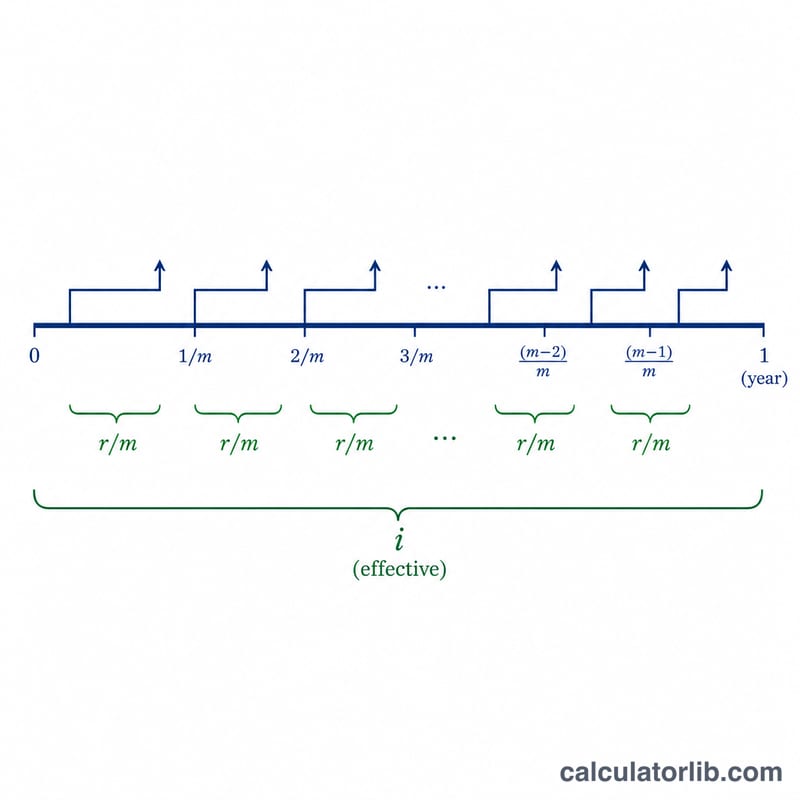
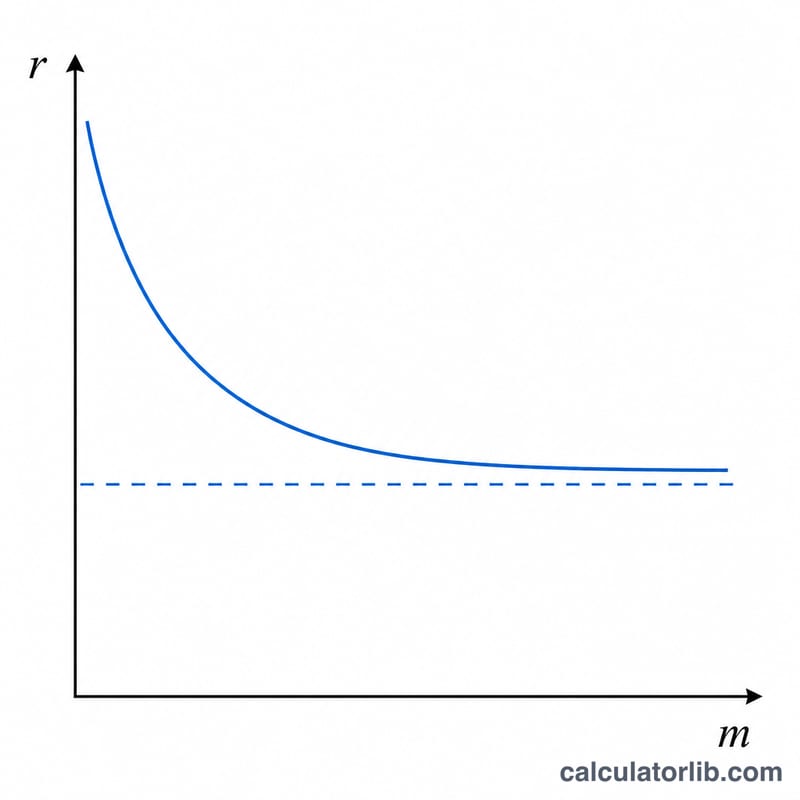
Let i be the effective rate as a decimal (\(i = I / 100\)). The nominal rate per period for finite compounding is $$r = m \left( (1 + i)^{1/m} - 1 \right)$$ As m grows without bound this approaches continuous compounding, where $$r = \ln(1 + i)$$ The total effective rate over t periods is $$i_t = (1 + i)^t - 1$$ and the rate per compounding interval is simply \(p = r / m\). All results are shown as percentages.
Worked example
With I = 3.2989%, m = 12, and t = 5: \(i = 0.032989\). The nominal rate is $$r = 12 \left( (1.032989)^{1/12} - 1 \right) \approx 3.250047\%$$ Over 5 periods the effective total is $$i_t = (1.032989)^5 - 1 \approx 17.619271\%$$ The monthly rate is \(p = r / 12 \approx 0.270837\%\).
FAQ
What is the difference between nominal and effective rate? The effective rate reflects the true yield after compounding, while the nominal rate is the stated annual rate before compounding is applied. They are equal only when \(m = 1\).
How do I enter continuous compounding? Type "Continuous" or "c" in the Compounding field; the nominal rate then equals \(\ln(1 + i)\) and the per-interval rate is not shown.
Why does the per-interval rate disappear for continuous compounding? With infinitely many intervals, each interval has an infinitesimal rate, so a single per-interval percentage is not meaningful.