
What this money counter does
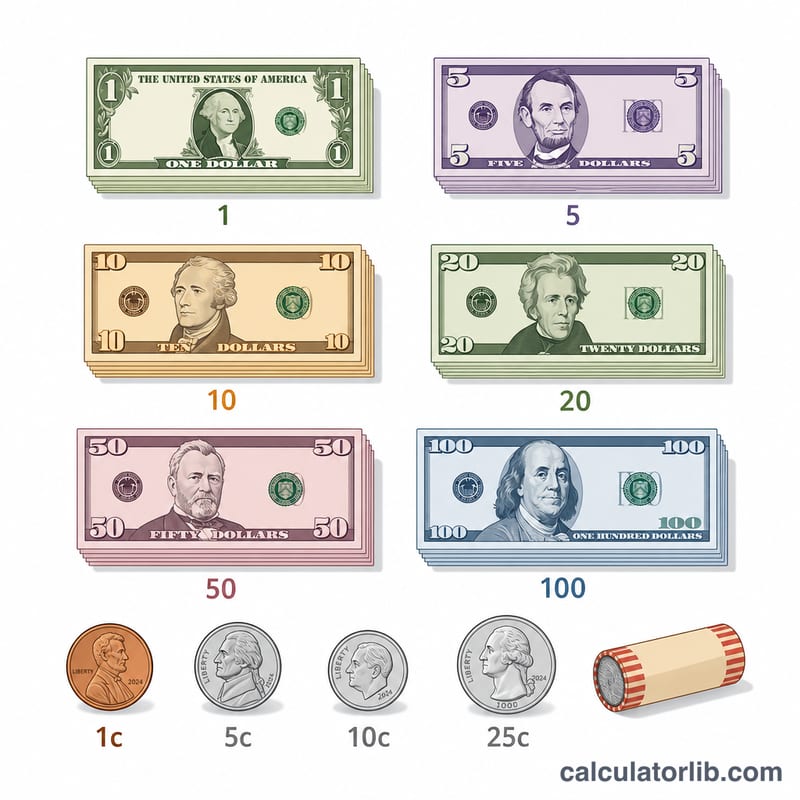
This calculator adds up the cash you have on hand. Enter how many of each bill (banknote), loose coin and rolled coin you hold, and it returns the total monetary value plus a piece count. It works like a cash-drawer, till, or piggy-bank counter. The page defaults to US Dollar (USD) denominations, but the underlying math is universal: the total is simply the sum of every denomination's count multiplied by its face value.
How to use it
Pick your currency, then tick the sections you want to count: Banknotes, Coins and/or Rolled Coins. Type how many of each denomination you have. Blank fields count as zero, and counts are non-negative whole pieces. Sections you leave unticked are excluded from the grand total even if you typed values, so you can quickly isolate just your bills or just your coins.
The formula explained
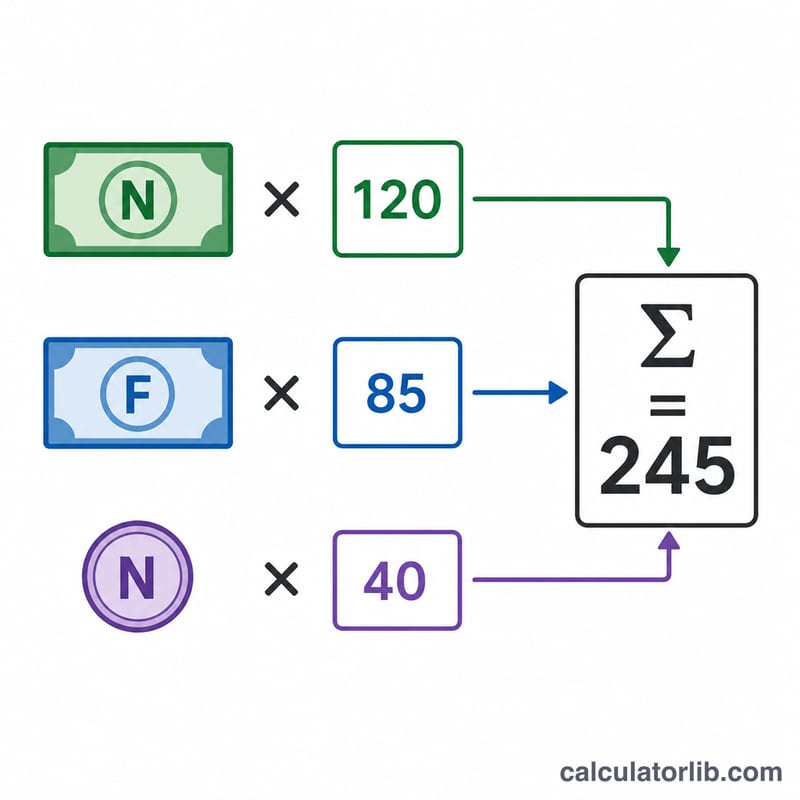
For every denomination row i with face value Fi and entered count Ni, the row value is \(N_i \times F_i\). Loose coins use the coin's value directly (25¢ = 0.25). Rolled coins multiply the number of rolls by the coins per roll and the coin face value, because a standard US roll holds a fixed number of coins (for example a quarter roll is 40 coins = $10.00). The grand total adds up only the sections whose toggle is on.
$$\text{Total} = \sum_i (N_i \times F_i)$$
$$\text{RollValue}_k = R_k \times C_k \times F_k$$
Worked example
Suppose you have three $20 bills, two $5 bills and four $1 bills; six quarters and three dimes; plus two rolled quarters and one rolled penny.
Banknotes: $$3\times20 + 2\times5 + 4\times1 = \$74.00.$$ Coins: $$6\times0.25 + 3\times0.10 = \$1.80.$$ Rolled: $$2\times\$10.00 + 1\times\$0.50 = \$20.50.$$ Grand total = $96.30 across 21 pieces.
FAQ
Are exchange rates used? No. Everything stays within the single currency you select; no conversion is applied.
What if I leave a box blank? Blank is treated as zero, so you only need to fill in the denominations you actually have.
How are rolled coins valued? Each roll is multiplied by the standard number of coins it holds and the coin's value, so one roll of dimes is \(50 \times \$0.10 = \$5.00\).