
What this calculator does
This tool answers a common pricing question: given what a product costs you and the gross margin you want to earn, what selling price should you set? Enter the cost and your target gross margin percentage, and it returns the required selling price (revenue), the gross profit in currency, and the equivalent mark-up percentage on cost. It is pure arithmetic and works in any currency — the currency symbol is cosmetic and does not affect the math.
How to use it
Enter your unit Cost (C) and your desired Gross Margin (G) as a percentage (for example 75 for 75%). The margin must be greater than 0 and strictly less than 100; a margin of 100% would require an infinite price because cost would be a zero fraction of revenue. The result updates with the selling price, the gross profit, and the mark-up.
The formula explained
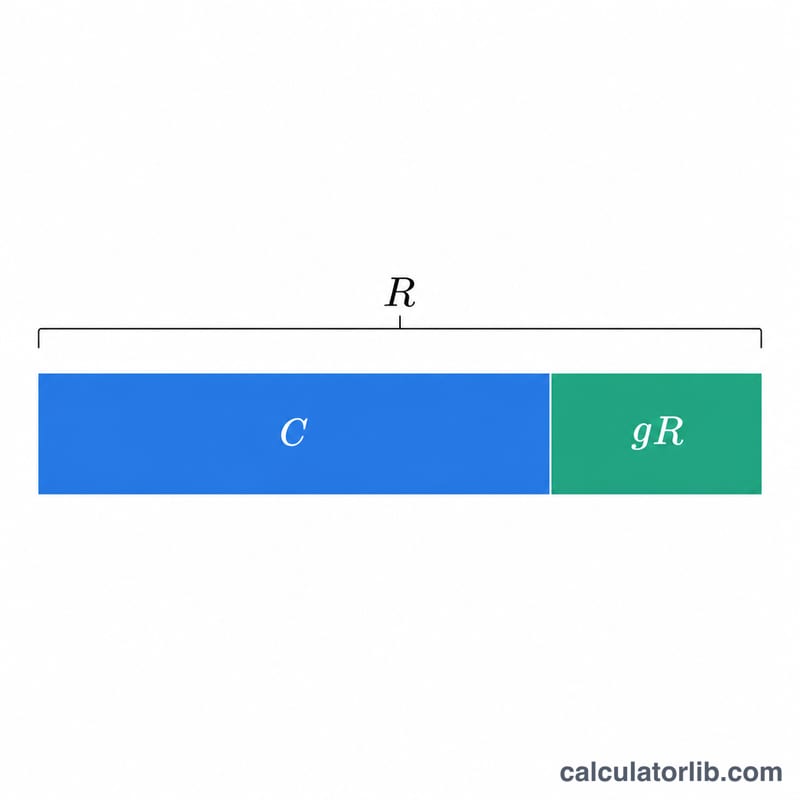
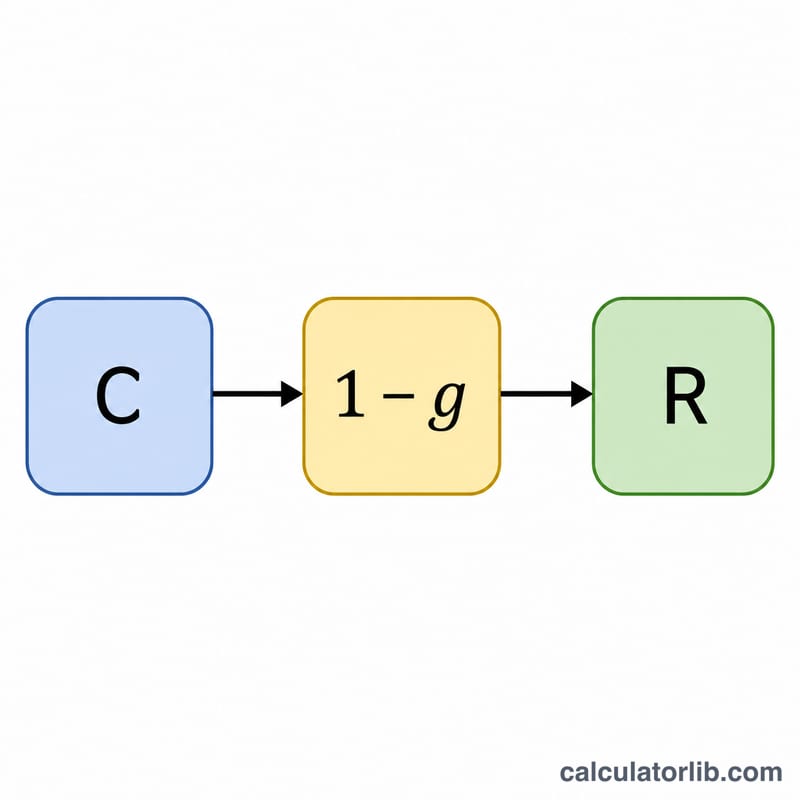
Gross margin is profit as a fraction of revenue, so revenue minus cost equals margin times revenue. Solving for revenue gives $$R = \frac{C}{1 - g}$$ where \(g\) is the margin written as a decimal (\(g = G / 100\)). Gross profit is then \(P = R \times g\), which also equals \(R - C\). Mark-up measures profit against cost instead of revenue: \(M = (P / C) \times 100\). Note that margin and mark-up are not the same number — a 75% margin equals a 300% mark-up.
Worked example
Suppose cost \(C = 125\) and you want a gross margin of 75% (\(g = 0.75\)). Revenue $$R = \frac{125}{1 - 0.75} = \frac{125}{0.25} = 500$$ Gross profit \(P = 500 \times 0.75 = 375\) (equal to \(500 - 125\)). Mark-up \(M = (375 / 125) \times 100 = 300\%\). So you would price the item at 500 to earn 375 profit per unit.
FAQ
Is gross margin the same as mark-up? No. Margin is profit divided by selling price; mark-up is profit divided by cost. The same item can show 75% margin and 300% mark-up.
Why must margin be under 100%? At exactly 100% the denominator \((1 - g)\) becomes zero and the price is undefined; margins at or above 100% are not achievable.
Does the currency matter? No. The calculation is currency-neutral, so it works identically for dollars, euros, yen or any other currency.