
What is the Money Calculator?
This tool applies to United States currency (USD). It counts how much cash you have by adding up bills and coins. Enter how many you have of each denomination — from $100 bills down to pennies — and it instantly returns the total dollar value, a subtotal for each denomination, the total in bills, the total in coins, and the total number of pieces. It is perfect for cashing out a register, counting a piggy bank, balancing a till, or tallying tip money.
How to use it
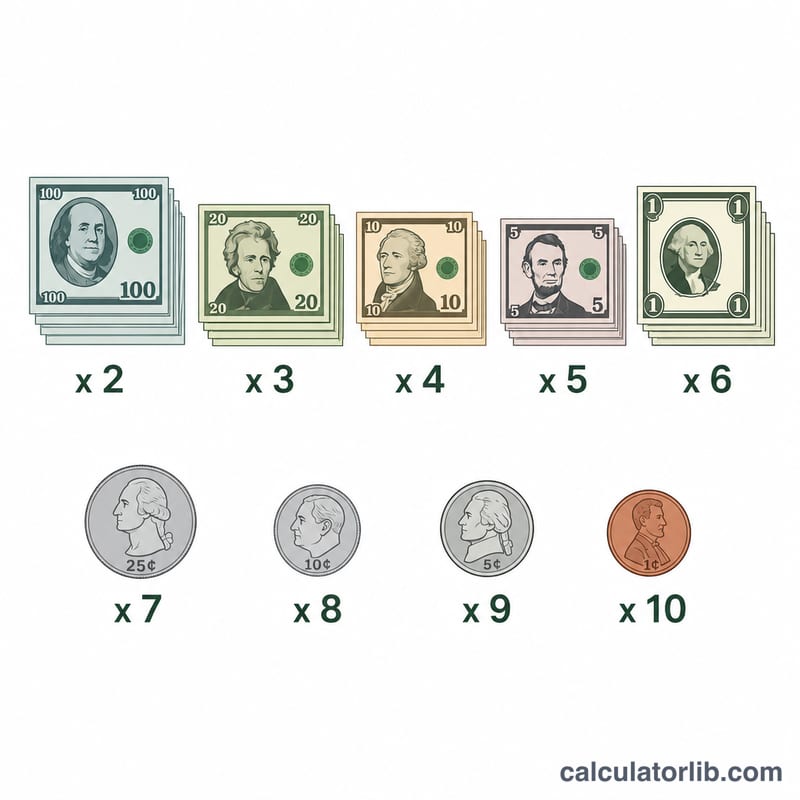
For each row, type the number of bills or coins you have. Leave any denomination you do not have blank or at zero. Counts must be whole numbers of zero or more; negative or fractional entries are clamped to a valid whole number. Press calculate and read the green hero box for your grand total, then scroll the table for the breakdown.
The formula explained
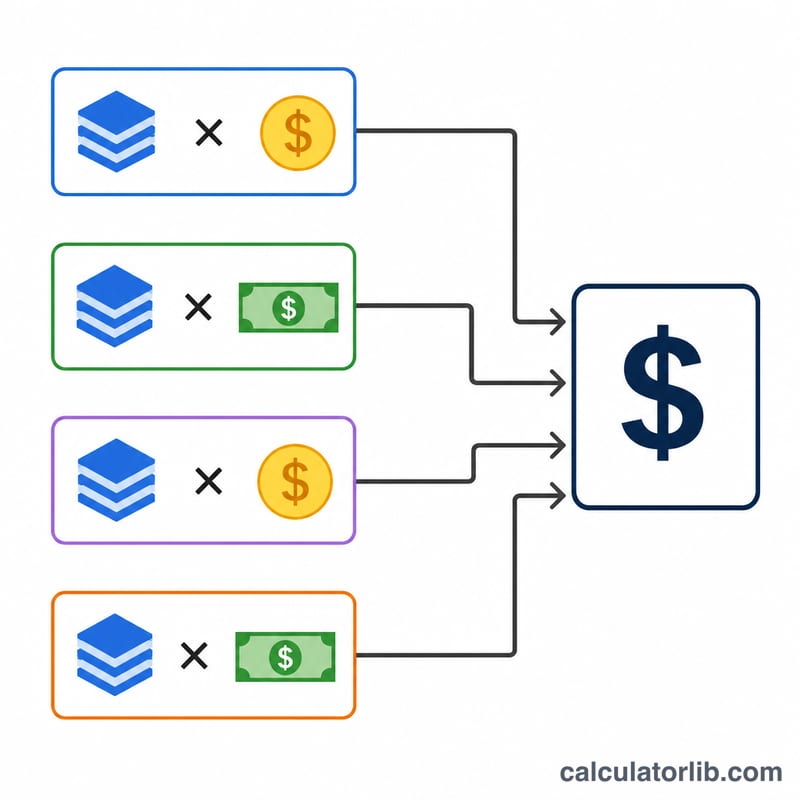
For each denomination i with face value \(f_i\) and count \(n_i\), the subtotal is \(n_i \times f_i\). The grand total is the sum of every subtotal.
$$\text{subtotal}_i = n_i \times f_i$$$$\text{Total} = \sum_{i} n_i \times f_i$$To avoid floating-point rounding errors (for example 0.1 + 0.2 not equaling exactly 0.30), the calculator works in integer cents: each face value is expressed in cents, all products are summed as whole numbers, and the result is divided by 100 only at the very end. This guarantees an exact, penny-accurate total.
Worked example
Suppose you have three $100 bills, two $20 bills, four $5 bills, six quarters, three dimes, and seven pennies. Bills: \(100 \times 3 = 300.00\), \(20 \times 2 = 40.00\), \(5 \times 4 = 20.00\), giving 360.00 in bills. Coins: \(0.25 \times 6 = 1.50\), \(0.10 \times 3 = 0.30\), \(0.01 \times 7 = 0.07\), giving 1.87 in coins. The grand total is
$$360.00 + 1.87 = \$361.87$$made up of 25 bills and coins.
FAQ
Which denominations are included? US bills of $100, $50, $20, $10, $5, $2, and $1, plus $1 coins, half dollars, quarters, dimes, nickels, and pennies.
What if I leave fields blank? Blank fields are treated as zero, so you only need to fill in the denominations you actually have.
Is the total exact? Yes. By summing in whole cents and converting to dollars only at the end, the calculator avoids floating-point rounding and always shows an exact amount with two decimal places.