What Is a Money Counter Calculator?
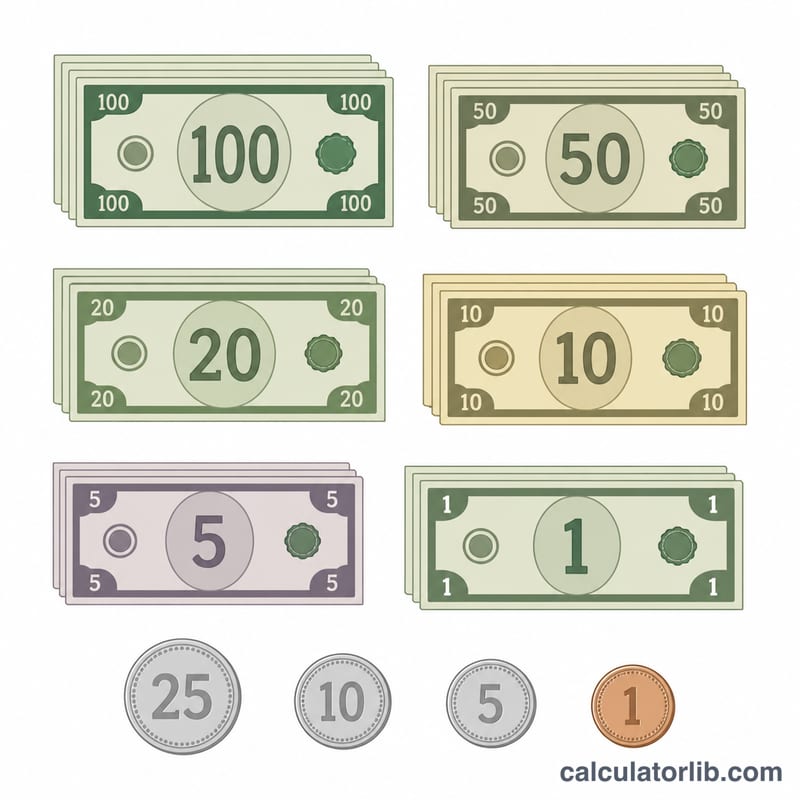
This Money Counter Calculator quickly totals a mix of bills and coins by multiplying each denomination by how many you have, then adding everything together. It uses US currency denominations ($100, $50, $20, $10, $5, $1 bills and quarter, dime, nickel, penny coins), making it perfect for cash drawers, tip jars, piggy banks, fundraisers, and end-of-shift register counts.
How to Use It
Enter the number of each bill and coin you are counting. Leave any field blank or at zero if you have none of that denomination. The calculator returns your grand total in dollars along with the total number of pieces counted, so you can reconcile both the value and the physical count.
The Formula Explained
The math is a weighted sum: \(\text{Total} = \sum (\text{denomination value} \times \text{count})\). Each count is multiplied by its face value, and the products are added. For example, three $20 bills contribute \(3 \times \$20 = \$60\). The same logic applies to coins using their decimal values ($0.25, $0.10, $0.05, $0.01).
$$\begin{gathered} \text{Total} = \text{Bills} + \text{Coins} \\[1.5em] \text{where}\quad \left\{ \begin{aligned} \text{Bills} &= 100\,\text{\$100} + 50\,\text{\$50} + 20\,\text{\$20} + 10\,\text{\$10} + 5\,\text{\$5} + \text{\$1} \\ \text{Coins} &= 0.25\,\text{Qtr} + 0.10\,\text{Dime} + 0.05\,\text{Nickel} + 0.01\,\text{Penny} \end{aligned} \right. \end{gathered}$$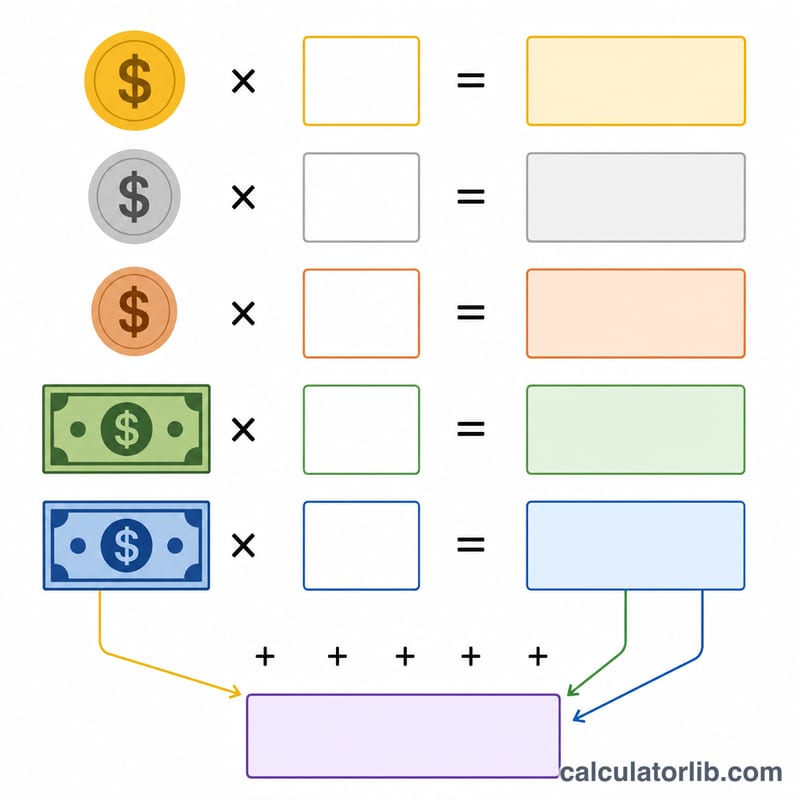
Worked Example
Suppose you have two $100 bills, one $20, four $1 bills, ten quarters, and five pennies. Bills:
$$(2 \times 100) + (1 \times 20) + (4 \times 1) = 200 + 20 + 4 = \$224.$$Coins:
$$(10 \times 0.25) + (5 \times 0.01) = 2.50 + 0.05 = \$2.55.$$Grand total = $226.55 across 22 pieces.
Cash Count Scenarios Compared
Four typical US-currency counts. Every subtotal below can be checked by hand from the stated counts, so you can use these as practice runs before trusting your own drawer count.
| Scenario | Bills entered | Coins entered | Bills subtotal | Coins subtotal | Grand total | Total pieces |
|---|---|---|---|---|---|---|
| Register starting float | 1×$20, 2×$10, 6×$5, 20×$1 | 40 quarters, 50 dimes, 40 nickels, 100 pennies | $90.00 | $18.00 | $108.00 | 259 |
| End-of-shift drawer | 2×$100, 3×$50, 12×$20, 8×$10, 10×$5, 35×$1 | 60 quarters, 45 dimes, 30 nickels, 80 pennies | $755.00 | $21.80 | $776.80 | 285 |
| Tip jar (mostly $1s and coins) | 1×$20, 2×$5, 47×$1 | 18 quarters, 12 dimes, 6 nickels, 23 pennies | $77.00 | $6.23 | $83.23 | 109 |
| Coin jar (coins only) | none | 143 quarters, 208 dimes, 96 nickels, 412 pennies | $0.00 | $65.47 | $65.47 | 859 |
Register starting float, step by step
Bills:
$$\text{Bills} = 20(1) + 10(2) + 5(6) + 1(20) = 20 + 20 + 30 + 20 = \$90.00$$Coins:
$$\text{Coins} = 0.25(40) + 0.10(50) + 0.05(40) + 0.01(100) = 10.00 + 5.00 + 2.00 + 1.00 = \$18.00$$Grand total and piece count:
$$\text{Total} = \$90.00 + \$18.00 = \$108.00, \qquad \text{Pieces} = 29 + 230 = 259$$Reading the comparison
- Value and piece count move independently. The tip jar holds only $83.23 across 109 pieces, while the coin jar holds $65.47 across 859 pieces — fewer dollars in eight times as many items. Piece count, not value, predicts how long a manual count takes.
- Coins decide whether a float works. The starting float is 83% bills by value ($90.00 of $108.00) but 89% coins by piece count (230 of 259), because the coins are there to make change, not to hold value.
- Check the shift difference, not just the totals. If the drawer started at $108.00 and ended at $776.80, the increase is \(\$776.80 - \$108.00 = \$668.80\), which should match recorded cash sales less cash refunds and paid-outs.
- Round coin counts to rolls where you can. The coin jar's 143 quarters wrap into 3 full rolls of 40 ($30.00) plus 23 loose quarters ($5.75) — the same $35.75, but far easier to verify and to deposit.
FAQ
Which currency does it use? It uses standard US dollar denominations. The same approach works for any currency if you map the values.
Does it count rolls of coins? Enter the individual coin count, not the number of rolls — multiply rolls by coins-per-roll first.
Can I leave fields empty? Yes. Empty fields are treated as zero.