
What is the Perfect Cubes List Generator?
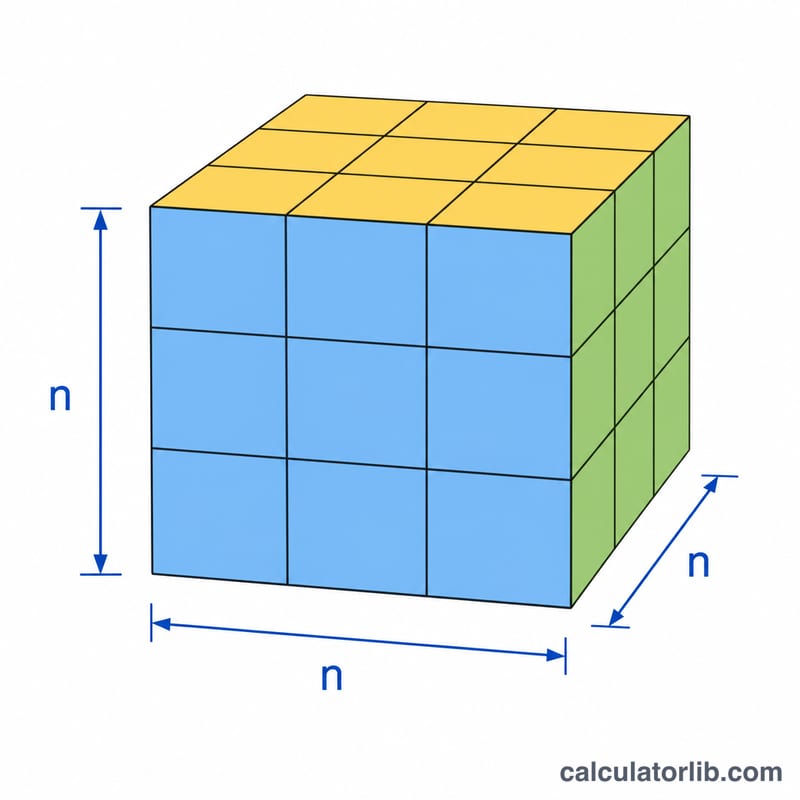
A perfect cube is any integer that equals the cube of an integer, that is a number of the form n cubed (\(n^3\)). This tool builds a table of consecutive perfect cubes: for every integer n it shows the cube notation and the integer value n times n times n. By default it lists the first 100 perfect cubes, from \(1^3 = 1\) up to \(100^3 = 1{,}000{,}000\), but you can choose any count and a custom starting integer.
How to use it
Enter how many cubes you want under "How many perfect cubes to list" (1 to 10,000). Optionally change "Start from integer" if you do not want to begin at 1. The generator produces a scrollable, printable table with three columns: the base integer n, its cube notation (such as \(7^3\)), and the computed cube value. It also reports the last cube and the total sum of every cube listed.
The formula explained
The cube of an integer is simply \(n^3 = n \times n \times n\). For a list of count C beginning at start S, the tool iterates over every integer n in the inclusive range \([S, S + C - 1]\) and computes \(n^3\) for each:
$$a_k = \left(\text{Start} + k\right)^{3}, \quad k = 0, 1, \dots, \text{Count} - 1$$Because each value is the cube of an integer by construction, every entry produced is a genuine perfect cube. This sequence (starting at 1) is catalogued as A000578 in the On-Line Encyclopedia of Integer Sequences, where \(a(n) = n^3\).
Worked example
With count = 5 and start = 1 the generator outputs:
$$1^3 = 1, \quad 2^3 = 8, \quad 3^3 = 27, \quad 4^3 = 64, \quad 5^3 = 125$$Spot checks against larger entries confirm the pattern: \(26^3 = 17{,}576\), \(51^3 = 132{,}651\), \(80^3 = 512{,}000\) and \(100^3 = 1{,}000{,}000\).
FAQ
What is a perfect cube? An integer that can be written as another integer raised to the third power, like 8 (\(2^3\)) or 27 (\(3^3\)).
Can I start from a number other than 1? Yes. Set "Start from integer" to any value. Note that negative integers also produce valid cubes, for example \((-2)^3 = -8\).
How large can the numbers get? Cubes grow quickly: \(100^3\) is one million and \(10{,}000^3\) is one trillion. The generator uses 64-bit integer arithmetic so values in the default range are always exact.