
What Is Continuous Compound Interest?
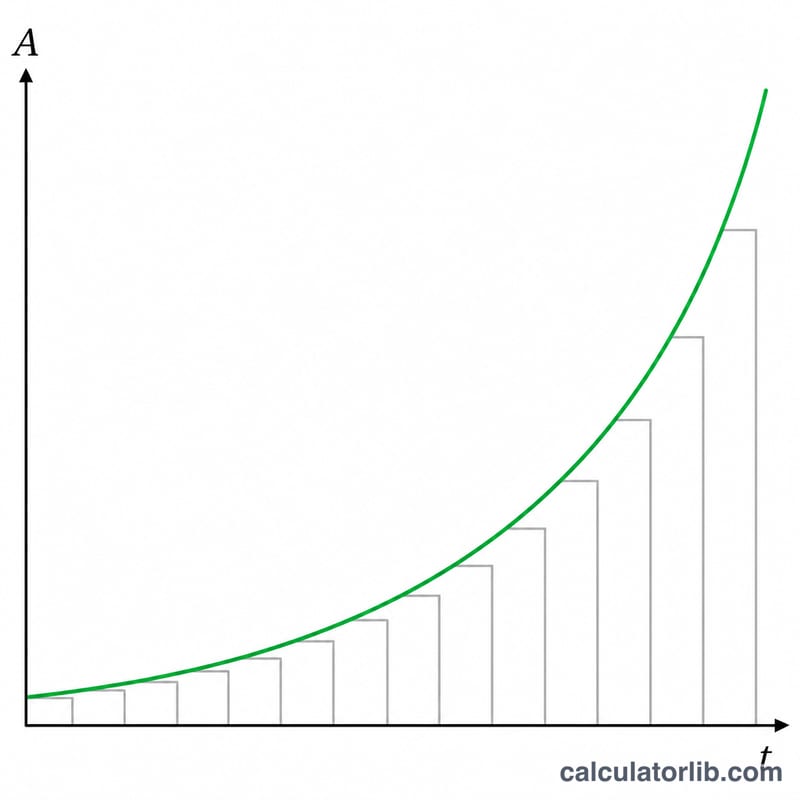
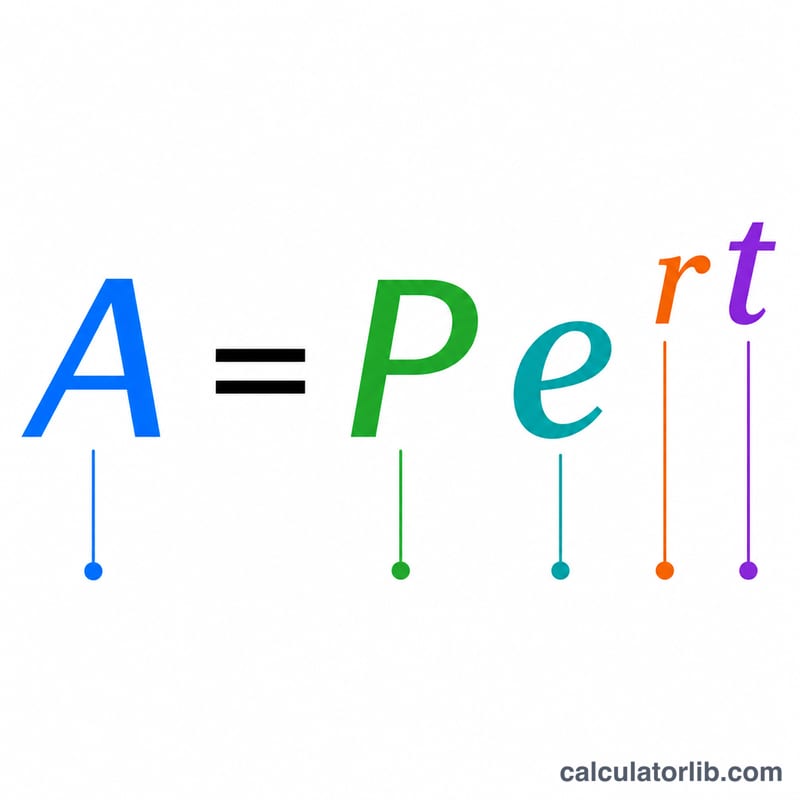
Continuous compounding is the mathematical limit of compound interest as the number of compounding periods per year approaches infinity. Instead of adding interest yearly, monthly, or daily, interest is effectively added at every instant. The growth is described by the elegant formula \(A = P \cdot e^{r \cdot t}\), where \(e\) is Euler number (≈ 2.71828). This is a universal mathematical model used in finance and many natural growth processes.
How to Use This Calculator
Enter three values: the principal (P) — your starting amount; the annual interest rate as a percentage; and the time in years. The calculator converts the percentage to a decimal, applies the exponential formula, and returns both the final amount and the total interest earned.
The Formula Explained
In \(A = P \cdot e^{r \cdot t}\), P is the principal, r is the annual rate expressed as a decimal (5% → 0.05), t is time in years, and A is the future value. The exponent \(r \cdot t\) is the total growth factor, and raising e to that power gives the multiplier applied to the principal. Total interest is simply \(I = A - P\).
Worked Example
Suppose you invest $1,000 at a 5% annual rate compounded continuously for 10 years. Then $$r \cdot t = 0.05 \times 10 = 0.5,$$ and \(e^{0.5} \approx 1.64872\). So $$A = 1000 \times 1.64872 = \$1{,}648.72,$$ and the interest earned is $648.72 — slightly more than annual or monthly compounding would yield.
FAQ
Is continuous compounding better than monthly? Yes, continuous compounding always produces the highest possible return for a given nominal rate, though the difference over monthly compounding is small in practice.
What is e? Euler number, an irrational constant approximately equal to 2.71828, central to exponential growth.
Does this apply to any currency? Yes — the formula is pure math and works for any currency or unit.