
What this calculator does
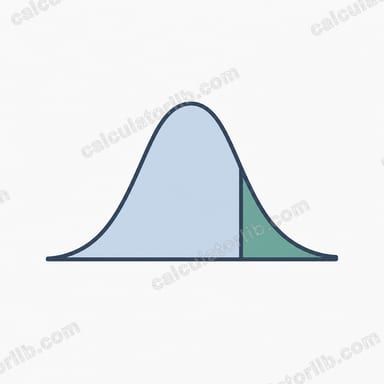
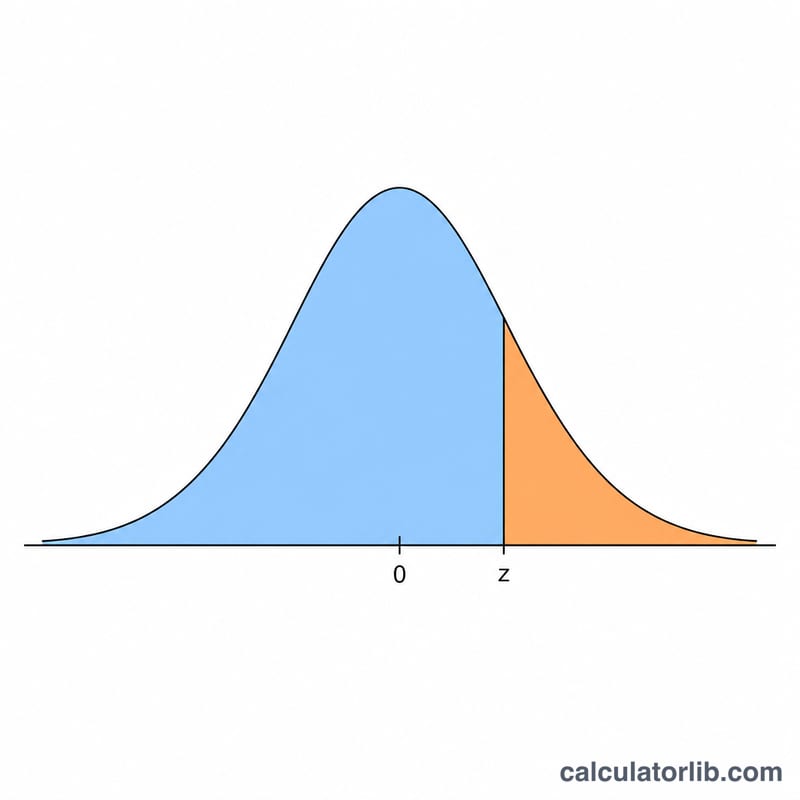
This tool computes the standard normal cumulative distribution function (CDF), written \(\Phi(z)\) or \(P(Z < z)\). It gives the probability that a normally distributed random variable falls below a given z-score. It also reports the upper-tail probability \(P(Z > z)\) and the corresponding percentile. This is a universal statistics tool — it applies anywhere, with no country-specific assumptions.
How to use it
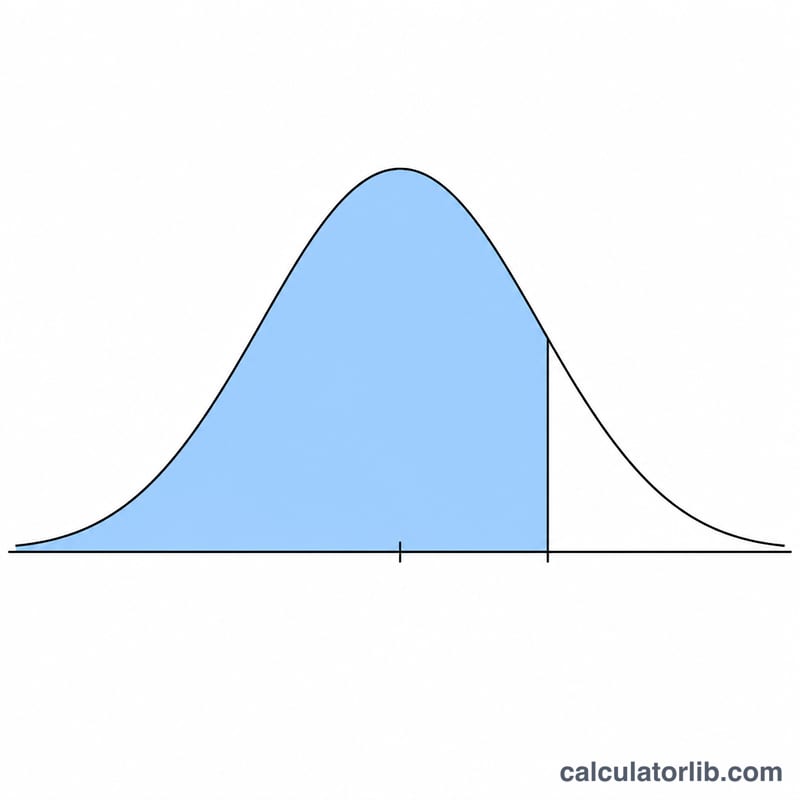
Enter your z-score in the first field. If you have a raw measurement instead, enter that value in z and fill in the distribution's mean (μ) and standard deviation (σ); the calculator standardizes it for you using \(z = \frac{x - \mu}{\sigma}\). Leave μ = 0 and σ = 1 to treat the input as an already-standardized z-score.
The formula explained
The standard normal CDF is defined through the error function: $$\Phi(z) = \tfrac{1}{2}\left[1 + \operatorname{erf}\!\left(\frac{z}{\sqrt{2}}\right)\right]$$ Because erf has no closed-form elementary expression, this calculator evaluates it with the Abramowitz & Stegun 7.1.26 rational approximation, which is accurate to about \(1.5\times10^{-7}\) — well within the precision needed for probability and statistics work.
Worked example
For \(z = 1.96\), a famous value in statistics: $$\Phi(1.96) = \tfrac{1}{2}\left[1 + \operatorname{erf}\!\left(\frac{1.96}{\sqrt{2}}\right)\right] \approx 0.9750$$ This means about 97.5% of the standard normal distribution lies below 1.96, leaving 2.5% in the upper tail — which is why ±1.96 brackets the central 95% used in confidence intervals.
FAQ
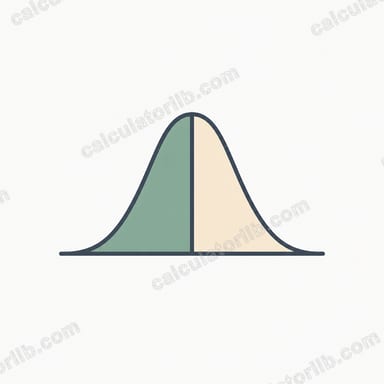
What is the value at z = 0? \(\Phi(0) = 0.5\) exactly, since the normal distribution is symmetric about its mean.
How do I get a two-tailed probability? For symmetric bounds ±z, the two-tailed area outside is \(2 \times (1 - \Phi(z))\); the central area is \(2\Phi(z) - 1\).
Can I use negative z-scores? Yes. By symmetry \(\Phi(-z) = 1 - \Phi(z)\), and the calculator handles negative inputs directly.