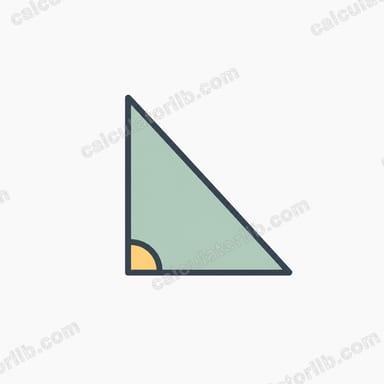
What is the SOH CAH TOA Calculator?
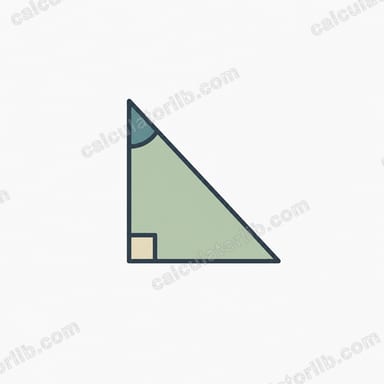
SOH CAH TOA is the classic mnemonic for the three primary trigonometric ratios of a right triangle: Sine = Opposite / Hypotenuse, Cosine = Adjacent / Hypotenuse, and Tangent = Opposite / Adjacent. This calculator takes the two legs of a right triangle (the sides forming the right angle) and instantly returns the hypotenuse, the angle θ opposite the side you label "a", and all three trig ratios.
How to use it
Enter the length of the opposite side (a) and the adjacent side (b) relative to the angle θ you want to solve. The calculator uses the Pythagorean theorem to find the hypotenuse, then computes sin θ, cos θ, and tan θ, and converts the angle into degrees. Units can be anything (cm, in, m) as long as both legs use the same unit.

The formula explained
For a right triangle with legs a (opposite) and b (adjacent): the hypotenuse is \(c = \sqrt{a^2 + b^2}\). The ratios follow directly:
$$\sin\theta=\frac{\text{opp}}{\text{hyp}},\quad \cos\theta=\frac{\text{adj}}{\text{hyp}},\quad \tan\theta=\frac{\text{opp}}{\text{adj}}$$The angle itself is \(\theta = \arctan\!\left(\frac{a}{b}\right)\), reported in degrees.
Worked example
Take the famous 3-4-5 triangle with opposite = 3 and adjacent = 4. The hypotenuse is
$$\sqrt{3^2 + 4^2} = \sqrt{25} = 5$$Then \(\sin\theta = \frac{3}{5} = 0.6\), \(\cos\theta = \frac{4}{5} = 0.8\), and \(\tan\theta = \frac{3}{4} = 0.75\). The angle
$$\theta = \arctan\!\left(\frac{3}{4}\right) \approx 36.87^\circ$$
FAQ
Which side is "opposite"? The opposite side is the leg that does not touch angle θ; the adjacent side is the leg that does (excluding the hypotenuse).
Why is the angle in degrees? Degrees are most intuitive for geometry; multiply by \(\frac{\pi}{180}\) to convert to radians if needed.
Can I enter the hypotenuse instead? This tool starts from the two legs. If you know a leg and the hypotenuse, subtract their squares to find the other leg first.