What this calculator does
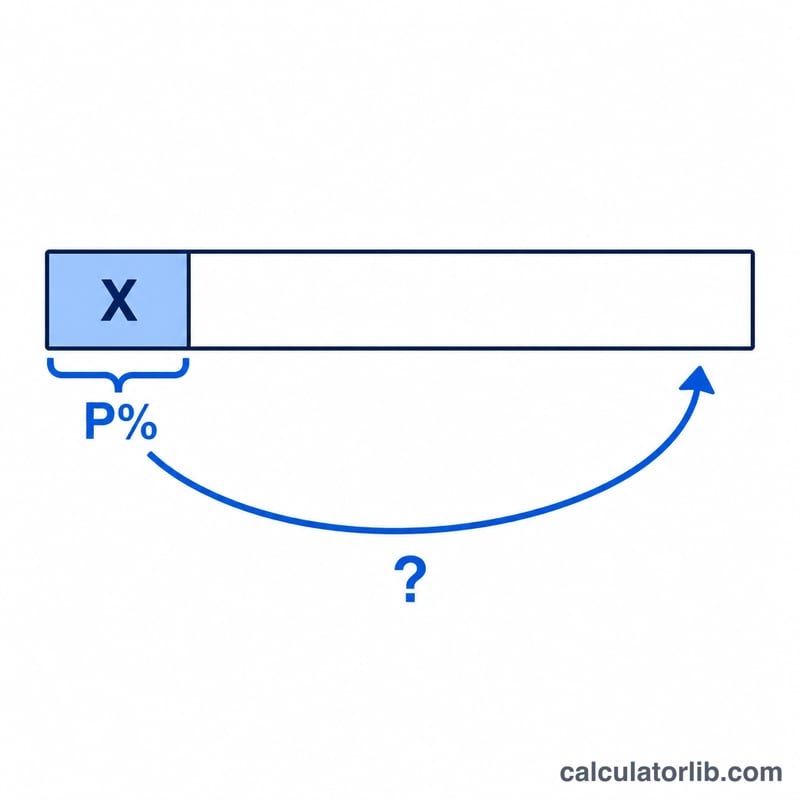
This tool answers the question: "P percent of what number equals X?" In other words, if you know that a certain percentage of an unknown whole equals a specific value, this calculator works backwards to find that whole number. For example, "25% of what number is 50?" — the answer is 200.
How to use it
Enter the percentage in the first field and the known value (X) in the second field. The calculator instantly returns the original whole number that the percentage was taken from. It works with whole numbers, decimals, and percentages above 100%.
The formula explained
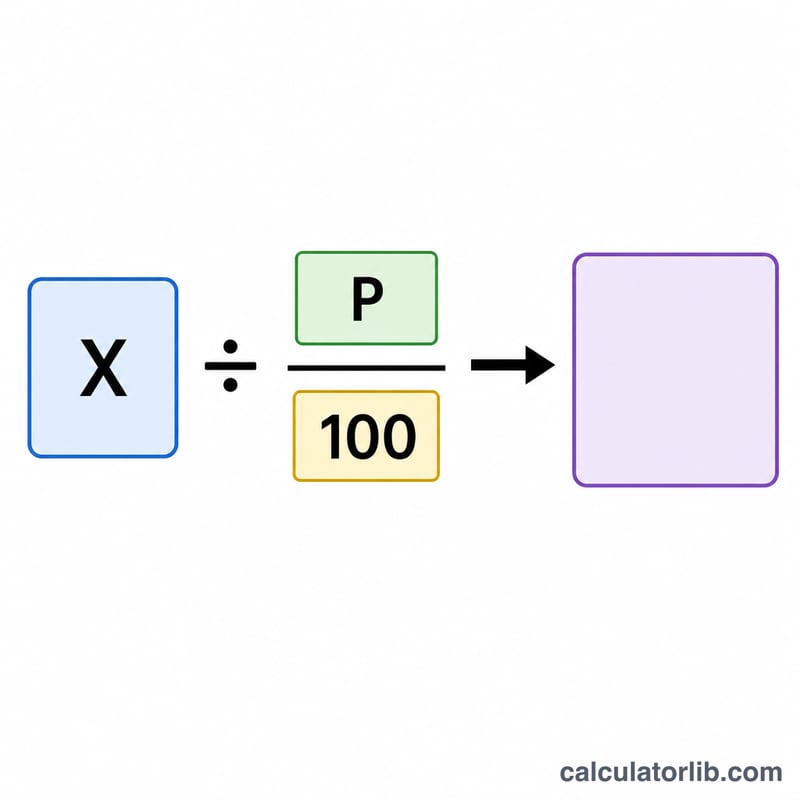
The relationship is straightforward. If P% of a number equals X, then \((P/100) \times \text{number} = X\). Rearranging to solve for the number gives:
$$\text{number} = \frac{X}{\dfrac{P}{100}}$$
You divide the known value by the percentage written as a decimal. A percent like 25 becomes 0.25, so X is divided by 0.25, which is the same as multiplying by 4.
Worked example
Suppose 40% of an unknown number equals 80. Convert the percent: \(40 / 100 = 0.4\). Then divide: $$80 / 0.4 = 200.$$ So 40% of 200 is 80. You can verify by multiplying back: \(200 \times 0.4 = 80\). ✓
FAQ
What if the percent is 0? A percentage of zero can never equal a non-zero value, so the equation has no solution. The calculator returns 0 in that case to avoid dividing by zero.
Can the percent be more than 100%? Yes. If 200% of a number equals 50, then the number is \(50 / 2 = 25\), which is smaller than X. Percentages above 100% simply make the original number smaller than the result.
How is this different from a basic percentage calculator? A standard percentage calculator finds X when you know the percent and the whole. This calculator does the reverse — it finds the whole when you already know the percent and the result.