
What This Converter Does
Margin and markup are two different ways of describing the same profit, and confusing them is a common pricing mistake. Margin expresses profit as a percentage of the selling price, while markup expresses the same profit as a percentage of the cost. This tool converts a gross margin percentage into its equivalent markup percentage so you can price products consistently.
How to Use It
Enter your gross margin as a percentage (for example, 25 for a 25% margin) and the calculator returns the markup you would have to add to your cost to achieve that margin. The margin must be below 100% — a 100% margin would imply zero cost, which makes the conversion undefined.
The Formula Explained
The relationship is:
$$\text{Markup} = \frac{\text{Margin (\%)}}{100 - \text{Margin (\%)}} \times 100$$
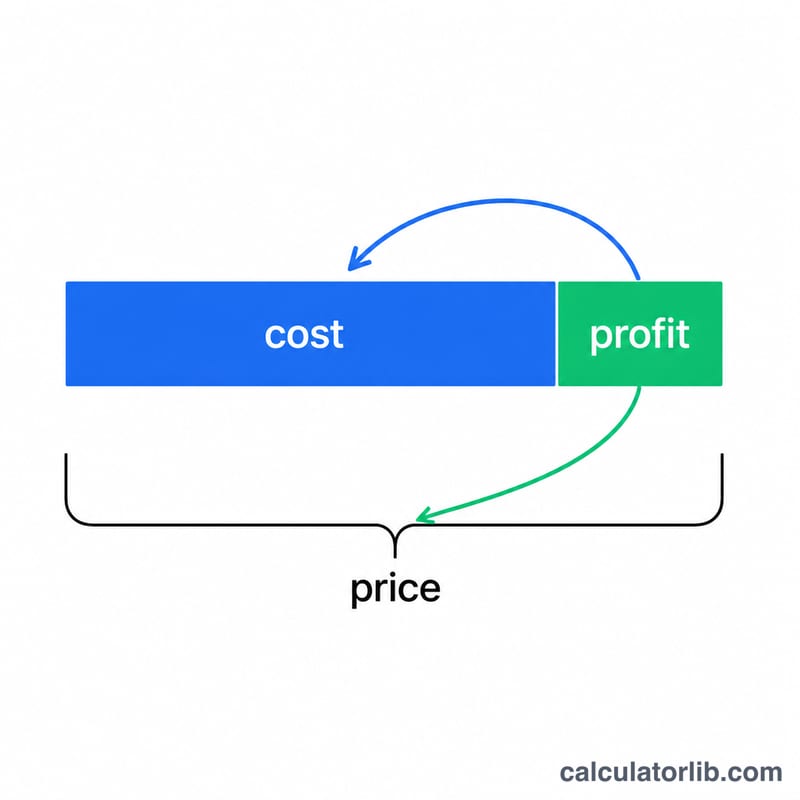
Because margin is based on price and markup is based on cost, and price = cost + profit, dividing the margin by the remaining share that represents cost (100 − Margin%) rescales the profit onto the cost base. Markup is always larger than the corresponding margin.
Worked Example
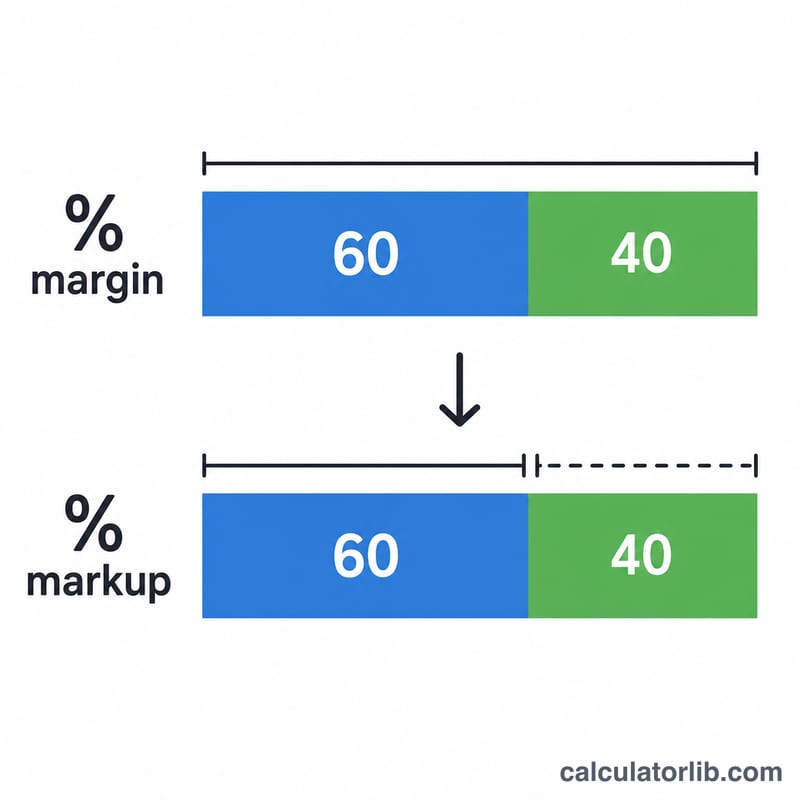
Suppose a product sells with a 40% gross margin. The markup is $$40 \div (100 - 40) \times 100 = 40 \div 60 \times 100 = 66.67\%.$$ So you must mark a cost up by about 66.67% to reach a 40% margin. If an item costs $60, adding 66.67% gives a $100 price, and the $40 profit is indeed 40% of that price.
FAQ
Is markup always higher than margin? Yes, for any positive margin the equivalent markup percentage is larger, because markup uses the smaller cost as its base.
Why can margin not be 100%? A 100% margin means cost is zero, so (100 − Margin%) becomes zero and the markup is mathematically undefined.
How do I go back from markup to margin? Use \(\text{Margin\%} = \text{Markup\%} \div (100 + \text{Markup\%}) \times 100\), the inverse relationship.