
What Is Markup Percentage?
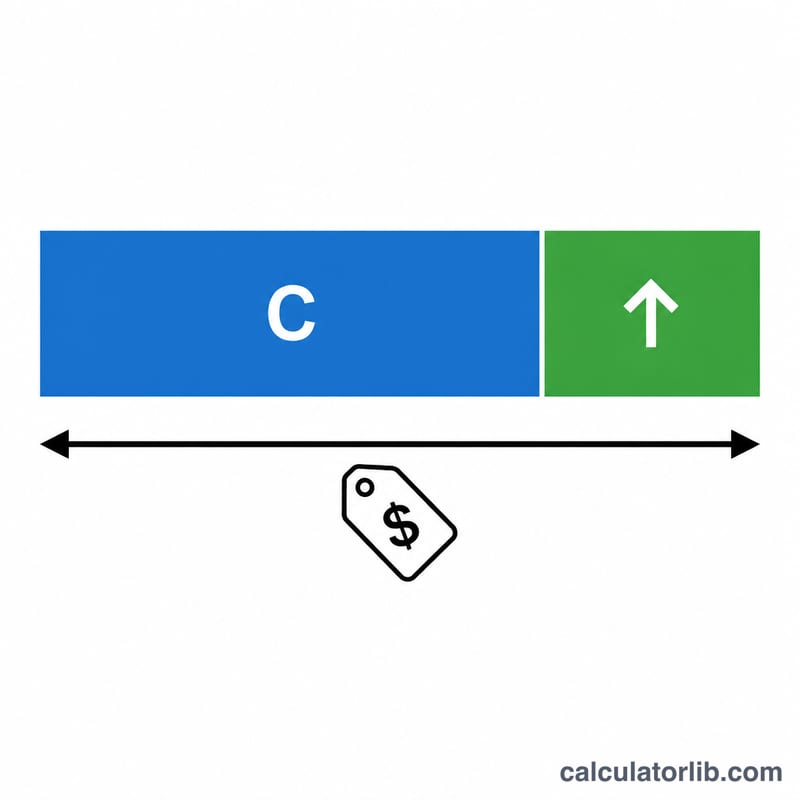
Markup percentage is the amount you add to the cost of a product, expressed as a percentage of that cost, to arrive at the selling price. It tells you how much profit you make relative to what you paid. For example, if an item costs you $80 and you sell it for $100, your markup is 25% because the $20 profit is 25% of the $80 cost.
How to Use This Calculator
Enter your cost (what you paid for the item) and your selling price (what the customer pays). The calculator instantly returns the markup percentage, the dollar profit, and the profit margin. This lets you quickly compare pricing scenarios or set a target price for a desired markup.
The Formula Explained
The core formula is:
$$\text{Markup \%} = \frac{\text{Selling Price} - \text{Cost}}{\text{Cost}} \times 100$$First subtract cost from selling price to get the profit. Divide that profit by the cost, then multiply by 100 to convert it to a percentage. Markup is always measured against the cost — this is what separates it from margin, which is measured against the selling price.
Worked Example
Suppose a retailer buys a jacket for $80 and sells it for $120. Profit = \(\$120 - \$80 = \$40\). Markup = $$(\$40 \div \$80) \times 100 = 50\%.$$ The profit margin, for comparison, is \((\$40 \div \$120) \times 100 \approx 33.33\%\). Notice how markup and margin differ even though the dollar profit is identical.
FAQ
What is the difference between markup and margin? Markup is profit as a percentage of cost; margin is profit as a percentage of selling price. Markup is always higher than margin for the same transaction.
Can markup be over 100%? Yes. If the selling price is more than double the cost, the markup exceeds 100%. For example, a $50 cost sold at $150 has a 200% markup.
How do I find selling price from a target markup? Multiply the cost by \((1 + \text{markup} \div 100)\). A $80 cost with a 25% target markup gives \(\$80 \times 1.25 = \$100\).