What is the Markup Calculator?
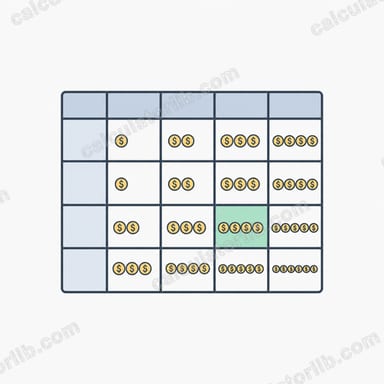
This calculator takes a product's cost and the gross margin you want to earn, then returns the markup percentage, the revenue (selling price) and the gross profit in dollars. It is useful for pricing products, setting price lists, and translating a margin target into the markup figure many point-of-sale and accounting systems actually expect.
Margin vs. Markup — the key difference
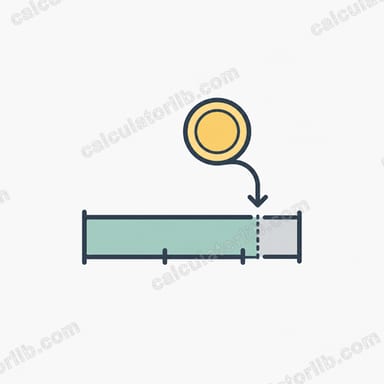
These two terms are easy to confuse because they describe the same profit from two different angles. Gross margin is profit as a fraction of the selling price (revenue). Markup is profit as a fraction of the cost. They are never equal except at zero. For example, a 50% margin is a 100% markup. The relationship is \(\text{markup} = \frac{G}{1 - G}\) and, going the other way, \(\text{margin} = \frac{m}{1 + m}\).

How to use it
Enter the cost of the item and your desired gross margin as a percentage (for example, 50 for 50%). The calculator converts the margin to a decimal fraction \(G = \frac{\text{margin}}{100}\) and computes everything for you. Keep the margin below 100% — at exactly 100% the revenue formula divides by zero and the price is undefined.
The formula explained
With cost \(C\) and margin fraction \(G\): revenue $$R = \frac{C}{1 - G}$$ gross profit \(P = R \times G\) (which also equals \(R - C\)), and markup $$\text{markup} = \frac{P}{C} \times 100$$

Worked example
Cost = $125.00, margin = 50%, so \(G = 0.50\). Revenue $$R = \frac{125}{1 - 0.50} = \frac{125}{0.50} = \$250.00$$ Gross profit \(P = 250 \times 0.50 = \$125.00\) (check: \(250 - 125 = 125\)). Markup \(= \frac{125}{125} = 1.00 = 100.00\%\). So a 50% margin requires a 100% markup and a $250 price.
FAQ
Is markup the same as margin? No. Margin is based on revenue; markup is based on cost. A 50% margin equals a 100% markup.
Why can't I enter a 100% margin? At 100% margin the term \((1 - G)\) becomes zero, so the selling price would be infinite. Use a value below 100%.
How do I convert markup back to margin? Use \(\text{margin} = \frac{\text{markup}}{1 + \text{markup}}\). A 100% (1.00) markup converts to a 50% margin.