
What Is Margin vs. Markup?
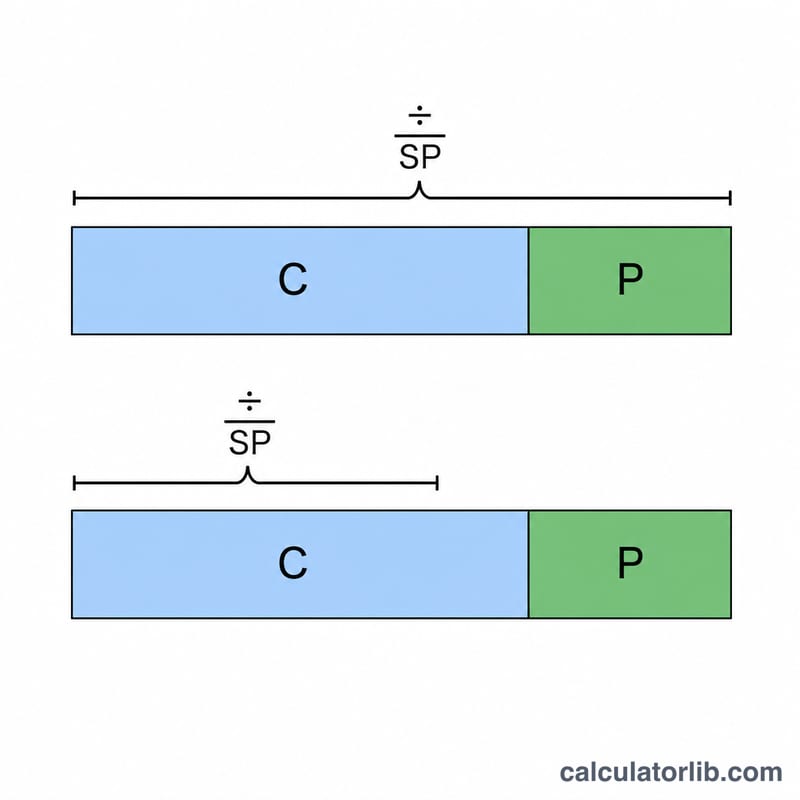
Margin and markup both describe profit, but they use different bases. Gross margin is profit expressed as a percentage of the selling price, while markup is profit expressed as a percentage of the cost. Because the denominators differ, a 40% margin is not the same as a 40% markup. This calculator converts any gross margin percentage into its equivalent markup percentage so you can price products consistently.
How to Use This Calculator
Enter your gross margin as a percentage (for example, 40 for 40%). The calculator instantly returns the matching markup percentage you would apply to your cost to achieve that margin. This is handy when a supplier or accounting system quotes profit one way and your pricing rules use the other.
The Formula Explained
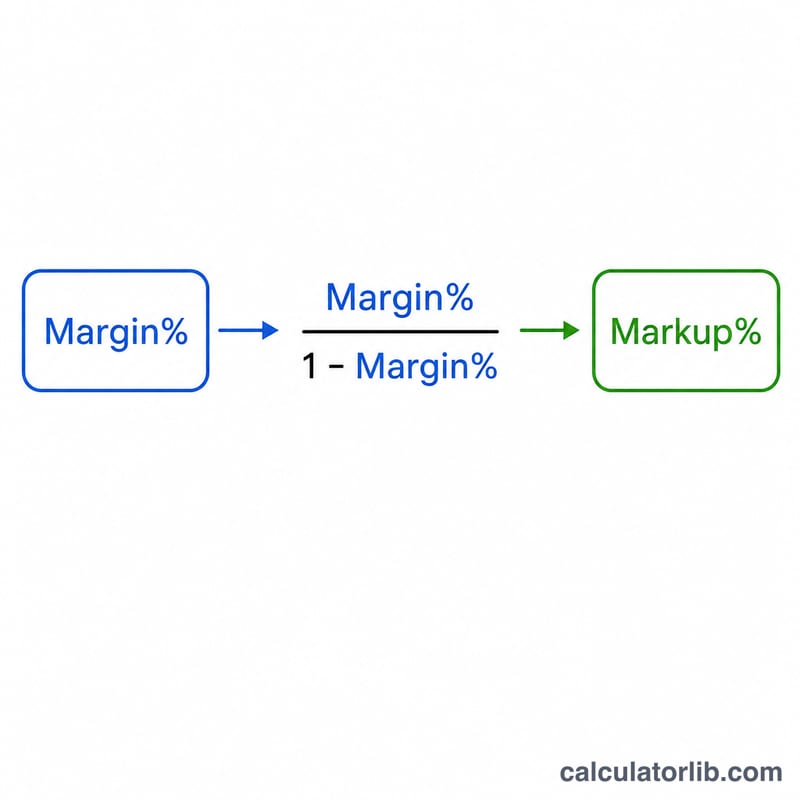
The core conversion is:
$$\text{Markup}\,(\%) = \frac{\text{Margin}\,\%}{1 - \text{Margin}\,\%}$$
Here Margin% is written as a decimal in the math (40% = 0.40). The inverse relationship lets you go the other direction: \(\text{Margin}\,\% = \dfrac{\text{Markup}\,\%}{1 + \text{Markup}\,\%}\). Note that a 100% margin is mathematically impossible, since it would require zero cost — that is why margins must stay below 100%.
Worked Example
Suppose your gross margin is 40%. Converting: $$\text{Markup} = \frac{0.40}{1 - 0.40} = \frac{0.40}{0.60} = 0.6667 = 66.67\%$$ So an item costing $100 sold with a 66.67% markup sells for $166.67, giving a $66.67 profit, which is 40% of the $166.67 selling price — confirming the 40% margin.
FAQ
Why is markup always higher than margin? Because markup divides profit by the smaller number (cost) while margin divides by the larger number (price). The same dollar profit therefore yields a higher percentage as markup.
Can margin reach 100%? No. A 100% margin implies the product costs nothing. As margin approaches 100%, the equivalent markup approaches infinity.
What is a 50% margin as markup? \(\dfrac{0.50}{1 - 0.50} = 1.00 = 100\%\) markup. Doubling the cost gives exactly a 50% margin.