
What This Calculator Does
The Price from Net Profit Margin Calculator works backward from a profit goal to the price you should charge. Instead of guessing a markup, you tell it your costs and the net profit margin you want to keep, and it returns the exact selling price that delivers that margin. This is essential for product pricing, service quoting, and break-even planning.
The Formula Explained
Net profit margin is profit as a percentage of revenue, not cost. Because the profit is measured against the price itself, you cannot simply add the margin to cost — you must divide:
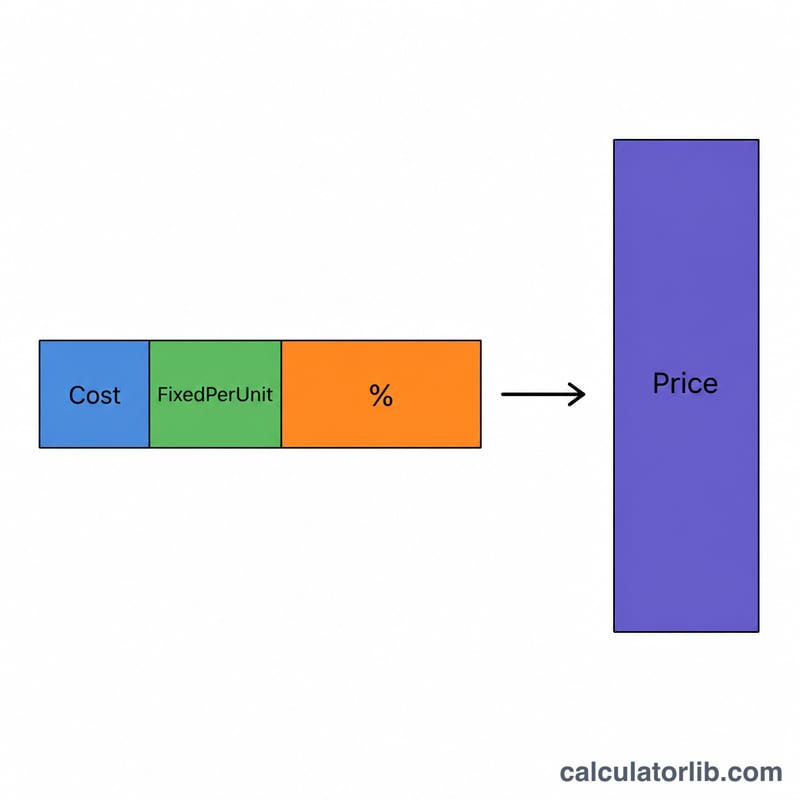
$$\text{Price} = \frac{\text{Cost} + \text{Fixed per Unit}}{1 - \text{Net Margin\%}}$$
Here Cost is your variable cost per unit, Fixed per Unit is any fixed overhead allocated to each unit, and Net Margin% is expressed as a decimal (e.g. 30% = 0.30). Dividing by \((1 - \text{margin})\) ensures the desired percentage of the final price is left over as profit.
How to Use It
Enter your variable cost per unit, your fixed cost allocated per unit, and your target net profit margin as a percentage. The calculator shows the required selling price, total cost, profit per unit, and the equivalent markup on cost.
Worked Example
Suppose a product has a $20 variable cost and $5 of fixed cost per unit, and you want a 30% net margin. Total cost = $25.
$$\text{Price} = \frac{25}{1 - 0.30} = \frac{25}{0.70} = \$35.71$$
Of that price, exactly 30% ($10.71) is profit.
FAQ
Why divide instead of multiply? Because margin is a share of revenue. Marking up cost by 30% would give a much smaller actual margin (about 23%).
What's the difference between margin and markup? Margin is \(\text{profit} \div \text{price}\); markup is \(\text{profit} \div \text{cost}\). The calculator reports both for clarity.
Can margin be 100%? No — at 100% the denominator is zero and the price is infinite. Use a value below 100%.