What this calculator does
The Farm Work Calories Burned Calculator estimates how much energy (in kilocalories) you spend on common agricultural and gardening tasks. It uses the MET (metabolic equivalent of task) method, the same approach used in fitness trackers and public-health guidelines. You enter your body weight and the number of minutes spent on each task, and the calculator multiplies these by each task's MET value to produce a per-task and total calorie estimate.
The MET reference values used here follow Japan's Ministry of Health, Labour and Welfare "Physical Activity Reference for Health Promotion 2013." However, the calorie formula itself is universal and applies anywhere in the world.
The formula explained
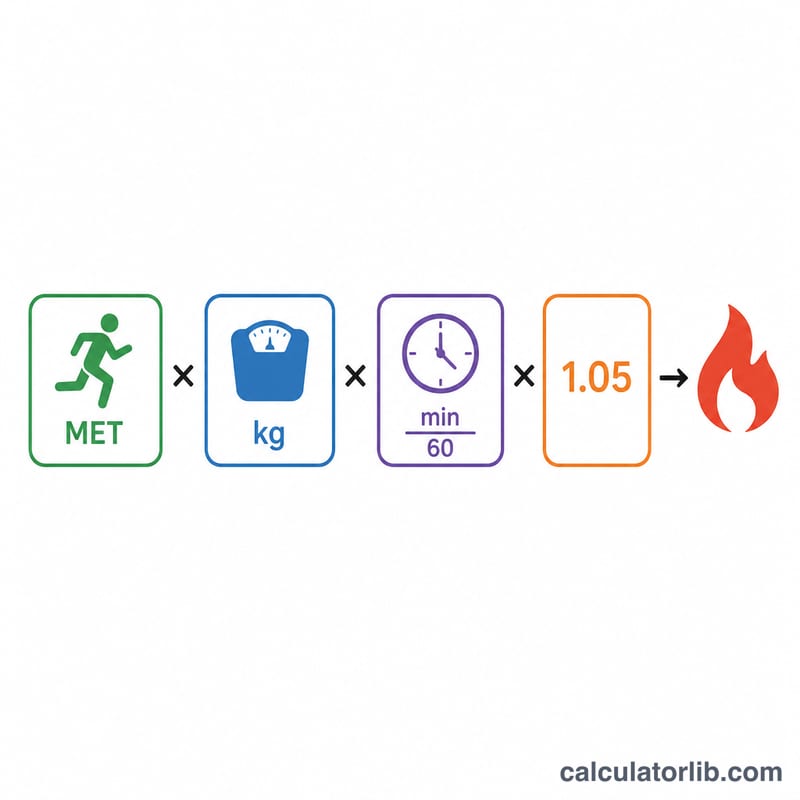
One MET represents the energy you burn at rest, roughly 1.05 kcal per kilogram of body weight per hour. The energy for one activity is:
$$\text{kcal} = \text{MET} \times \text{weight(kg)} \times (\text{minutes} \div 60) \times 1.05$$
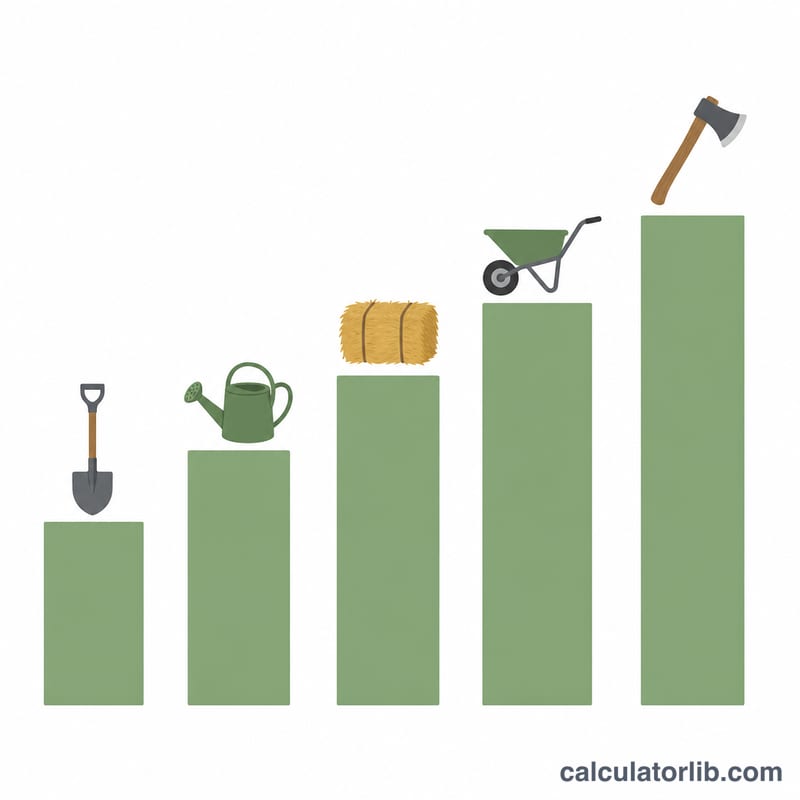
Each farm task has a typical MET: watering plants 2.5, weeding 4.5, planting seedlings 4.3, feeding livestock 4.3, tilling/cultivating 4.5, shoveling soil or mud 5.5, and bundling hay 7.8. The total is the sum across every task you enter.
How to use it
Enter your body weight in kilograms, then fill in how many minutes you spent on each task (leave a task at 0 if you did not do it). The calculator returns the total calories burned plus a breakdown by task.
Worked example
Suppose you weigh 60 kg and spend 10 minutes watering plants and 60 minutes tilling. Watering = \(2.5 \times 60 \times (10/60) \times 1.05 = 26.25\) kcal. Tilling = \(4.5 \times 60 \times (60/60) \times 1.05 = 283.5\) kcal. Total = \(309.75\) kcal, about 310 kcal.
Farm Task MET Values Reference
The calculator uses one MET value for each task. A MET (metabolic equivalent) expresses the energy cost of an activity as a multiple of resting energy use. The kcal-per-hour column is for a 60 kg person: \(\text{MET} \times 60 \times 1.05\).
| Task | MET value | kcal per hour (60 kg person) |
|---|---|---|
| Watering plants | 2.5 | 157.5 |
| Weeding the garden | 4.5 | 283.5 |
| Planting seedlings | 4.3 | 270.9 |
| Feeding livestock | 4.3 | 270.9 |
| Tilling / cultivating | 4.5 | 283.5 |
| Shoveling soil or mud | 5.5 | 346.5 |
| Bundling hay | 7.8 | 491.4 |
Source of the MET values: the Japan Ministry of Health, Labour and Welfare (MHLW) Physical Activity Reference for Health Promotion 2013. The 1.05 factor follows the Japanese convention for converting MET-hours into kcal.
Interpreting Your Result
In the Japanese physical activity guidelines, activities of 3 METs or more are counted as moderate-intensity physical activity. WHO classifies 3.0 to 5.9 METs as moderate and 6.0 METs or more as vigorous. Five of the seven tasks in this calculator (4.3 to 5.5 METs) fall in the moderate range. Bundling hay (7.8 METs) is vigorous (6.0 METs or more). Watering plants (2.5 METs) is below 3 METs and counts as light activity.
The result is an estimate of gross energy expenditure. It includes the energy your body would use at rest during those minutes, so it is not the extra (net) calories above resting. The 1.05 factor converts MET-hours per kilogram of body weight into kcal under the Japanese convention.
Actual energy use varies with individual factors such as fitness, age, sex, body composition, work pace, terrain, tool weight and weather. Treat the figure as an approximation rather than a precise measurement. This tool offers general information only and gives no medical or dietary advice.
FAQ
Is the result exact? No. MET-based estimates are approximations for an average person; actual burn varies with intensity, fitness, age, and terrain.
Why divide minutes by 60? The formula needs time in hours, so minutes are converted to hours before multiplying.
Does heavier mean more calories? Yes. Body weight is a direct multiplier, so a heavier person burns more calories doing the same task for the same time.