
What is relativistic kinetic energy?
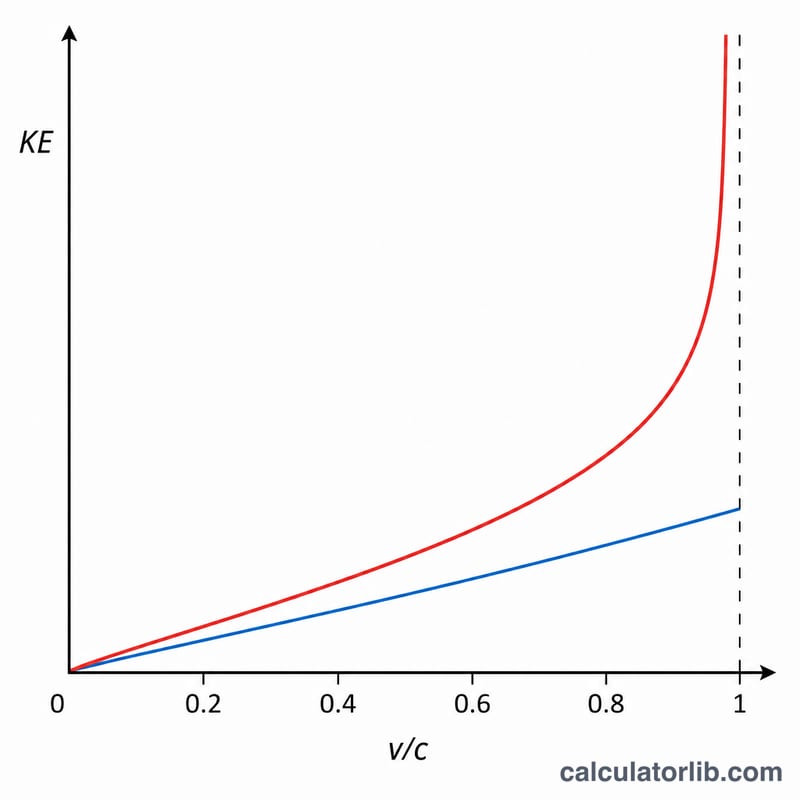
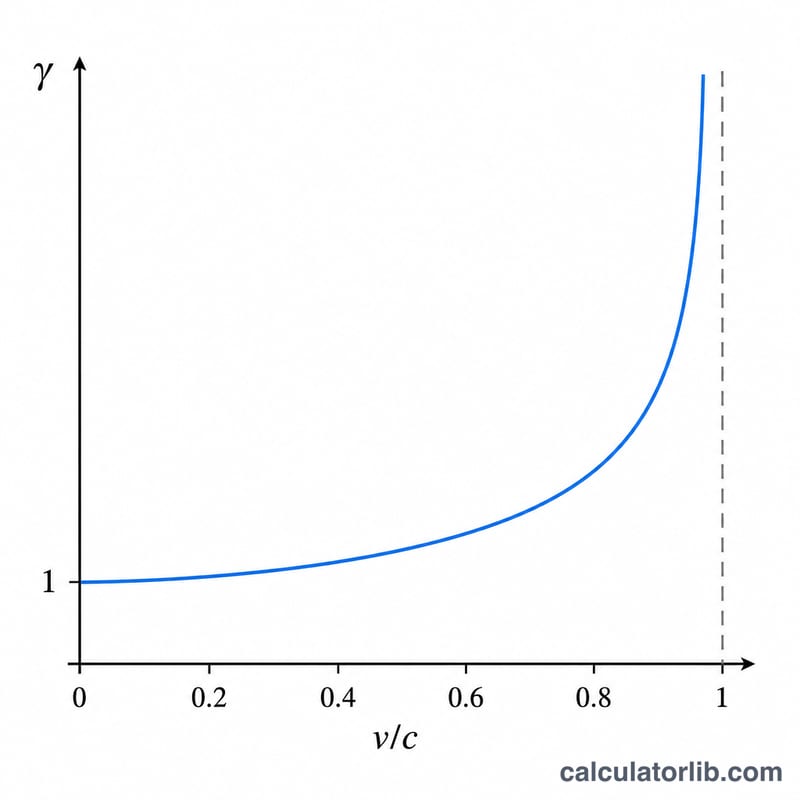
In special relativity, a moving object's kinetic energy grows faster than Newton's \(\frac{1}{2}mv^2\) predicts as its speed approaches the speed of light \(c \approx 299{,}792{,}458\ \text{m/s}\). The exact expression is $$KE = (\gamma - 1)\,mc^2,$$ where \(\gamma\) (the Lorentz factor) equals \(\frac{1}{\sqrt{1 - (v/c)^2}}\). As \(v \to c\), \(\gamma \to \infty\), so an infinite amount of energy would be required to reach light speed — which is why no massive object can.
How to use this calculator
Enter the object's rest mass in kilograms and its velocity in metres per second. The calculator returns the relativistic kinetic energy in joules, the Lorentz factor \(\gamma\), the speed ratio \(\beta = v/c\), and the classical \(\frac{1}{2}mv^2\) value so you can see how large the relativistic correction is.
The formula explained
First compute \(\beta = v/c\). Then \(\gamma = \frac{1}{\sqrt{1 - \beta^2}}\). The relativistic kinetic energy is the total relativistic energy \(\gamma mc^2\) minus the rest energy \(mc^2\), giving \((\gamma - 1)mc^2\). At low speeds \(\gamma \approx 1 + \frac{1}{2}\beta^2\), so \((\gamma - 1)mc^2 \approx \frac{1}{2}mv^2\), recovering the familiar Newtonian formula.
Worked example
Take \(m = 1\ \text{kg}\) moving at \(v = 150{,}000{,}000\ \text{m/s}\). Then \(\beta = 150{,}000{,}000 / 299{,}792{,}458 \approx 0.50035\), \(\beta^2 \approx 0.25035\), \(\gamma = \frac{1}{\sqrt{0.74965}} \approx 1.15490\). $$KE = (1.15490 - 1) \times 1 \times (299{,}792{,}458)^2 \approx 1.39 \times 10^{16}\ \text{J}.$$ The classical estimate \(\frac{1}{2} \cdot 1 \cdot 150{,}000{,}000^2 = 1.125 \times 10^{16}\ \text{J}\) understates it noticeably at this high speed.
FAQ
Why does it differ from \(\frac{1}{2}mv^2\)? The classical formula is only the first term of the relativistic series; the difference becomes significant above roughly 10% of light speed.
What if I enter \(v \geq c\)? No massive object can reach or exceed c, so the calculator returns zero for impossible inputs.
What units are used? SI throughout: mass in kg, velocity in m/s, energy in joules.