
What Is Rotational Kinetic Energy?
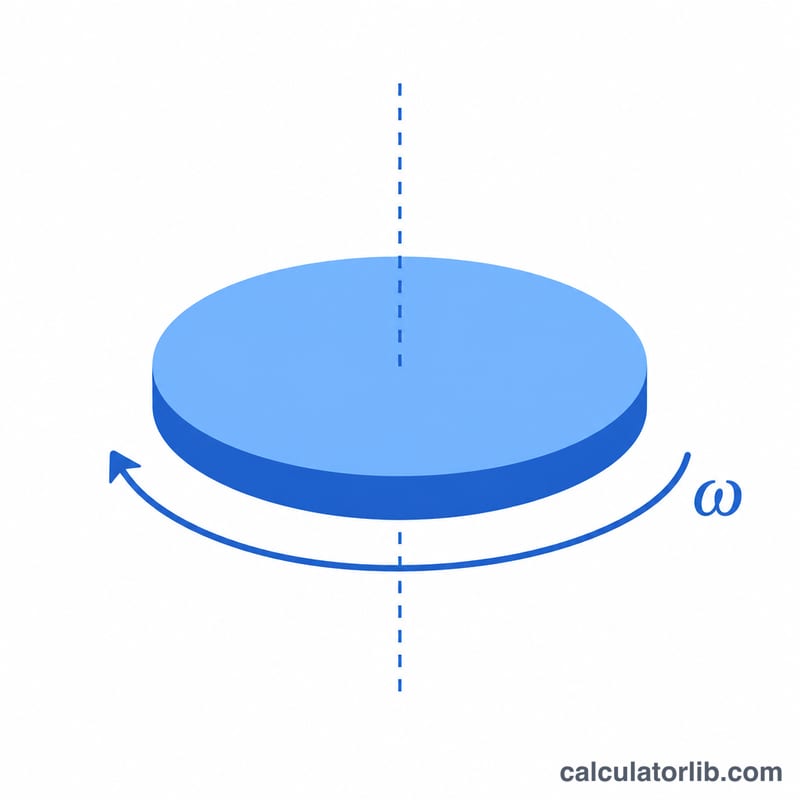
Rotational kinetic energy is the energy an object possesses because it is spinning about an axis. Just as a moving object has translational kinetic energy (\(\frac{1}{2}mv^2\)), a rotating object stores energy that depends on how its mass is distributed around the axis (the moment of inertia, \(I\)) and how fast it spins (the angular velocity, \(\omega\)). This calculator works for any rotating body — flywheels, wheels, gears, planets, and turbines.
The Formula
The rotational kinetic energy is given by:
$$KE = \frac{1}{2} \cdot I \cdot \omega^2$$
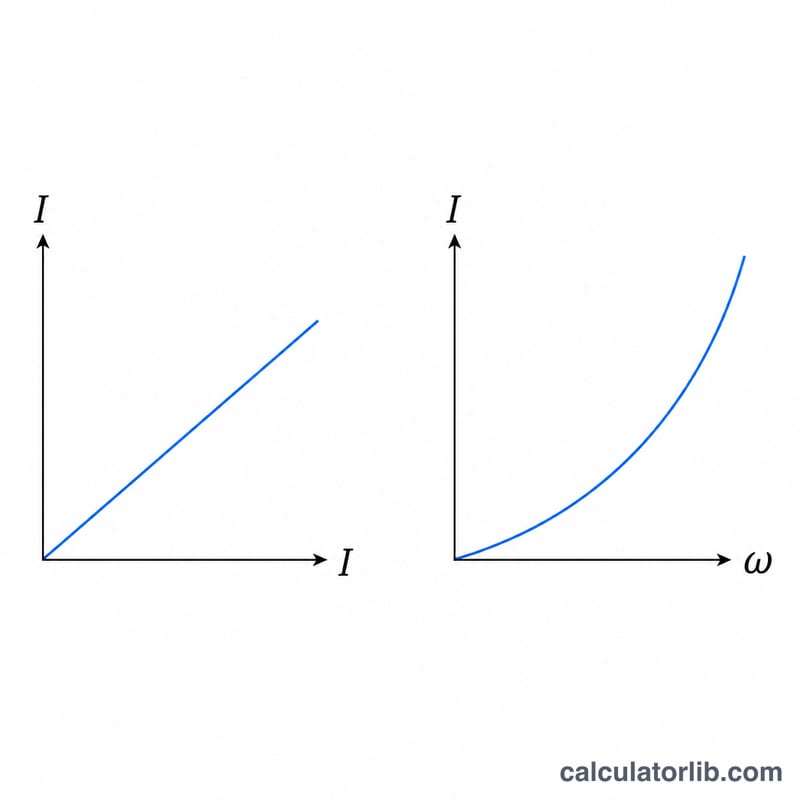
where KE is measured in joules (J), I is the moment of inertia in kilogram-square-metres (\(\text{kg}\cdot\text{m}^2\)), and ω is the angular velocity in radians per second (rad/s). Note that energy grows with the square of angular velocity, so doubling the spin rate quadruples the stored energy.
How to Use the Calculator
Enter the moment of inertia of your object and its angular velocity, then read off the kinetic energy. If your speed is given in revolutions per minute (RPM), convert it first: \(\omega \, (\text{rad/s}) = \text{RPM} \times \frac{2\pi}{60}\).
Worked Example
A flywheel has a moment of inertia of \(I = 2 \ \text{kg}\cdot\text{m}^2\) and spins at \(\omega = 10 \ \text{rad/s}\). Then $$KE = \frac{1}{2} \times 2 \times 10^2 = \frac{1}{2} \times 2 \times 100 = 100 \ \text{joules}.$$ The flywheel therefore stores 100 J of rotational kinetic energy.
FAQ
What units should I use? Use SI units: \(\text{kg}\cdot\text{m}^2\) for inertia and rad/s for angular velocity to get energy in joules.
How do I convert RPM to rad/s? Multiply RPM by \(2\pi\) and divide by 60. For example, \(60 \ \text{RPM} = \frac{60 \times 6.2832}{60} \approx 6.28 \ \text{rad/s}\).
Why is the energy squared in ω? Kinetic energy depends on the square of speed for both linear and rotational motion, which is why even modest increases in spin rate dramatically raise stored energy.