
What is the Binary Division Calculator?
This tool divides one binary (base-2) number by another and returns both the quotient and the remainder in binary as well as decimal. Because binary long division is error-prone by hand, the calculator converts your inputs to decimal, performs integer division, and converts the results back to base-2 for you.
How to use it
Enter the dividend (the number being divided) in the first box and the divisor in the second box, using only the digits 0 and 1. Press calculate to see the quotient and remainder. The divisor cannot be zero, since division by zero is undefined.
The formula explained
If A and B are the binary inputs, the calculator computes \(A_{10} = \text{parseBinary}(A)\) and \(B_{10} = \text{parseBinary}(B)\). The integer quotient is \(Q = \left\lfloor A_{10} / B_{10} \right\rfloor\) and the remainder is \(R = A_{10} \bmod B_{10}\). The full relationship is:
$$\left(\text{Dividend}_2\right) \div \left(\text{Divisor}_2\right) = Q \;\text{R}\; R$$where
$$\begin{gathered} \text{Dividend}_2 \div \text{Divisor}_2 = Q \;\text{remainder}\; R \\[1.5em] \text{where}\quad \left\{ \begin{aligned} Q &= \left\lfloor \frac{A}{B} \right\rfloor \\ R &= A \bmod B \\ A &= (\text{Dividend}_2)_{10} \\ B &= (\text{Divisor}_2)_{10} \end{aligned} \right. \end{gathered}$$Both \(Q\) and \(R\) are then converted back to binary. This mirrors how computers perform unsigned integer division.
Worked example
Divide \(1100_2\) by \(10_2\). In decimal, \(1100_2 = 12\) and \(10_2 = 2\). Then
$$12 \div 2 = 6 \;\text{remainder}\; 0$$Converting back: \(6 = 110_2\) and \(0 = 0_2\). So
$$1100 \div 10 = 110 \;\text{remainder}\; 0$$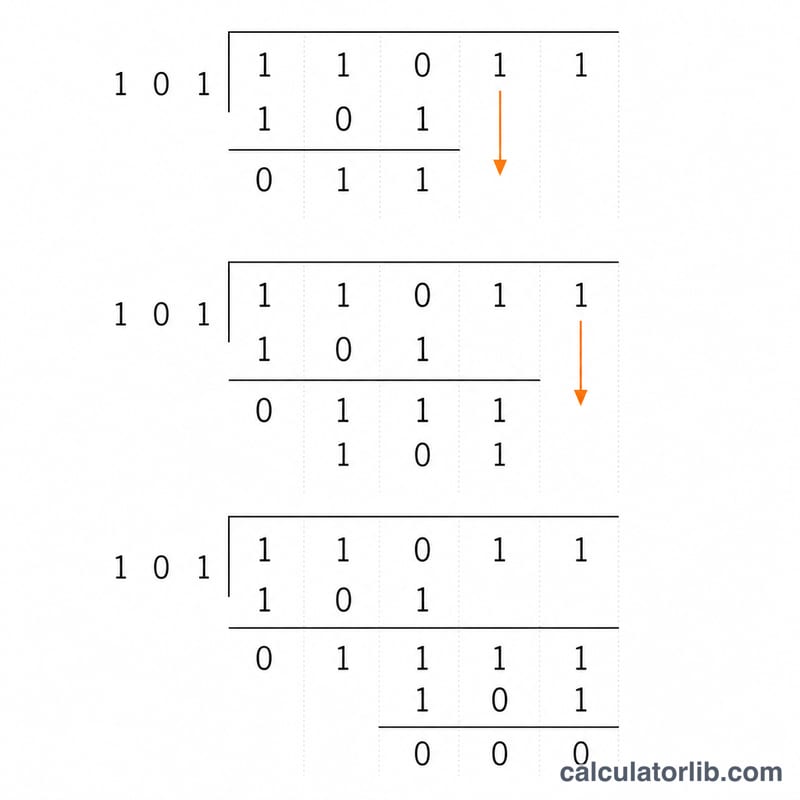
How to Divide Binary Numbers by Hand
Binary long division works exactly like decimal long division, but it is actually simpler: at each step the divisor either fits into the current bits (write a 1) or it does not (write a 0). There are no multiplication tables to memorize — you only ever multiply the divisor by 0 or 1.
The general procedure to compute \(\text{Dividend}_2 \div \text{Divisor}_2 = Q \;\text{R}\; R\) is:
- Align from the most significant bit. Start with the leftmost bit of the dividend as your current working value.
- Compare the current working value to the divisor. If the working value is greater than or equal to the divisor, the divisor "fits."
- Write the quotient bit. Write 1 above if it fits, otherwise write 0.
- Subtract. If you wrote 1, subtract the divisor from the working value; the difference becomes the new working value. If you wrote 0, the working value is unchanged.
- Bring down the next bit of the dividend and append it to the working value.
- Repeat steps 2–5 until every bit of the dividend has been brought down.
- Read off the result. The bits collected on top form the quotient \(Q\); whatever working value is left over is the remainder \(R\).
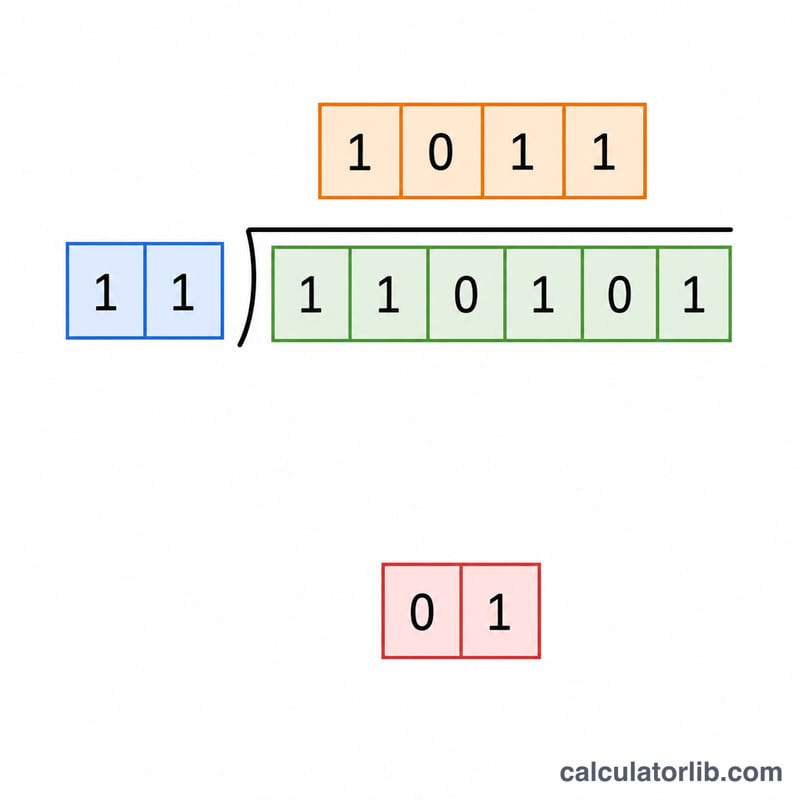
Worked example: \(1011_2 \div 10_2\) (that is, 11 ÷ 2 in decimal).
- Bring down the first bit: working value =
1. Is \(1 \ge 10\)? No → quotient bit 0. - Bring down next bit: working value =
10. Is \(10 \ge 10\)? Yes → quotient bit 1, subtract: \(10 - 10 = 0\). - Bring down next bit: working value =
01=1. Is \(1 \ge 10\)? No → quotient bit 0. - Bring down last bit: working value =
11. Is \(11 \ge 10\)? Yes → quotient bit 1, subtract: \(11 - 10 = 1\). - No bits remain. Quotient =
0101= 101, remainder =1.
Cross-check in decimal: \(11 \div 2 = 5\) remainder \(1\), and \(101_2 = 5\), \(1_2 = 1\). ✓
More Binary Division Examples
Each example shows the binary long division alongside its decimal cross-check, where the relationship is always \(\text{Dividend} = \text{Divisor}\times Q + R\).
Example 1 — non-zero remainder: \(1011_2 \div 10_2\)
- Decimal equivalents: \(1011_2 = 11\), \(10_2 = 2\).
- Long division gives quotient bits
101with a leftover bit1. - Result: \(1011_2 \div 10_2 = 101_2 \;\text{R}\; 1_2\) → in decimal \(11 \div 2 = 5\;\text{R}\;1\).
- Check: \(2 \times 5 + 1 = 11\). ✓
Example 2 — divisor larger than dividend: \(100_2 \div 1000_2\)
- Decimal equivalents: \(100_2 = 4\), \(1000_2 = 8\).
- Since the divisor (8) is larger than the dividend (4), it never fits, so every quotient bit is 0.
- Result: \(100_2 \div 1000_2 = 0 \;\text{R}\; 100_2\) → in decimal \(4 \div 8 = 0\;\text{R}\;4\).
- Check: \(8 \times 0 + 4 = 4\). ✓ When the dividend is smaller than the divisor, the quotient is always 0 and the remainder is the dividend itself.
Example 3 — clean division with cross-check: \(11110_2 \div 110_2\)
- Decimal equivalents: \(11110_2 = 30\), \(110_2 = 6\).
- Bring down bits until
110is reached → fits once; continue bringing down bits, subtracting \(110\) each time it fits. - Result: \(11110_2 \div 110_2 = 101_2 \;\text{R}\; 0\) → in decimal \(30 \div 6 = 5\;\text{R}\;0\).
- Verify the quotient: \(101_2 = 5\), and check \(6 \times 5 + 0 = 30\). ✓ Because the remainder is 0, the division is exact.
You can confirm any of these conversions with a binary-to-decimal converter, and confirm the final check by multiplying the quotient and divisor back together.
Key Terms in Binary Division
- Dividend
- The number being divided — the value written under the division bracket. In \(1011_2 \div 10_2\), the dividend is \(1011_2\).
- Divisor
- The number you divide by. In \(1011_2 \div 10_2\), the divisor is \(10_2\). The divisor must not be zero.
- Quotient
- The whole-number result of the division — how many times the divisor fits into the dividend. Written above the bracket, one bit per step.
- Remainder
- The amount left over after the largest whole quotient is removed: \(R = \text{Dividend} - \text{Divisor}\times Q\). It is always smaller than the divisor.
- Binary (base-2)
- A number system using only the digits 0 and 1, where each place value is a power of two (\(1, 2, 4, 8, \dots\)) rather than a power of ten.
- Bit
- A single binary digit (0 or 1) — short for "binary digit."
- LSB / MSB
- The Least Significant Bit is the rightmost bit (the 1's place); the Most Significant Bit is the leftmost bit (the highest place value). Binary long division processes bits from the MSB toward the LSB.
- Integer / floor division
- Division that keeps only the whole-number quotient and discards any fractional part — exactly what binary long division produces alongside its remainder.
- Modulo
-
The operation that returns only the remainder of a division (often written
modor%). For \(1011_2 \div 10_2\), the modulo result is \(1_2\).
FAQ
Can I divide fractional binary numbers? No — this calculator handles unsigned whole (integer) binary numbers and returns an integer quotient plus remainder.
What if the divisor is larger than the dividend? The quotient is 0 and the remainder equals the dividend, e.g. \(10 \div 100\) gives quotient 0, remainder 10.
Why show decimal too? Seeing the decimal equivalents makes it easy to verify the result and understand the conversion.