
What Is the Involute Function?
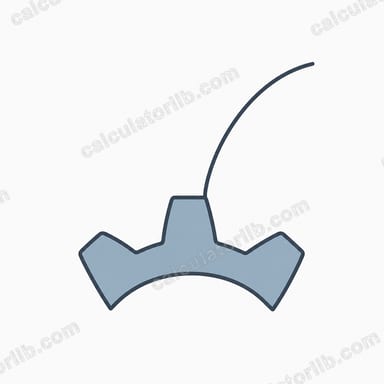
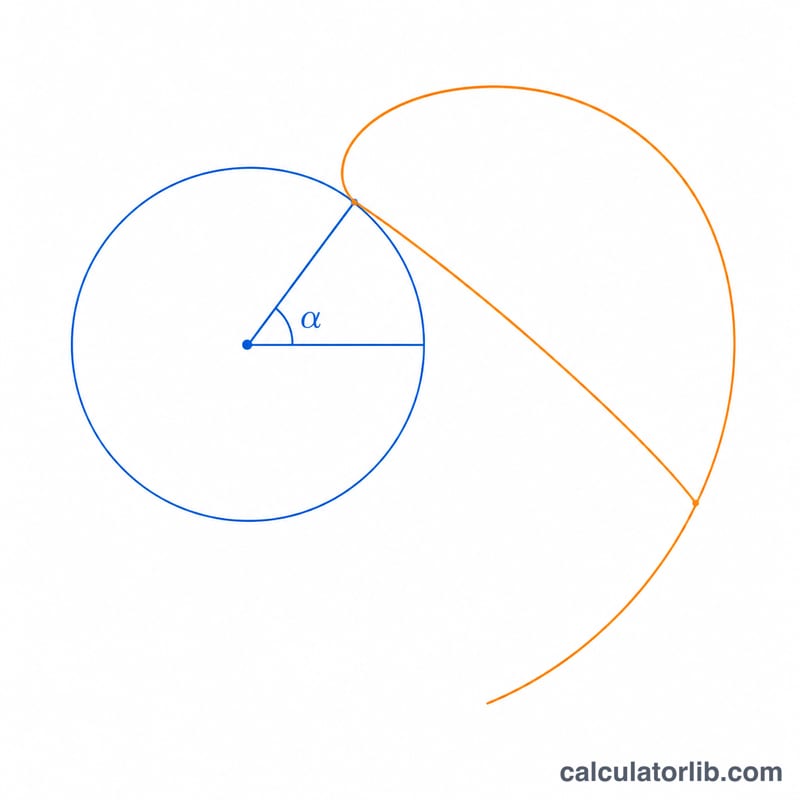
The involute function, written \(\operatorname{inv}(\alpha) = \tan(\alpha) - \alpha\), is a fundamental relationship in gear and spline engineering. It describes the geometry of an involute curve — the path traced by the end of a taut string unwinding from a circle (the base circle). Because involute tooth profiles transmit motion smoothly with constant velocity ratio, virtually all modern gears use them, and the involute function appears throughout gear-measurement and design calculations.
How to Use This Calculator
Enter the pressure angle (or any angle) and choose whether it is given in degrees or radians. The calculator converts the angle to radians if needed, then computes \(\tan(\alpha) - \alpha\). The result is dimensionless and always expressed relative to radians. Note that \(\alpha\) must be strictly between 0 and 90° (0 and \(\pi/2\) radians); at exactly 90° the tangent is undefined.
The Formula Explained
The involute function requires the angle in radians: $$\operatorname{inv}(\alpha) = \tan(\alpha) - \alpha$$ If you supply degrees, convert first with \(\alpha_{\text{rad}} = \alpha_{\text{deg}} \times \pi/180\). A common mistake is subtracting the angle in degrees from a tangent computed in radians — the two terms must use the same unit (radians).
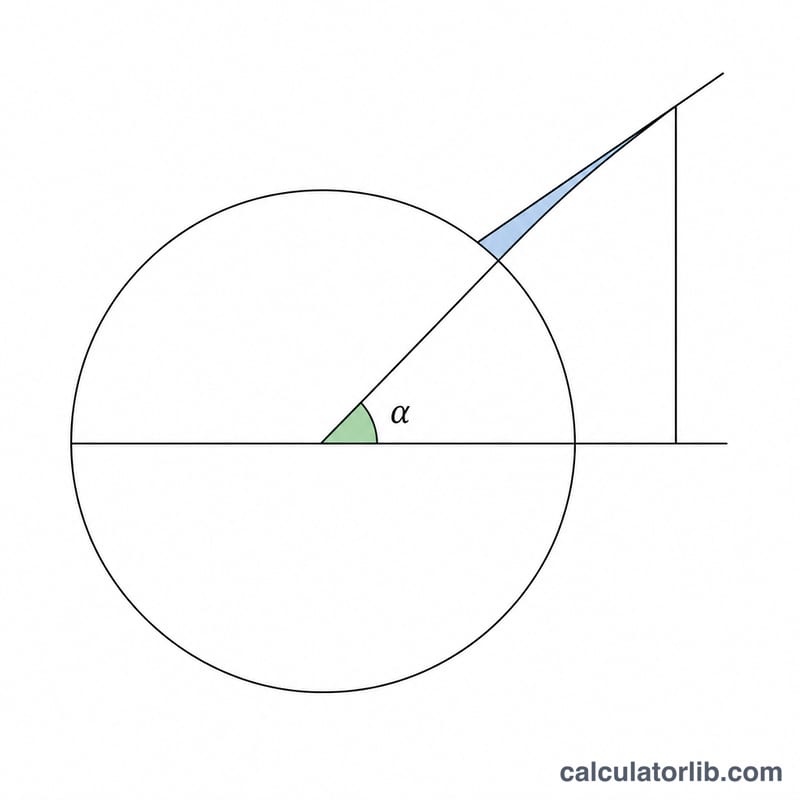
Worked Example
For a standard 20° pressure angle: convert to radians, $$20 \times \frac{\pi}{180} = 0.349066 \text{ rad}$$ Then \(\tan(0.349066) = 0.363970\), so $$\operatorname{inv}(20°) = 0.363970 - 0.349066 = \mathbf{0.014904}$$ This is the well-known tabulated value used in gear charts.
FAQ
Why must the angle be in radians? The subtraction \(\tan(\alpha) - \alpha\) only makes geometric sense when \(\alpha\) is an arc length on the unit circle, which is the radian measure.
What angles are valid? Any angle where the tangent is defined, i.e. not 90°, 270°, etc. For gear work, pressure angles are typically 14.5°, 20°, or 25°.
How do I reverse it (find α from inv(α))? There is no closed-form inverse; it is solved iteratively (e.g. Newton's method). This tool computes the forward direction only.